Training · Strength
Strength Training for Women: Why Lifting Heavy Changes Everything
Why strength training for women is one of the best things you can do for body composition, bone density and longevity, from the owner of Inception Gym Christchurch (5.0 across 1,090+ Google reviews).
By Dr Matt Walley · 1 October 2024
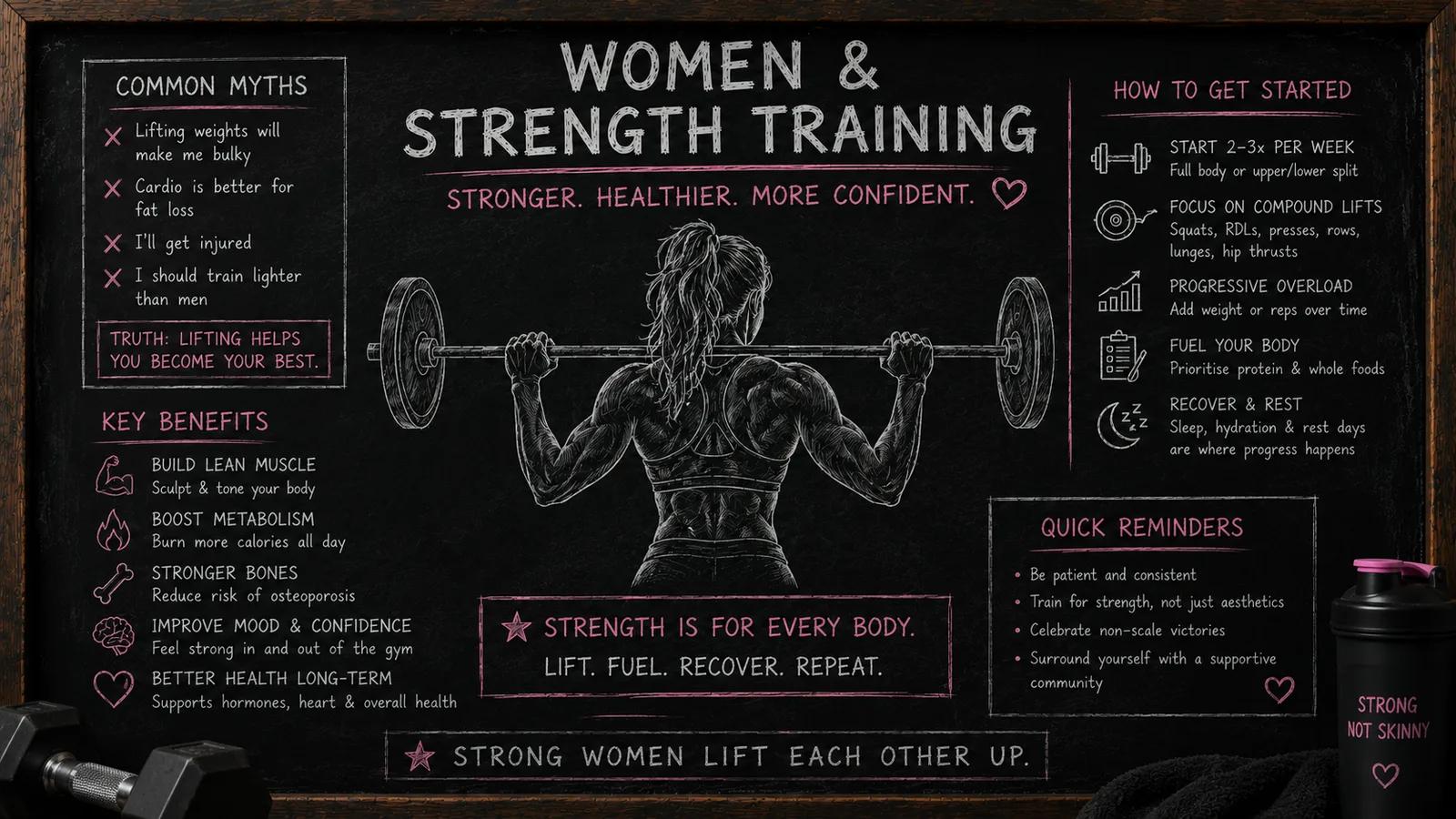
Strength training for women is one of the highest-return things you can do for your health: it reshapes body composition, builds bone density, raises resting metabolism and protects your independence into old age. And no, lifting heavy will not make you bulky.
I am Dr Matt Walley, and I co-founded Inception Gym Christchurch with my wife Elise in 2022. I am on our floor most days, and the pattern I see is consistent: the women who commit to heavy, progressive lifting get the leaner, stronger, more capable bodies they came for. The women who stay on light weights and endless cardio, hoping to look "toned," usually do not. This article explains why, and how to start.
Key takeaways
- The "bulky" fear is a physiology misunderstanding: women's hormonal profile makes rapid muscle bulk unlikely.
- Heavy lifting is the single best defence against osteoporosis, and the earlier you start, the more you bank.
- Muscle raises your resting metabolism, so strength training beats cardio-only for lasting body composition change.
- Strength is increasingly recognised as a marker of healthy ageing, which is why I treat it as a longevity tool, not a vanity one.
- Progressive overload plus enough protein is the mechanism. Everything else is detail.
Will lifting heavy make me bulky?
No. This is the single most common reason women tell me they avoid the squat rack, and it is based on a misreading of how muscle physiology works.
Building large amounts of muscle mass depends heavily on testosterone, and women produce a fraction of what men do naturally. That hormonal reality means that even training hard with good nutrition, the rate a woman accumulates visible mass is slow and controllable. What actually happens when women lift heavy consistently is this:
- Muscle fibres get denser and more efficient
- Body fat percentage drops as metabolic rate climbs
- The body takes on a leaner, more defined look
- Strength goes up substantially without a matching jump in size
In fourteen years of coaching and four years running this gym, I have never once had a woman accidentally get "too muscular" from lifting heavy. Not once. The look almost every woman describes wanting, athletic and lean, is a strength-training outcome, not a cardio one.
The very muscular female physiques people picture are the product of years of training history, precise nutrition and, in some cases, pharmaceutical help. That is not what happens when you pick up a barbell three times a week at your local gym.
What does strength training actually do for women?
Bone density: the benefit almost nobody talks about
This is the most underrated benefit and, for long-term health, arguably the most important. Osteoporosis hits women far harder than men, especially after menopause. Bone responds to mechanical loading, and heavy resistance training is the most efficient loading you can give it. Every loaded squat, every deadlift, every press tells the body to lay down more bone tissue.
The window matters. For women in their 30s and 40s, the bone you build and preserve now compounds across decades. If you are training through or past menopause specifically, I have written a dedicated piece on strength training, menopause and bone density that goes deeper.
Metabolic rate
Muscle is metabolically active tissue. It burns energy at rest in a way fat does not, so adding lean muscle lifts your resting metabolic rate. Women who rely on cardio alone for weight management often find their bodies adapt and demand ever more exercise for the same effect. Strength training sidesteps that by raising the energy you burn at baseline, which is why it produces more sustainable body composition change.
Hormonal and cognitive health
Resistance training has well-documented positive effects on insulin sensitivity and hormonal balance. Women managing conditions like PCOS often see markers improve with consistent lifting. The mood and cognitive effects are just as real: I have watched training become the most reliable thing in a lot of members' weeks, the appointment that holds the rest of their routine together.
Longevity and functional strength
The way I have come to think about it, after years on the floor, is that strength is a proxy for how well you will age. Strength markers such as grip strength and the ability to get up off the floor unaided are among the clearest signals of independent, capable ageing, and resistance training is the most direct way to build and protect them. That is why I coach women in their 60s, 70s and beyond the same way in principle as women in their 30s: load the body, progress it, keep it. Strength is not vanity. It is survival capacity.
On a practical level, that shows up as carrying groceries, lifting children and staying independent without physical limitation. If you are thinking about training for the long game, my article on training for longevity and the companion guide on zone 2 cardio and VO2 max pair naturally with heavy lifting.
Where should a woman start with strength training?
Learn the foundational movements
Heavy compound movements are the core of any effective programme:
- Squat variations: back squat, front squat, goblet squat
- Hip hinge variations: deadlift, Romanian deadlift, hip thrust
- Horizontal push: barbell bench press, dumbbell press
- Horizontal pull: barbell or cable rows
- Vertical push and pull: overhead press, lat pulldown, pull-up progressions
These recruit the largest muscle groups and give you the best return for time invested. If barbell work feels intimidating on day one, our plate-loaded machines are a genuinely good on-ramp; I explain why in the plate-loaded machines guide.
Progressive overload is the mechanism
The principle that drives every result in strength training is progressive overload: gradually increasing the demand on the body over time. That does not mean going heavier every session. It means tracking your training so that across weeks and months you are lifting more weight, doing more reps, or doing the same work with better technique. The most common mistake I see from new lifters is repeating the same weights indefinitely. The body adapts fast, and maintaining a stimulus produces maintenance, not progress. My full breakdown is in the progressive overload guide.
Nutrition: eat enough, protein first
Training without adequate nutrition produces limited results. The two errors I see most often in women are under-eating and under-prioritising protein.
- Protein: aim for roughly 1.6 to 2.0g per kilogram of bodyweight daily, food first, to support muscle protein synthesis
- Calories: under-eating relative to training demand is one of the biggest reasons women stall on a strength programme
- Consistency: hitting your targets 80 to 90% of the time beats perfect weeks followed by write-offs
For the fundamentals, start with gym nutrition basics. If you are training while on a GLP-1 medication, protecting muscle changes the equation, and I have written specifically on GLP-1s, strength training and muscle. Members who want it dialled in can also lean on our in-house PhD-led Inception Nutrition coaching, built around your actual body composition data.
Why Inception Gym works for women who train seriously
Our 800sqm facility at Tower Junction runs 92+ pieces of equipment, 43 of them plate-loaded, dumbbells up to 70kg, two squat racks and a layout built for real training rather than a photo backdrop.
One thing I made sure of when we specced the floor was strong coverage for hip and glute development, an area a lot of gyms neglect:
- Dedicated glute equipment including hip thrust stations and cable systems
- A full cable tower setup for pull-throughs and unilateral work
- Specialty bars including trap bars and multi-grip options
- Leg press, hack squat and leg extension and curl stations
The full inventory is on the equipment page. If you want to see the gym before committing, you can claim a free trial and use the floor for yourself.
A culture that welcomes serious training
Our 5.0 Google rating across 1,090+ reviews reflects something I care about more than any equipment spec: how it feels to walk in. Members consistently describe the floor as professional, welcoming and free of the quiet judgement many women have felt at other gyms, where lifting heavy is silently coded as a men's activity. That is a deliberate choice, not an accident, and it is the thing I am proudest of.
The gym is owner-operated and open 24 hours, 7 days a week, 365 days a year. Our team is on the floor and staffed Monday to Thursday 9am to 7pm and Friday and Saturday 10am to 2pm (unstaffed Sundays and public holidays), and they are there to talk technique and programming, not to watch you. If gym nerves are the real barrier, read overcoming gym anxiety first.
Free body composition scans
Every member gets complimentary body composition scans showing lean mass, fat mass and how they change over time. This matters more for women than most realise: it is completely normal for the scales to sit flat or even nudge up in the early weeks of a strength programme while body fat drops and lean mass climbs. Without a scan, that genuine progress gets misread as failure and people quit right before it pays off. You can book a free body scan to set your baseline.
Start now
The most common thing holding women back from lifting is not ability. It is uncertainty about whether the programme is right, whether their technique is correct, and whether the room will be welcoming. At Inception, the equipment, the coaching and the culture to do it properly are all in one place at Tower Junction.
So do not wait for the perfect starting point. Claim your free trial, come in, and let us put you on the equipment. Strength is not an optional extra for women. It is one of the best long-term investments you will ever make, and I would be glad to help you start it.