Training · Strength
Progressive Overload: The Only Rule You Need for Muscle Growth
Progressive overload is the single most important principle for building muscle and strength. Dr Matt Walley on the methods, tracking, and how to apply it at any level.
By Dr Matt Walley · 8 January 2025
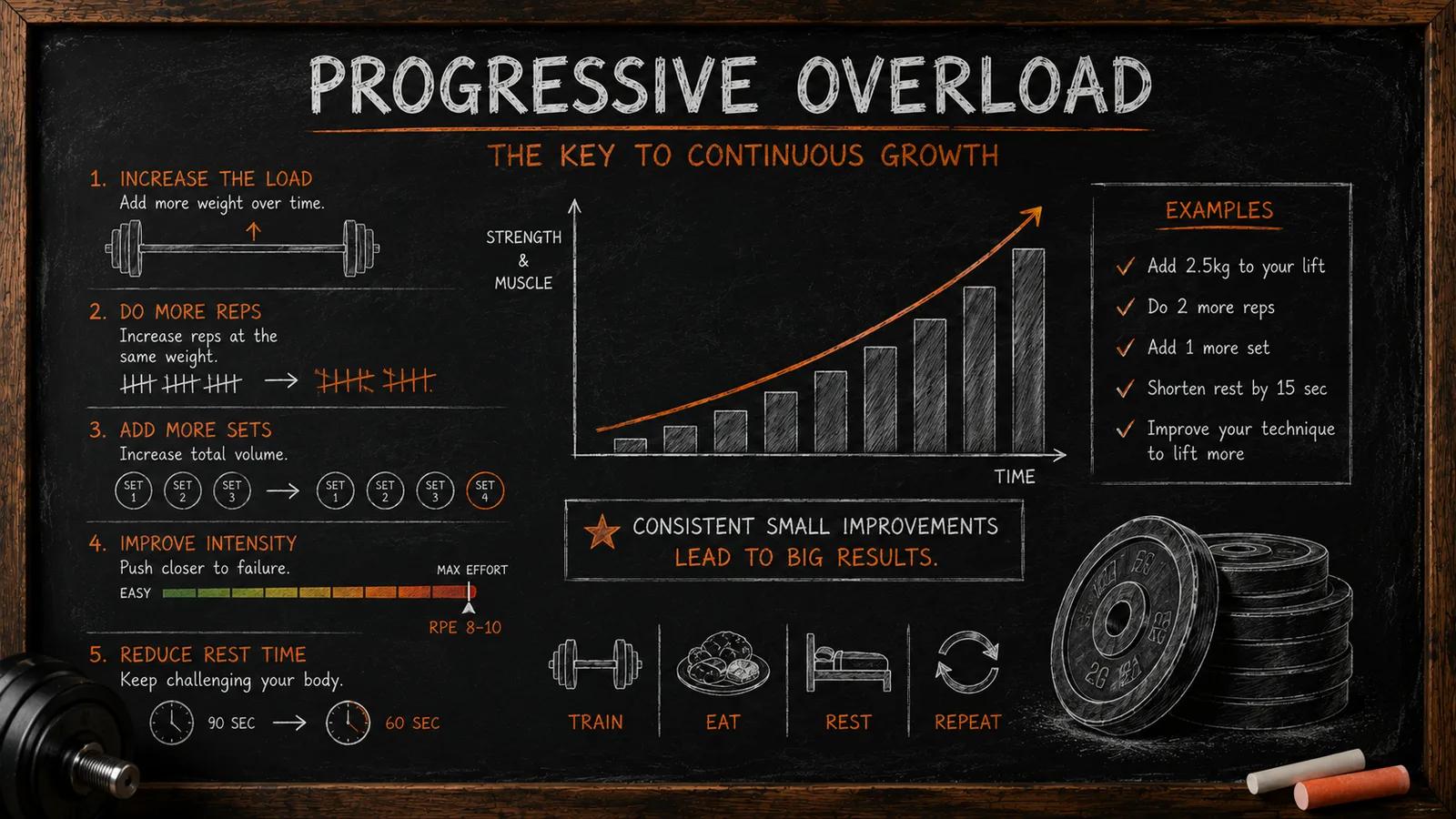
Progressive overload means gradually asking your muscles to handle more than they did last time. It is the single mechanism behind building muscle and strength, and if you get it right the rest of the noise (the perfect split, the ideal rep range, the magic supplement stack) barely matters.
I am Matt Walley, and I co-founded Inception Gym Christchurch with my wife Elise in 2022. I am on our training floor most days, and I can tell you the members who progress are almost never the ones with the cleverest programme. They are the ones who quietly add a little more load, a rep, or a set, week after week.
Key takeaways
- Progressive overload is the requirement that your training becomes progressively more demanding over time.
- There are five ways to apply it: more load, more reps, more sets, less rest, and better technique or range of motion.
- Plateaus are not a mystery. They are the predictable result of repeating the same session indefinitely.
- Tracking is non-negotiable. Memory is optimistic; a written log is honest.
- Body composition data tells you whether the overload is actually translating into muscle.
What is progressive overload?
The principle was formalised by Thomas DeLorme in the 1940s while he rehabilitated injured soldiers. He found that systematically increasing the load on a muscle was the key variable driving strength and size. The application has grown more sophisticated since. The core idea has not moved an inch.
Your body is an adaptive organism. Subject it to a stress it cannot quite manage with its current capacity, and it adapts to handle that stress better next time. In resistance training that means building more muscle tissue and becoming neurologically more efficient at recruiting it.
The catch: once your body has adapted, the same stimulus no longer drives further change. You have to raise the demand. That is progressive overload, and it is the whole game.
Why do most gym-goers plateau?
The plateau is not bad luck. It is the honest outcome of doing the same thing forever.
If you have benched four sets of ten at 60kg for six months, your body is fully adapted to that demand. It has no reason to build more muscle to handle a load it already owns. Repeating the same programme with the same weights maintains where you are; it does not move you forward.
Commitment without progression is not training. It is maintenance with extra steps.
This is the invisible ceiling I watch frustrate people. They are consistent, they turn up, they eat reasonably well, and nothing changes. The problem is almost never effort. It is that the effort is aimed at repeating, not exceeding.
The five methods of progressive overload
Most people equate progressive overload with adding weight to the bar. Load is only one of five levers, and on our floor I coach people to reach for whichever one the session actually allows.
Method 1: increasing load
The obvious one. If you did four sets of eight bench at 80kg last week, four sets of eight at 82.5kg this week is progressive overload.
This is the most reliable lever for compound lifts, especially early to intermediate, when strength climbs fast. Small regular jumps (2.5kg upper body, 5kg lower body) compound into dramatic progress over months. You cannot add load linearly forever, though. Gains slow as you advance, and form breaking down under too much weight kills the very stimulus you are chasing.
Method 2: increasing reps
Four sets of eight at 80kg this week, four sets of ten at 80kg next week. More total work, same load.
This is your move when load has hit a temporary ceiling. It builds capacity at a given weight before you add load and restart the rep climb. It is the basis of the classic double-progression model: build reps inside a target range, then add load when you reach the top of it.
Method 3: increasing sets (volume)
Adding a set lifts total volume, one of the primary drivers of hypertrophy. Three sets of ten last week to four sets of ten this week is more volume for that muscle. Powerful, but it has limits: add too many sets and recovery becomes the bottleneck. Raise volume gradually. If you want the detail, I have written a full breakdown in our training volume guide.
Method 4: reducing rest periods
Doing the same work in less time raises training density, and that is a form of overload. Rest three minutes between sets last month, ninety seconds at the same weight now, and your body is meeting a higher relative demand.
It is less often tracked but useful for conditioning and body composition. Just do not cut rest so hard that your performance on the later sets collapses. Performance stays the priority; density is a bonus.
Method 5: improving technique and range of motion
A technically clean rep is a different stimulus from a sloppy one. A squat to parallel is far more range than a quarter squat. A bench that touches the chest gives the pecs more stretch than one that stops six centimetres short.
This one is undervalued and, early on, arguably the most important. Earning a genuine full range of motion and consistent technique at a given load is real progression, and it sets the foundation for loading up safely later. I would rather see a member own 60kg through a full range than half-rep 80kg. Every time.
How do you track progressive overload?
Progressive overload demands tracking. Without records you are trusting memory, which is unreliable and generous.
At minimum, log:
- Exercise name
- Weight used
- Sets and reps achieved
- Date
Over time that builds a clear trajectory. If your bench has gone from 60kg for three sets of eight to 90kg for four sets of ten across twelve months, you are objectively stronger. If the numbers have not budged in three months, that is a clear signal that programming or recovery needs to change.
Some of our members use a notebook, some an app. The format does not matter. The habit does. Whatever you will actually keep filling in is the right tool.
Measuring outcomes: body composition data
Weight on the bar is the input. Body composition is the output. Track one without the other and your picture is half-drawn.
Scale weight is a poor measure of training progress. Someone who gains 2kg of muscle and loses 2kg of fat sees no change on the scale while making genuine progress. Without a body composition scan, that progress is invisible, and the industry is finally shifting from BMI toward real composition data for exactly this reason.
Every Inception Gym member gets complimentary body composition scans showing lean muscle mass, body fat percentage, and distribution. Read alongside your training log, that data answers two questions at once: are you applying overload correctly, and is your body responding the way you want? If you have been overloading hard but muscle mass is flat, that points to nutrition. If the training log itself has stalled, that is a programming problem. The data tells you where to aim. You can book a free body scan here and see for yourself.
How does periodisation fit in?
Progressive overload cannot run in a straight line forever. The body does not respond linearly, and accumulated fatigue eventually needs managing.
Periodisation is simply the planned variation of your training stimulus over time. At its simplest:
- Accumulation phases: higher volume, moderate intensity, building work capacity
- Intensification phases: lower volume, higher intensity, peaking strength
- Deload phases: reduced volume and intensity to let you recover
Novices can often ride a simple linear progression, adding weight most sessions, for months before periodisation is even needed. Intermediates and advanced lifters need more planning.
For most of our members, who are not competitive powerlifters or bodybuilders, a simple rhythm works: train with progressive intent for six to eight weeks, take a lighter deload week, then return with slightly adjusted targets. That single deload week is where I lose most people, and it is the one I fight for hardest. Backing off on purpose is not lost time; it is what lets the next block of progress happen.
Progressive overload for different goals
For muscle growth (hypertrophy)
The research points to volume (total sets by reps by load) as the primary driver of hypertrophy. Progressive overload here means steadily increasing total volume through some combination of more weight, more reps, and more sets. Anything from roughly six to twenty reps per set contributes when effort is high, but for most people I steer the main work into a moderate 8 to 15 rep range and push the load up inside it.
For strength
Strength is mostly a neurological adaptation. It wants heavier loads and lower reps (1 to 6) with high specificity to your target lifts. Progressive overload here is predominantly load-based, and our two squat racks, plate-loaded machines, and dumbbells up to 70kg are set up to let you chase it without queueing.
For general fitness
If your goal is general fitness rather than maximum size or strength, overload still applies. Gradually raise the challenge (more weight, more reps, shorter rest, or more demanding movements) and you keep adapting instead of stalling.
Putting it into practice
If you are not currently tracking and applying deliberate overload, start here:
- Record your current working weights and rep schemes for your main lifts.
- For each lift, pick the simplest progression available. Usually: complete all target reps across all sets before adding weight.
- Aim to apply at least one form of progressive overload to each major lift every one to two weeks.
- Review your log monthly. Are the numbers moving?
Recovery and nutrition are what let all of this land. If you want to go deeper, our rest days and recovery guide covers why the adaptation happens between sessions, not during them, and the nutrition team inside the Inception Group can help you fuel it properly. Detail on that is on our memberships page.
The bottom line
Progressive overload is not optional if you want to build muscle and strength. It is the mechanism. The split, the exercises, the supplements, the timing: all of it is secondary to the requirement that your training must become progressively more demanding over time.
Apply it deliberately, track it honestly, and back it with real recovery and nutrition. That is the whole method, and it works for everyone from a nervous first-timer to a seasoned lifter.
If you want a floor built for this, with 92 machines, 43 of them plate-loaded, two squat racks, and dumbbells to 70kg, come and try it. Start with a free trial, bring your training log, and let us help you make the numbers move. We are open 24 hours, 7 days, at Tower Junction on Blenheim Road, and I am usually on the floor.