Training
Zone 2 cardio and VO2 max: the longevity metrics every lifter should track
What is Zone 2 training, and why VO2 max now outranks smoking and diabetes as a mortality predictor. A plain-English protocol from Dr Matt Walley at Inception Gym Christchurch, rated 5.0 across 1,090+ Google reviews.
By Dr Matt Walley · 12 July 2026
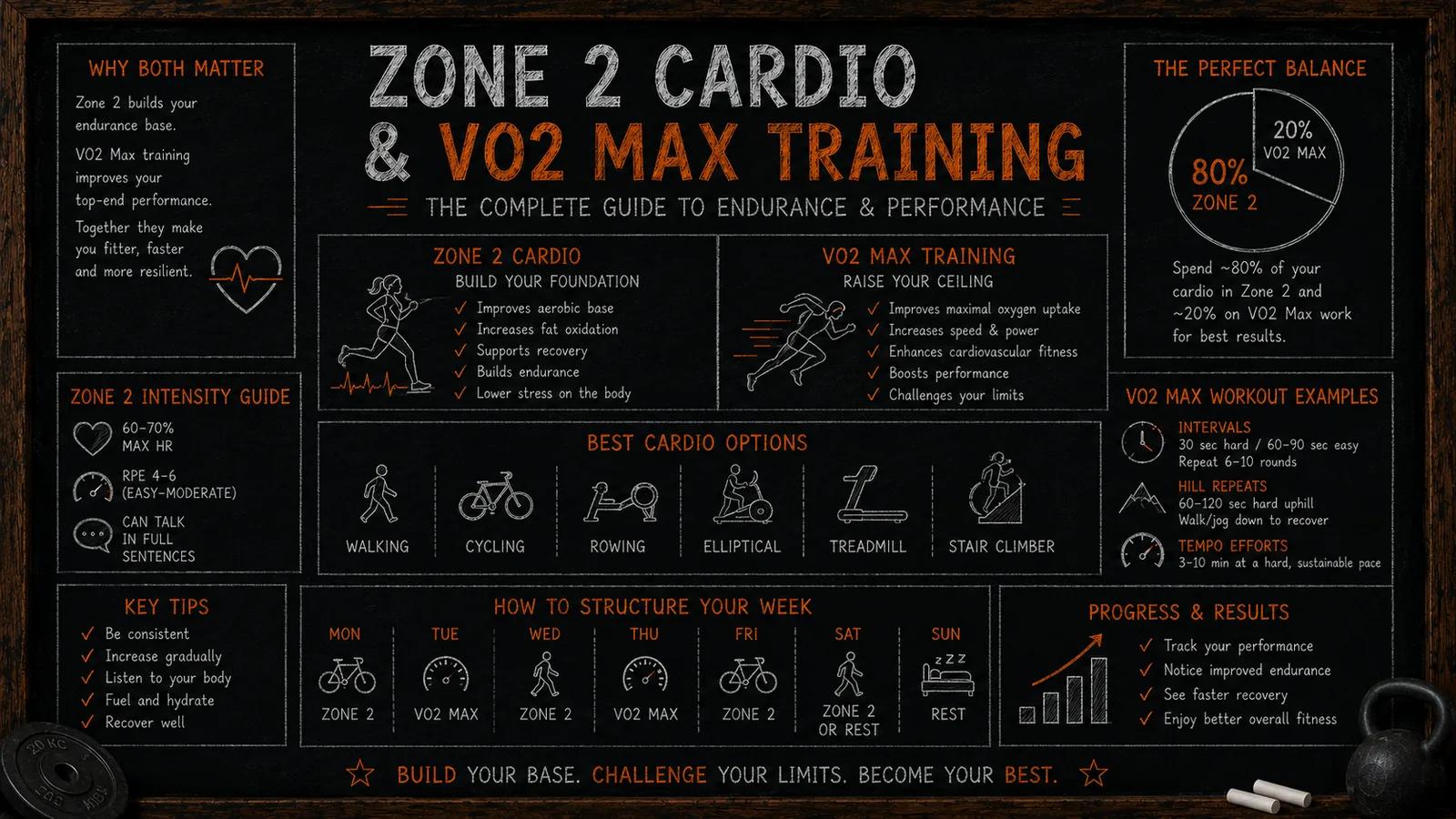
Zone 2 training is steady cardio held at roughly 60 to 70 percent of your maximum heart rate, the intensity where you can still hold a conversation but would rather not. Done for 150 to 200 minutes a week, it builds the aerobic base that drives VO2 max, and VO2 max is now one of the strongest predictors of how long you will live.
That is not a soft wellness claim. It is the reason I put a full cardio bank on the floor at Inception, three steps from the plate-loaded machines, so lifters have no excuse to skip it.
Key takeaways
- Zone 2 sits at about 60 to 70 percent of your max heart rate: conversational, nose-breathing pace.
- VO2 max, the ceiling that Zone 2 raises, tracks harder with mortality than smoking, hypertension, or type 2 diabetes.
- The simple weekly target is 150 to 200 minutes of Zone 2, structured on an 80/20 model with a small dose of hard intervals.
- Lifters get the most from bolting Zone 2 onto strength days rather than treating cardio as a separate war.
- At Inception the cardio machines sit beside 43 plate-loaded stations, and our free body scans give you a real number to train against.
What is Zone 2 training, in plain English?
Zone 2 is the second of five commonly used heart-rate zones. It is the pace where your body is working aerobically, burning mostly fat, clearing lactate as fast as it produces it. You are breathing through your nose, or close to it. You could recite your address without gasping. You could not comfortably sing.
The mistake I see most often on our floor is people training too hard to be in Zone 2 and too easy to get an interval benefit. They land in a grey no-man's-land at maybe 80 percent, feel tired, and get a fraction of the adaptation. Zone 2 is meant to feel almost annoyingly easy. That easiness is the point: it is a volume you can repeat three or four times a week without wrecking your recovery for the squat rack.
How do I find my Zone 2 heart rate?
The quick field method, no lab required:
- Estimate your maximum heart rate. The rough starting point is 220 minus your age. It is imperfect, but it gets you in the ballpark.
- Take 60 to 70 percent of that number. For a 40-year-old, max is around 180, so Zone 2 sits near 108 to 126 beats per minute.
- Sanity-check it with the talk test. If you cannot speak a full sentence, drop the pace. If you can sing, pick it up.
A chest-strap monitor beats a wrist optical sensor for accuracy, especially on grip-heavy machines where wrist blood flow gets choked. But the talk test alone will keep most people honest.
Why VO2 max is the metric worth caring about
VO2 max is the maximum volume of oxygen your body can use per minute when you are working flat out. It is the single best snapshot of your aerobic engine, and the research on it has moved from the sports-science corner into the longevity conversation for a good reason.
In my read of the evidence, low cardiorespiratory fitness carries a mortality risk that sits above smoking, hypertension, and type 2 diabetes. That is the most under-appreciated fact in the whole gym.
Sit with that. We treat smoking as the obvious killer, and it is. Yet the data on VO2 max suggests that being profoundly unfit is its own category of risk, and unlike your genes it is a number you can move. Going from the bottom fitness bracket to even the below-average bracket produces one of the largest risk reductions in the literature. You do not need to become an athlete. You need to climb off the floor.
Zone 2 is the foundation that lets you raise that ceiling. It builds mitochondrial density and capillary networks, the plumbing and the engines, so that when you do go hard your VO2 max has somewhere to grow.
How to improve VO2 max: the 80/20 model
You do not raise VO2 max by grinding yourself into the ground every session. The model that works, borrowed from endurance sport and applied sensibly to lifters, is 80/20.
- 80 percent easy. The bulk of your cardio minutes live in Zone 2. This is the aerobic base, the boring, essential volume.
- 20 percent hard. A small slice sits up in the higher zones: intervals near your VO2 max, four to five minutes on, equal rest, repeated a handful of times.
For most lifters at Inception, that translates to something manageable:
- Two to three Zone 2 sessions a week, 30 to 45 minutes each, totalling your 150 to 200 minutes.
- One shorter interval session, once you have a few weeks of base behind you. Think five rounds of four minutes hard, four minutes easy.
- Everything held around your lifting, not in competition with it.
That is it. No 90-minute suffer-fests. The magic is in consistency across months, not heroics across one week.
A contrarian take on steady-state cardio for lifters
Here is where I break with a lot of the strength world. For twenty years the lifting culture treated cardio as the enemy, the thing that steals your gains. That fear is mostly outdated. The interference effect is real but small, and it mostly bites when you do hard intervals immediately before or after heavy lower-body work.
Zone 2 does not carry that penalty in any meaningful way for the average member. What I actually see is the opposite: the members who add easy cardio recover better between heavy sets, hold their conditioning across a long session, and last longer in the sport of training itself. A bigger aerobic engine means you get less winded on your working sets and you recover faster between them. Cardio is not the tax on strength. For most people it is the thing that lets strength keep compounding into their fifties and sixties.
Why we built the cardio bank beside the plate-loaded floor
When Elise and I designed the 800 square metre floor, we made a deliberate choice about layout. The cardio machines do not sit in a forgotten annex behind the toilets, which is where most gyms hide them. They sit in the same open space as the strength equipment, a few steps from the 43 plate-loaded stations and the 2 squat racks.
That is not an accident of floor plan. It is behavioural design. If Zone 2 is fifteen steps and a locked door away, people skip it. If it is right there, in eyeline as you rack the bar after your last set, you step onto a bike or the ski erg and give it twenty easy minutes. The proximity is the intervention.
In my experience running a 92-machine floor, the members who make real progress on both fronts are the ones who stopped treating strength and cardio as two separate gym trips. They finish their lifting, walk ten metres, and ride out an easy Zone 2 block while the session is still warm. You can see the full layout and machine list on our equipment inventory page.
What I see members get wrong most often
Three mistakes come up again and again, and all three are fixable in a single conversation on the floor:
- They go too hard. As I said, they turn every easy session into a moderate grind and wonder why they are always tired. Slow down. Zone 2 should feel like you are leaving something in the tank, because you are.
- They chase the interval sessions first. The hard 20 percent is the seasoning, not the meal. Without the aerobic base underneath it, VO2 max intervals just dig a recovery hole. Build the base first.
- They never measure anything. They train for months with no idea whether their engine is growing. This is where a real number changes everything. Our free body composition scans give members an objective baseline and let us track the trend over time, so cardio stops being a vibe and becomes a metric you can move. You can book one on the free body scan page.
If you are unsure how to read your own numbers, this is exactly what my coaching team is for. Reading heart-rate data and turning it into a weekly plan is a skill, and it is one we bring PhD-level rigour to rather than guesswork. Our personal training is built around exactly this kind of measured, evidence-led programming.
A simple week to start
If you want a concrete template, here is what I would hand a member starting from a lifting base with little cardio history:
- Monday: Lower-body strength, then 25 minutes Zone 2 on the bike.
- Wednesday: Upper-body strength, then 30 minutes Zone 2 on the ski erg or a walk on an incline treadmill.
- Friday: Full-body or accessory work, then 30 minutes Zone 2.
- Sunday: One optional easy 40-minute Zone 2 session, outdoors if the weather in Christchurch cooperates.
That is roughly 125 to 135 minutes to begin, climbing toward 200 as it becomes routine. Add the interval session only after three or four weeks, once the easy work feels genuinely easy.
Start building your engine at Inception
VO2 max is the rare longevity metric that sits entirely in your hands, and Zone 2 is the least glamorous, most reliable way to raise it. You do not need a coach in a lab. You need a bike, a heart-rate strap, and the discipline to keep it easy.
If you want to try it on our floor, come and use the cardio bank next to the strength equipment and see how the layout changes your habits. Start with a free trial, or book a free body composition scan so we can give you a real baseline to train against from day one. I am on the floor most weeks; find me and I will happily show you where Zone 2 actually sits on the machine you are standing on.
For the wider picture on measuring progress, read our guide to [body composition tracking](/articles/body-composition-tracking), and if cardio machines are new to you, start with the [cardio equipment guide](/articles/cardio-equipment-guide).