Training
Strength training through perimenopause: protecting muscle and bone
Strength training through menopause is the most effective way to protect bone density and lean muscle. A first-hand guide from Inception Gym Christchurch, 5.0 across 1,090+ Google reviews, on how to load safely and track lean mass.
By Dr Matt Walley · 12 July 2026
PhD, University of Canterbury, specialising in advanced research methods. Drawing on 1,380+ client body-composition programmes at Inception. Not medical advice: talk to your GP about bone density screening and diagnosis.
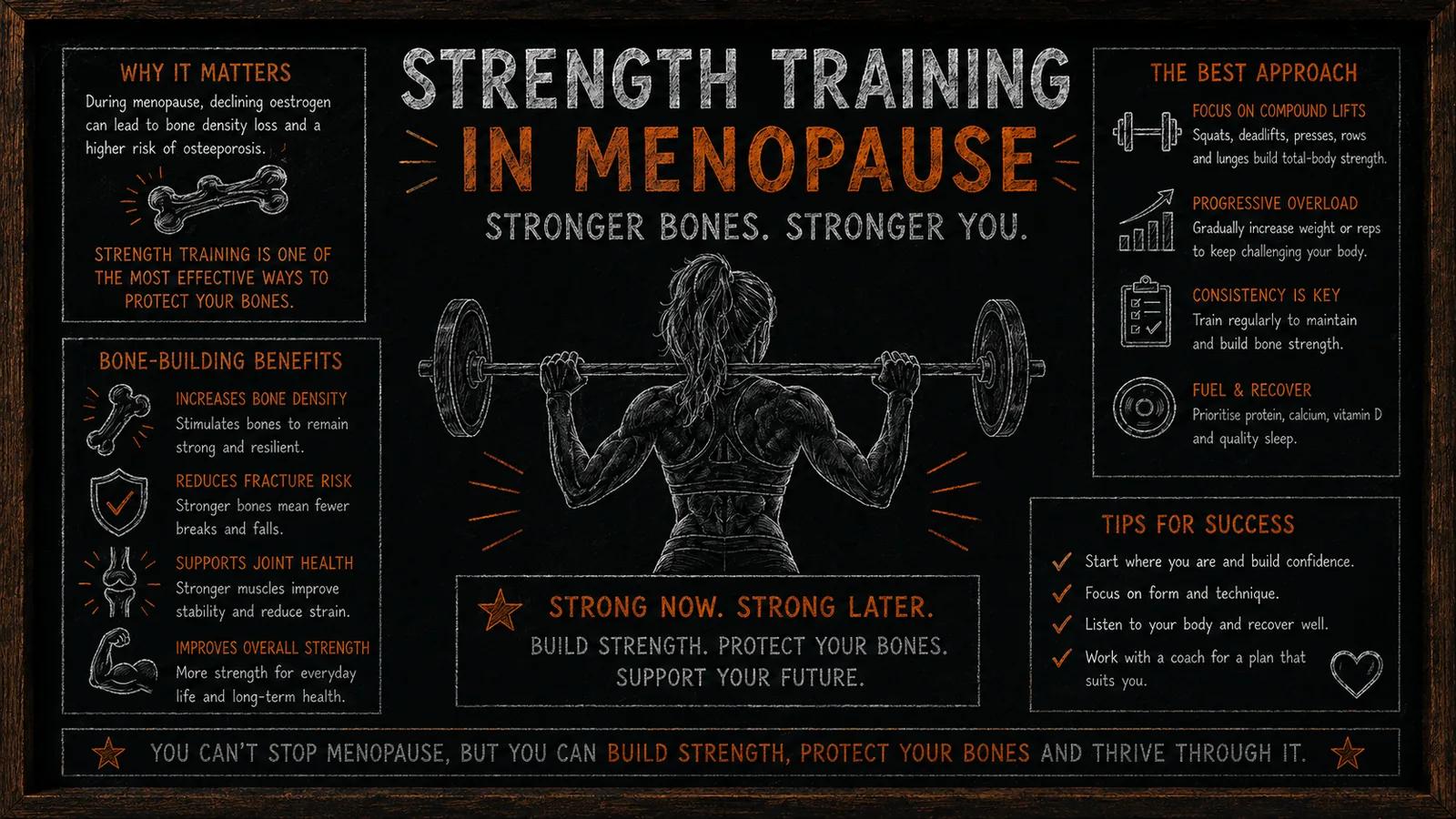
Strength training through menopause is the single most effective thing you can do to protect your bones and muscle. On average, women lose up to 10 percent of their bone density in the first five years after menopause (Better Health Channel, Victorian Department of Health), alongside accelerating muscle loss, and progressive resistance work is the training stimulus best supported by evidence for defending both at once.
I am Dr Matt Walley, and I co-founded Inception Gym here in Christchurch with my wife Elise in 2022. I am on our floor most days, and if there is one conversation I wish I had earlier with more women in their forties and fifties, it is this one. Let me lay it out plainly.
Key takeaways
- Perimenopause accelerates the loss of both bone density and lean muscle at the same time.
- Strength training loads bone directly, which is the stimulus that tells it to stay dense.
- Heavy, progressive resistance beats light "toning" work by a wide margin for this goal.
- Protein needs rise, not fall, through this life stage.
- A free body composition scan lets you measure lean mass instead of guessing.
Why does perimenopause hit muscle and bone at the same time?
Oestrogen does more than regulate the menstrual cycle. It is protective of bone and it supports the way your body builds and holds muscle. As oestrogen declines through perimenopause, both of those protections weaken together.
Bone is living tissue. It is constantly being broken down and rebuilt. When oestrogen falls, the breakdown side starts to win, and bone density can drop sharply in the years around the final period. At the same time, the muscle loss that creeps in from your thirties onward, sarcopenia, tends to speed up.
So you are fighting on two fronts at once. The good news is that one training approach addresses both, and it is not the one most women are quietly nudged towards.
Why heavy resistance beats "toning" for bone density
Bone responds to load. When a muscle contracts hard against real resistance and pulls on the bone it is attached to, that mechanical stress is the signal that tells bone to reinforce itself. Light weights lifted for endless reps do not create enough of that signal.
This is where a lot of well-meaning advice fails women. The message has long been "keep it light, keep it gentle." Gentle does not load bone. Meaningful resistance does.
The pink two-kilo dumbbells are not protecting your skeleton. Loading your bones enough that they are forced to get stronger is what protects it, and that means lifting properly heavy, in good form, with a plan.
To be clear about what "heavy" means here: it means a weight that is genuinely challenging for you in a controlled rep range, not a max-effort ego lift. For most people that lands somewhere in the range where the last couple of reps of a set are hard but your form still holds. That is the zone where bone and muscle both get the message.
What I see women get wrong on our floor
In my experience running a 92-machine floor, the most common mistake is not going too hard. It is staying too comfortable for too long. I watch women lift the same 5 kilos for a year, wonder why nothing changes, and quietly conclude the gym does not work for them.
It works. The load just never went up. Bone and muscle only adapt when you give them a reason to, and that reason is progressive overload: a little more weight, or a few more good reps, over weeks and months. If your training log looks identical to how it did six months ago, that is the problem to fix first.
The second thing I see is women avoiding the equipment that would help them most, usually because the free weights corner feels intimidating on a busy evening. That is a real feeling and it is exactly why we built the floor the way we did.
Why our plate-loaded machines suit this job
We run 43 plate-loaded machines across our 800 square metre floor, and I chose that depth deliberately. Plate-loaded machines are, in my honest opinion, one of the best tools a woman starting serious resistance training can use.
Here is why. A plate-loaded leg press, hack squat, or chest press lets you load real weight and progress it in small honest increments, while the machine guides the movement path. You get the heavy loading that bone and muscle need, without having to balance a barbell you are still learning to trust. You can push genuinely hard and know that if a rep gets tough, you can stop safely.
That combination, real load plus a safe fail, is what lets people train close to their honest limit. And training close to your honest limit is exactly what builds bone and muscle. We still have our full equipment inventory of 92-plus machines and our two squat racks for when you want them, but you do not need to start there.
If you want to walk the floor before committing to anything, a free trial is the low-friction way to try the machines for yourself.
Do I need to lift heavy, or is walking enough?
Walking is wonderful for your heart, your head, and your general health. I recommend it to everyone. But walking does not load your skeleton hard enough to reverse or halt perimenopausal bone loss, and it does very little to build muscle.
Think of it this way:
- Cardio, including walking: excellent for cardiovascular health and mood, minimal effect on bone density and muscle mass.
- Light resistance: better than nothing, but rarely enough load to force adaptation.
- Progressive heavy resistance: the stimulus that actually defends bone and rebuilds muscle.
You want all three in your life. But if bone and muscle are the goal, only the third one does that specific job, and nothing else substitutes for it.
Protein: you need more, not less
This is the part almost everyone under-does. As you move through perimenopause, your body becomes less efficient at turning the protein you eat into muscle. The response is to eat more protein and spread it across the day, not to cut back.
Most women I speak with are eating far less protein than would actually support the training they are doing. Getting a solid serve of protein at each meal is often the difference between training hard and seeing nothing, versus training hard and actually holding onto lean mass.
This is one of the reasons we built PhD-led nutrition into Inception Group rather than leaving it as an afterthought. If you are unsure where to start, our nutrition side exists precisely for this. You can read more on the memberships overview about how the pieces fit together.
Safety: busting the myth that lifting is dangerous
The fear I hear most is that lifting weights will hurt you, or that it is somehow risky for a woman over forty. The reverse is closer to the truth. The women most at risk of a serious fracture later in life are the ones who never loaded their bones and let them thin quietly for decades.
A few honest points on safety:
- Learn the movement with a manageable weight before you load it heavily. Form first, load second.
- Progress gradually. Small jumps, made consistently, beat big jumps made recklessly.
- Machines let you push hard with a built-in safety margin, which is why they suit this so well.
- If you have an existing condition or a diagnosis of low bone density, get individual guidance first.
Done sensibly, resistance training is one of the safest and highest-return things you can do for your body in this decade of your life. If you want a hand getting the technique right, our personal training is there for exactly that.
How do I know it is working?
You measure. This is where I get genuinely frustrated with the standard advice, which tells women to judge progress by the bathroom scales. The scales cannot tell muscle from fat, and through this life stage those two can move in opposite directions while the number barely shifts.
Every Inception member gets free body composition scans, and I would encourage any woman training through perimenopause to use them. A scan shows you your lean mass directly. When you can see your muscle holding or climbing while you train, you stop guessing and start knowing. That feedback is what keeps people consistent, and consistency is what wins this over the years.
The floor matters more than people admit
One last thing, and it is not a small one. None of this works if you dread walking in. We hold a 5.0 rating across 1,090+ Google reviews, and the theme that comes up again and again is that people do not feel judged on our floor. I take real pride in that, because an intimidating gym is a gym you quietly stop attending, and a gym you stop attending protects nobody's bones.
Elise and I built this place to be somewhere a woman starting serious training in her forties feels like she belongs from day one. That is not marketing to me. It is the whole point.
Start this decade strong
If you are moving through perimenopause, the best time to start protecting your bone and muscle was ten years ago, and the second best time is this week. Come and try the floor for yourself with a free trial, and book your free body composition scan so you have a real baseline to build from. Measure it, load it, and watch it hold. That is the plan, and I would be glad to see you on the floor.
Related reading: Training after 40: how to build strength and protect your health and our guide to free body composition scans.