Nutrition
On Ozempic or Wegovy? Why lifting heavy is non-negotiable for keeping muscle
Strength training on GLP-1 medication protects the muscle you would otherwise lose. Here is how we handle it at Inception Gym Christchurch, rated 5.0 across 1,090+ Google reviews, with heavy plate-loaded lifting, PhD-led protein targets, and free body scans that prove it.
By Dr Matt Walley · 12 July 2026
PhD, University of Canterbury, specialising in advanced research methods. Drawing on 1,380+ client body-composition programmes at Inception. Not medical advice: your prescriber manages the medication.
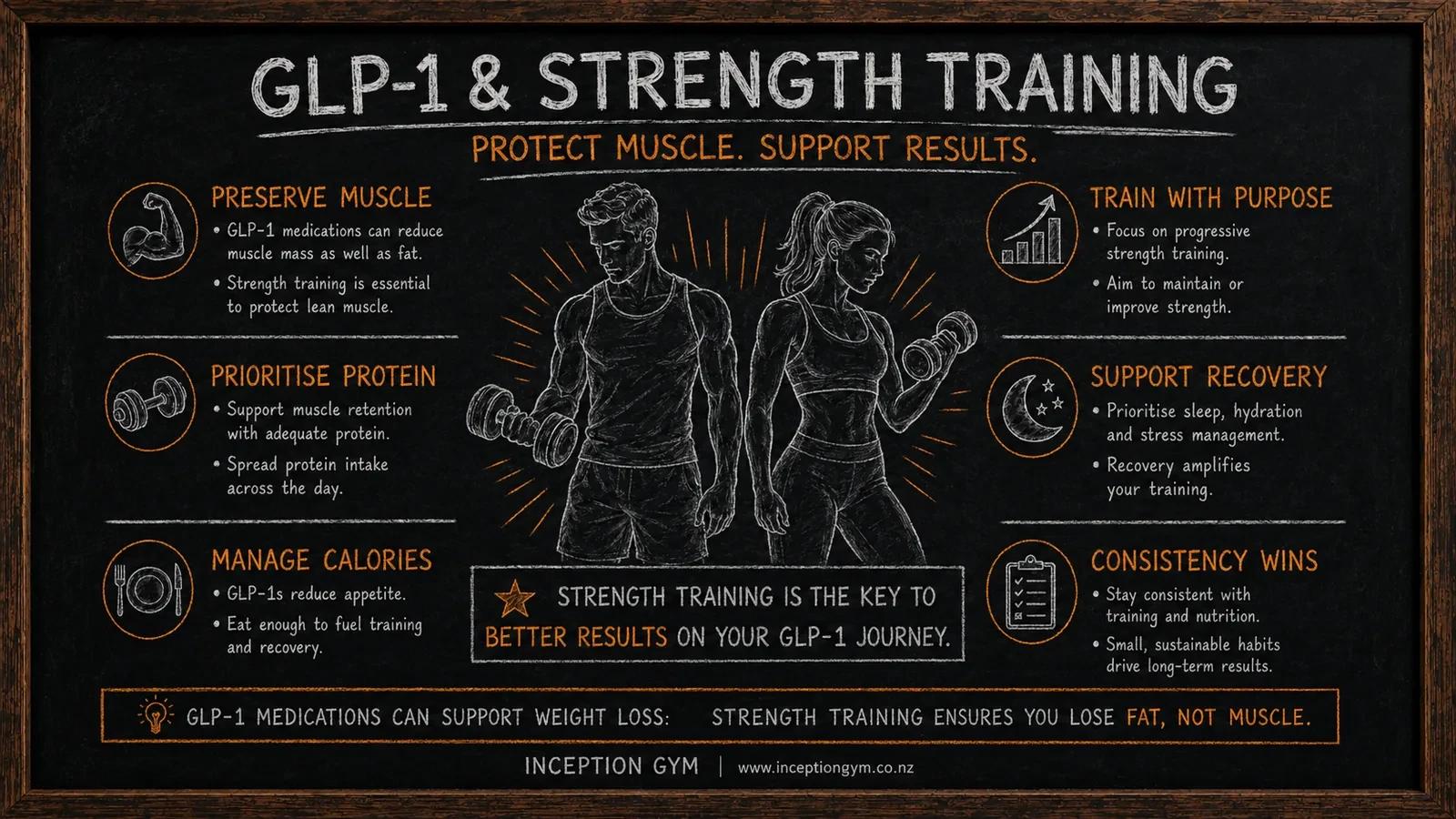
If you are on Ozempic, Wegovy, or Mounjaro, strength training on GLP-1 is the single most important thing you can do to keep the weight you lose from being muscle. Without heavy lifting and enough protein, a large share of what comes off the scale is lean tissue, not just fat, and that is the part you spend the rest of your life trying to get back.
I am Dr Matt Walley. My wife Elise and I built Inception Gym in Christchurch in 2022, and I am on the floor most days. Over the last couple of years I have watched more and more members walk in holding a GP prescription for a GLP-1 medication and a very sensible question: how do I not waste this. This article is my answer.
Key takeaways
- A meaningful portion of the weight lost on GLP-1 medication is lean muscle unless you actively defend it.
- Two things defend it: lifting heavy with progressive overload, and eating enough protein.
- Rapid appetite suppression makes hitting your protein target harder exactly when you need it most.
- We built the tools for this: 43 plate-loaded machines to load heavy safely, PhD-led nutrition targets, and free body scans that show whether your muscle is holding.
- The gym is the medical-grade partner to your prescription, not a replacement for it.
Why does GLP-1 weight loss cost you muscle?
GLP-1 medications work by turning your appetite down. You eat less, you lose weight, and for a lot of people that is genuinely life-changing after years of things not working. I have no argument with the drugs. They do what they say.
The catch is in the composition of what you lose. When the body drops weight quickly on a large calorie deficit, it does not politely take it all from your fat stores. It takes a chunk from muscle too. In the STEP 1 trial's body composition analysis of semaglutide, published in the Journal of the Endocrine Society, participants lost 15 percent of their body weight and 9.7 percent of their lean body mass: roughly a third of everything that came off was lean tissue, not fat. The exact number varies by study and by person, but the direction never does: without a stimulus telling your body to keep its muscle, it lets muscle go.
That is the part that should bother you. Fat lost is a win. Muscle lost is a future problem: a slower metabolism, less strength, worse balance as you age, and a body that regains fat more easily if you ever come off the medication.
The scale going down is not the goal. The scale going down while your muscle stays on is the goal, and only two things make that happen: heavy lifting and enough protein. Everything else is detail.
What does "lifting heavy" actually mean here?
Heavy is relative to you. It does not mean ego-loading a bar until your form falls apart. It means giving your muscles a reason to stay by working them hard enough, through a full range, with gradually increasing load over weeks. That is progressive overload, and it is the signal that tells your body the muscle is still needed.
For most people starting this on a GLP-1, I want:
- Two to four resistance sessions a week, every major muscle group hit.
- Compound movements loaded properly: pressing, rowing, squatting or leg pressing, hinging.
- Sets taken close enough to failure that the last two or three reps are genuinely hard.
- A little more load or a rep more than last time, tracked, not guessed.
If you want the deeper mechanics of that last point, I wrote a full piece on it in our progressive overload guide. It is the engine of the whole thing.
Why plate-loaded machines matter more when you are on a GLP-1
Here is a first-hand observation from running a 92-machine floor. People losing weight fast on these medications often feel a bit different in the gym than they expect. Appetite is down, sometimes energy is down on a given day, and if they have lost weight quickly, their balance and coordination under a heavy free-weight bar has not caught up yet. Ask someone to put a heavy barbell on their back in that state and you are adding a stability tax on top of the training you actually came to do.
This is exactly why I stocked the floor the way I did. We run 43 plate-loaded machines out of our 92-plus pieces. A plate-loaded machine gives you the honest heavy load you need for the muscle-keeping signal, but it holds the movement path for you, so you can push a hard set without a balance demand you are not ready for.
That is not a beginner compromise. I am a strong believer that plate-loaded work belongs in serious programmes, and on a GLP-1 it is often the smartest way to train heavy safely from day one. If you want my full case for the equipment, it is in our plate-loaded machines guide, and you can see the whole inventory on our equipment page.
We still have two squat racks and dumbbells up to 70kg for the days you want them. But nobody has to earn their heavy training by first winning a balance fight.
The protein problem nobody warns you about
This is the trap I see most often, and it is a cruel one. The medication suppresses your appetite. Protein is the most filling macronutrient there is. So the exact food your muscle needs to survive a deficit is the food you least feel like eating.
In my experience the members who lose muscle on these drugs are almost never the ones who skipped the gym. They are the ones who could not eat enough protein because they simply were not hungry, and no one gave them a target or a plan. They trained hard on an empty tank and wondered why the scan looked wrong.
So we treat protein as a non-negotiable prescription of its own, not a suggestion. Practical tactics that work when appetite is gone:
- Front-load protein early in the day before the fullness sets in.
- Lean on high-protein, low-volume foods so you are not fighting a huge plate.
- Use a quality protein supplement to close the gap on the days food will not happen.
- Spread it across the day rather than trying to win it all at dinner.
I go deeper on numbers and sources in our protein intake guide. The short version: on a GLP-1 you should treat your daily protein target the way you treat the injection itself, as something you do not skip.
How do you actually know your muscle is holding?
You cannot manage what you cannot see, and the bathroom scale is close to useless here because it cannot tell muscle from fat. A number going down looks like success even when half of it is the wrong tissue.
This is where we have a genuine advantage, and it is the reason I would back Inception for anyone on a GLP-1 in Christchurch. Every member gets free body composition scans. Not a one-off. Repeat scans that separate fat mass from lean mass, so you can watch the two lines move independently.
That changes everything about how you run your weight loss:
- If fat is dropping and lean mass is holding, you are doing it right. Keep going.
- If lean mass is falling, we catch it in weeks, not years, and we fix the training load or the protein before real damage is done.
That feedback loop is the whole point. It turns "I hope this is working" into "here is the proof." You can read how the scans work in our body composition scans guide, or just book your free body scan and get a baseline before you go any further.
We are the partner to your prescription, not a replacement
I want to be very clear about the lane. Your GP or prescriber handles the medication. That is medicine, and it stays with them. Talk to your prescriber before starting or intensifying resistance training, particularly around dose changes, and flag anything unusual you feel during sessions. What we handle is everything the medication cannot do on its own: the heavy training stimulus, the protein strategy, and the measurement that proves your muscle is surviving.
Inception Group gives us an unusual amount of that under one roof: the gym floor, PhD-led nutrition, the supplement store, and the body scanning. Almost no gym in Christchurch is set up to support a GLP-1 patient across all of those at once, and honestly, almost none of them are even talking about it. We are, because I have watched the difference it makes on our scans.
If you are over 40 and starting this journey, the muscle-keeping argument is even more urgent, and I wrote specifically for that group in our guide to training over 40.
Start with a scan and a heavy session
If you take one thing from me: do not spend months on a GLP-1 and let the scale fool you. Get a baseline scan, start lifting heavy properly, and eat your protein like it is prescribed. Then let the repeat scan tell you the truth.
The lowest-friction way to begin is to come and train. Start with a free trial and put your hands on the plate-loaded floor, or book your free body composition scan so we can set your baseline before the weight starts moving. If you would rather talk it through first, reach out to us directly and ask for me. This is exactly the conversation I built the place to have.
Keep the fat loss. Keep your muscle. That is the whole game, and we have every tool to help you win it.