Lifestyle · Culture
Overcoming gym anxiety: a practical guide for new and returning members
Gym anxiety is real and common. My practical strategies for walking in confidently, and why the culture at Inception Gym Christchurch (5.0 across 1,090+ Google reviews) makes it easier.
By Dr Matt Walley · 29 May 2025
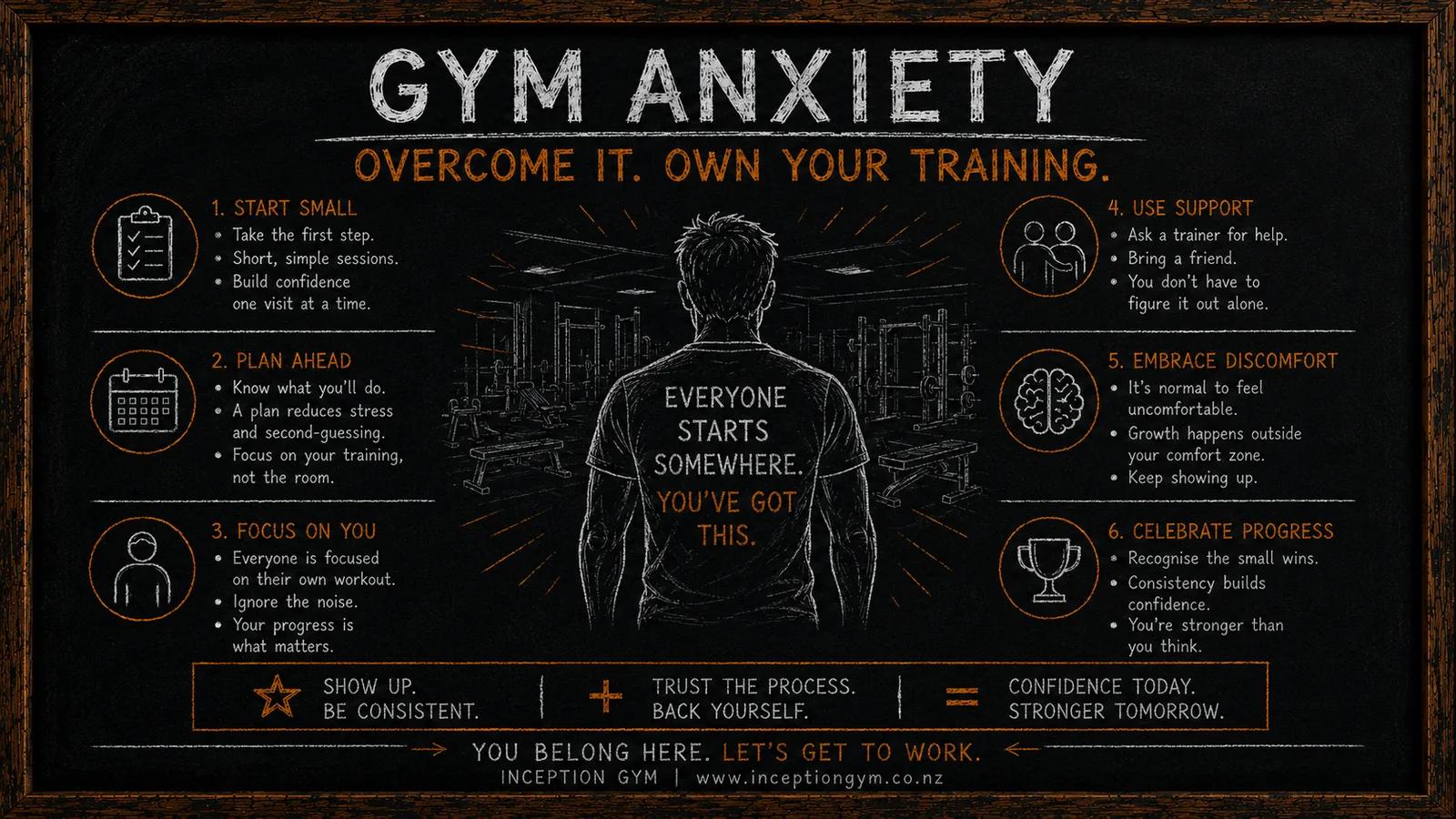
Gym anxiety fades with familiarity, and you can speed that up: arrive with a written plan, treat the first visit as reconnaissance rather than a workout, train at quieter hours, and choose a gym whose culture works in your favour. I have watched hundreds of nervous first-timers walk onto our floor at Inception Gym Christchurch since we opened in 2022, and almost none of them still feel that way a month later.
I am Dr Matt Walley. My wife Elise and I own and run this gym, and I am on the floor most days. This is not a theory piece. It is what I actually see work.
Key takeaways
- Gym anxiety is normal, common, and almost always temporary.
- Uncertainty is the fuel. Remove it with a written plan and a low-stakes first visit.
- Train off-peak while you build confidence; our 24/7 access means you pick the hour.
- The right culture matters more than the right equipment when you are starting out.
- A free trial lets you test the room before you commit to anything.
Where does gym anxiety come from?
In my experience it clusters around three distinct fears, and naming them is the first step to disarming them.
Fear of not knowing what to do
The most common worry I hear at the front desk is simply not knowing how the place works. Which machine does what. How you adjust a seat. What the unwritten etiquette is. How long is fair to sit on one station.
That is a rational concern, not a character flaw. Gyms are full of equipment with no obvious instructions and social norms nobody ever states out loud. The anxiety is the natural response to an unfamiliar room with unclear rules.
Fear of being judged
The second cluster is the feeling of being watched and evaluated: for how you look, what you lift, or whether your technique is right. It is sharpest for people who have decided they are not the "gym type."
Here is what I can tell you from years of standing on my own floor: the experienced members are almost entirely focused on their own training. The person you think is watching you is counting their own reps and thinking about their own next set. The self-consciousness is real, but the audience you imagine mostly is not there.
Fear of doing something wrong
A subset of both: the specific worry about using a machine incorrectly, either hurting yourself or looking incompetent. This one has a grain of truth, because poor technique on some lifts does carry injury risk. That is exactly why asking, rather than guessing, is the smart move, not the embarrassing one.
What practical strategies actually work?
Arrive with a plan
Uncertainty fuels anxiety. Walking in with no idea what you will do creates maximum uncertainty. Walking in with a specific written plan removes most of it.
Your plan does not need to be clever. "Leg press, then seated row, then lat pulldown, then fifteen minutes on the treadmill" is enough. The point is a predetermined sequence that kills the "what do I do now" moment before it starts.
Most beginners do well on a simple programme of three to five exercises covering the major patterns: push, pull, hip hinge, squat. You can build one from a complete beginner's guide, or better, during the initial consultation we include free on our contract memberships.
Use your first visit as reconnaissance
Give yourself permission for the first visit to be about learning the room, not completing a session. Walk the floor, find where things are, try two or three machines you already half-know, and leave.
The anticipation is always worse than the reality. I have never had a member tell me the first workout was scarier than the week they spent dreading it.
Reframing the first visit as reconnaissance instead of performance lowers the stakes, and lower stakes mean lower anxiety. That is the whole trick.
Ask for help
Every member on our floor was a beginner once, and every one of my staff is here specifically to help you use the place. Asking for a quick orientation is not an imposition; it is the intended use of the resource.
The fear that asking makes you look uninformed is backwards. When someone asks me how to set up a machine properly, my read is that they care about doing it right. That earns respect, not judgment.
Train at off-peak times
If your anxiety is specifically about crowds, train when it is quiet. Mid-morning and mid-afternoon are far calmer than the 6 to 8am and 5 to 7pm rushes at almost any gym.
We run 24/7 access, so you genuinely can pick any hour. Training at 9am, 2pm, or 8pm takes the crowd variable off the table entirely for your first few weeks while you build familiarity. Use that.
Focus on process, not the room
A lot of gym anxiety is comparison: measuring yourself against everyone else and against an imagined standard. Shift your attention from "how do I compare" to "am I finishing the plan I came in with," and the comparison dynamic loses its grip.
This is not a platitude. Your attention is something you can deliberately steer. Watch your breathing, your form, the weight, the next exercise on your list. When your eyes drift to the room, bring them back to the task. A structured warm-up routine is a great anchor for exactly this.
Why does Inception Gym's culture make a difference?
A gym cannot fully control its culture, but it can shape it hard through how the space is built and how the owners behave. Our 5.0 rating across 1,090+ Google reviews reflects something real about how it feels to train here.
Those reviews consistently mention the atmosphere, the cleanliness, and the welcoming-but-professional feel of the room. At that volume, nothing is hidden. That many people trained here and chose to leave five stars.
Owner-operated, not franchised
Elise and I founded Inception in 2022 and we still run it directly. That changes the feel compared to a franchise where the people making decisions have never trained in the building. Every choice here, the 800 sqm layout, the 92-plus machines, the two squat racks, the way we greet a nervous new member, was made by people whose names are on the door. If you want the fuller picture, I wrote about why owner-operated gyms feel different.
A room built on connection, not convenience
The thing I am proudest of is not the equipment. It is that people talk to each other here. A gym works best as a third place, somewhere between home and work where you are recognised and expected. That sense of belonging is the strongest antidote to anxiety I know of, and it is why I put more effort into building community than into any single piece of kit. Convenience gets you in the door once. Connection is what brings you back on the days you would rather not.
Professional rather than intimidating
Because a lot of our members are working professionals training around their day, the prevailing tone is focused and purposeful rather than cliquey or performative. That, honestly, is one of the quiet reasons this is a genuinely easy gym to start at: people are here to train, not to be seen, and that makes the room far less self-conscious for someone new.
Use the free trial to test the water
The single most practical tool for gym anxiety is a trial. Rather than committing before you know how the room feels, a free trial at Inception Gym lets you experience the facility, the culture, and the equipment with zero financial or contractual commitment.
That changes the emotional context entirely. You are not deciding whether this is your gym for the next two years. You are just seeing what it is like. No wrong answer, no commitment. That drop in stakes reliably drops the anxiety with it.
Every member also gets free body composition scans. Knowing your real starting point in measurable terms, rather than guessing from the mirror, gives you an objective baseline to work from and a reason to come back.
Building for the long term
Gym anxiety almost always diminishes with familiarity. Most people who push through the first three or four weeks find it either disappears or fades to background noise. Recognition from staff and regulars, comfort with the equipment, and the quiet confidence of just showing up all compound.
The whole game is getting through those first few weeks. The strategies above are the tools. Our culture is the environment to use them in. For anyone who wants a steadier ramp, this guide for first-timers walks the early weeks step by step.
The first step
The anxiety you feel before walking in is shared by nearly everyone who has done it, including the experienced lifters you will see on our floor. They got through it by doing the thing anyway and discovering the dread was worse than the reality.
You do not need to wait until you feel ready. That feeling rarely arrives on its own. Readiness comes from showing up, and the anxiety drops from there.
Take the lowest possible first step. Book a free trial and come see Inception Gym Christchurch for yourself, no obligation. Walk the floor, try a machine or two, and let the room stop being unfamiliar. That is all it takes to start. I will see you in there.