Training · Recovery
Injury Prevention and Recovery: Training Smart at Any Age
Injury prevention and recovery for gym training in Christchurch. How I coach members to warm up right, load gradually, train around pain and recover on schedule at any age.
By Dr Matt Walley · 10 July 2024
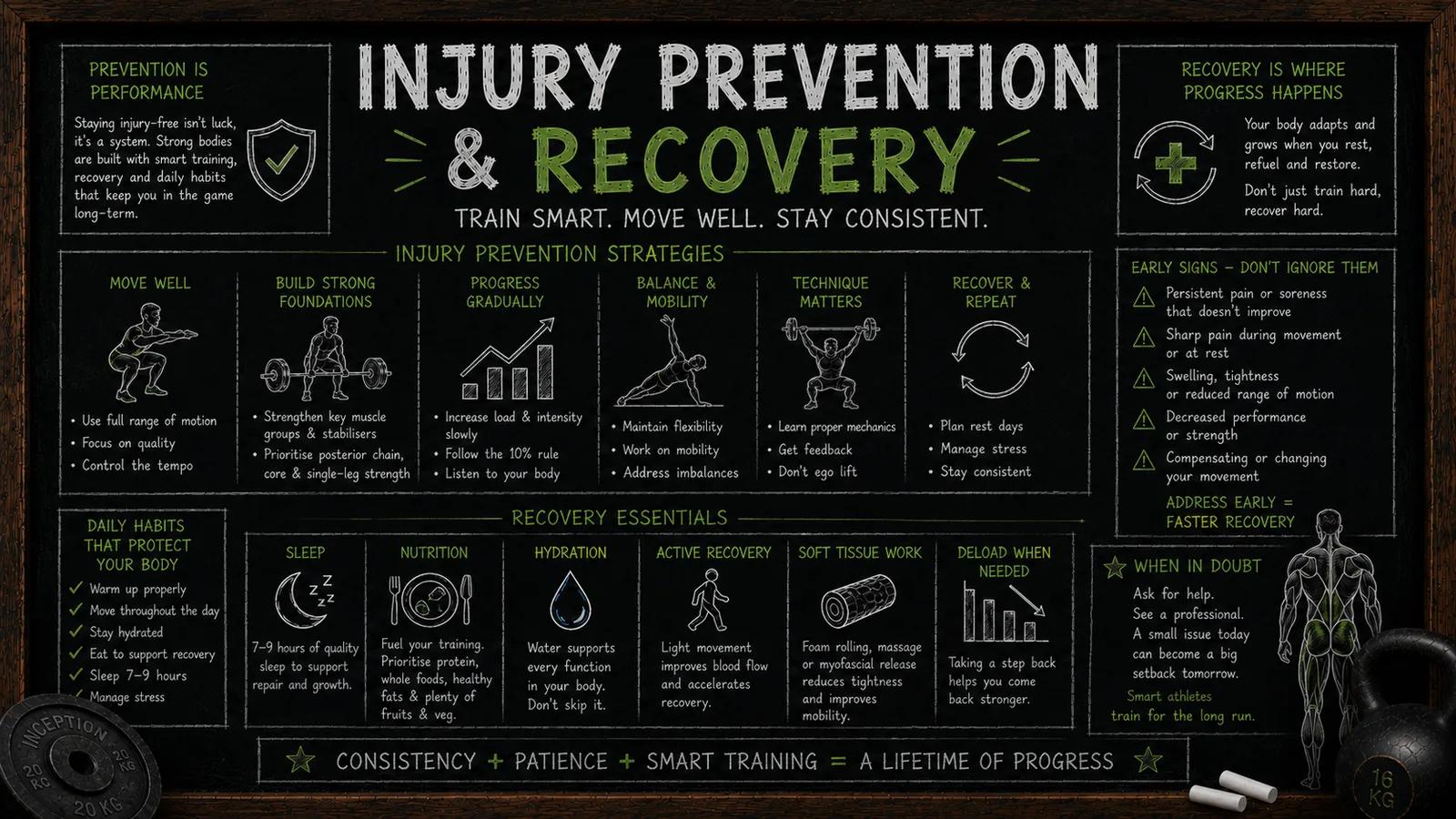
Injury prevention comes down to five habits: warm up for the specific lifts you are about to do, add load gradually rather than by ego, train full ranges of motion, substitute around pain instead of pushing through it, and treat sleep and protein as part of the programme, not extras. People who train for decades are not the ones who never get hurt. They are the ones who learn to train around limitations while fixing the root cause.
I am Matt Walley, co-founder of Inception Gym Christchurch, and I have spent years managing my own niggles and coaching members through theirs. This is how I think about it.
Key takeaways
- Most gym injuries build slowly over weeks, so prevention beats treatment every time.
- Increase load by no more than 5 to 10 percent, and only once every rep is clean.
- Sharp or movement-altering pain is a stop signal. Discomfort and normal soreness are not.
- Recovery is a scheduled discipline: sleep, protein, and deload weeks, not an afterthought.
- A deep machine range means you can almost always train the target muscle through a pain-free path.
Why is injury prevention more important than treatment?
Most gym injuries are not sudden events. They are the slow accumulation of sloppy movement patterns, rushed warm-ups, loading too fast, and warning signs somebody chose to ignore. By the time something goes, the damage has been building for weeks.
Prevention is not glamorous. It is the single most effective thing you can do for long-term training. On our floor I watch the members who are still going strong years in, and to a person they treat the boring parts as the main event.
The lifters still training productively at 60 and 70 did not get there by pushing through pain in their 30s. They got there by modifying early and recovering on purpose.
Warm up for the movement, not just your heart rate
A five-minute treadmill walk raises your heart rate. It does not prepare your specific joints and tissues for the lift in front of you. What I coach:
- General cardiovascular work (3 to 5 minutes): ski erg, stair climber or light cycling to raise blood flow and core temperature.
- Dynamic stretching (3 to 5 minutes): leg swings, arm circles, hip circles, torso rotations, moving through progressively larger ranges.
- Movement-specific ramp-up (2 to 3 minutes): light sets of the actual exercise. Squatting? Two sets with the bar. Pressing? Start with the lightest dumbbells and build up.
That ten-minute investment prevents most of the training injuries I see.
Progressive overload, not ego loading
The most common cause of gym injuries is adding weight too quickly. Progressive overload means gradually increasing demand, and the operative word is gradually. My rule: add no more than 5 to 10 percent once you can complete every prescribed rep with clean form. If you are chasing three sets of ten and only manage seven on the last set, the weight is too heavy. Drop it, own the movement, then progress.
This matters more the older you get. Tendons and ligaments adapt slower than muscle. Your muscles can feel ready for a heavier load weeks before your connective tissue is. Patience here is not weakness, it is strategy. If you want the full framework, read my guide to progressive overload.
Train through full ranges of motion
Partial reps let you move heavier weight, but they build imbalances and leave your joints weak in the positions they rarely see. Full range of motion builds strength, keeps you mobile and protects joints when life throws you something unexpected.
If a specific range causes pain, that is diagnostic information, not a hurdle to bulldoze. Reduce the load, modify the movement, and if it persists, get it assessed.
How do you train around an existing injury?
Having an injury does not mean you stop training. It means you train differently. The body is adaptable, and almost every injury still leaves productive work on the table.
The substitution principle
If a movement hurts, find a variation that trains the same muscle without triggering pain. At a gym with a thin equipment list that is hard. Across our 92 pieces of equipment it is usually straightforward.
Common substitutions I set members up with:
- Shoulder pain on barbell bench: move to a chest press machine with a neutral grip, or dumbbells with a reduced range.
- Knee pain on squats: try a leg press with a higher foot position, or the hack squat with controlled depth. See hack squat vs leg press.
- Lower back discomfort on deadlifts: use a seated row or chest-supported row to train the posterior chain without spinal loading. Leg curls hit the hamstrings with no lower back involvement.
- Elbow pain on barbell curls: switch to a cable curl or a machine curl that lets the wrist sit naturally.
The aim is always the same: keep loading the target muscle through a pain-free path. When you have depth of kit, you almost always find the one that works. This is the honest case for free weights and machines together rather than one camp winning.
When to train and when to back off
There is a real difference between discomfort and pain. Mild muscular discomfort, delayed onset soreness from a previous session, the general aches of an active life: normal, safe to train through.
Sharp pain, sudden onset pain, pain that worsens mid-set, or pain that changes how you move: that is your body telling you to stop. Listen. Reducing the load or switching exercises is not failure. Ignoring a clear signal and making it worse is.
Deload weeks are part of the plan
A deload week cuts your volume and intensity by 40 to 50 percent for one week. It lets accumulated fatigue clear and gives your joints and connective tissue time to catch up.
Once you are past 40 I would build in a deload every four to six weeks. Managing a chronic issue, you may want them more often. This is not lost time. It is the investment that lets your next block actually run instead of getting cut short by a flare-up. I go deeper on this in rest days and recovery.
Recovery is the other half of the work
What you do outside the gym decides how well you recover and adapt. I treat recovery as a scheduled discipline with the same weight as the training itself.
Sleep
Sleep is when you repair muscle tissue, consolidate movement patterns and regulate the hormones that drive recovery. Seven to nine hours is the evidence-based target for adults who train. Chronic short sleep impairs recovery, raises injury risk and drops your strength output. Prioritise it as seriously as you prioritise your sessions.
Nutrition
Your body cannot repair what it does not have materials for. I coach a food-first approach: hit protein at 1.6 to 2.0 grams per kilogram of body weight daily from real meals, get enough total calories to support your activity, and cover micronutrients with a varied diet. Supplements fill gaps, they do not replace the plate.
A few that genuinely help:
- Creatine monohydrate supports cellular energy and is one of the most studied supplements there is. It is not just for young men either; the interest in creatine for women and healthy ageing is well founded. Our Inception Labs Creatine uses Creapure, the purity gold standard.
- Collagen protein supports tendon and ligament repair, which matters most when you are training around a joint.
- Omega-3 fatty acids help manage systemic inflammation and support joint health.
Members get reduced pricing on Inception Labs at our on-site supplement store. If you want the plate dialled in around your training and injury history, our sister company Inception Nutrition runs PhD-led coaching, and your free body composition scan gives us the data to build from. For a fuller breakdown, see protein intake.
Active recovery
Rest days are not zero-movement days. Light walking, gentle stretching, foam rolling and mobility work improve blood flow, cut stiffness and speed things along. The goal is movement without load: enough to support recovery, not enough to add stress.
Talk to someone who actually knows
One of the most useful things about an owner-operated gym is who you can talk to. I hold a PhD and I have spent years working through injury management, movement patterns and evidence-based recovery, and I am on the floor. A five-minute chat about a cranky shoulder, a quick plan to modify around a knee, a better exercise variation: that is the support you get here that a thinly staffed franchise cannot match. Ask for me during staffed hours, Monday to Thursday 9am to 7pm and Friday and Saturday 10am to 2pm (unstaffed Sundays and public holidays), and remember members have 24-hour access every day of the year.
Our personal trainers also work with members managing injuries and age-related limitations, and they are worth their weight when you want a second set of eyes on your loading.
Training smart at every stage
In your 30s
Recovery takes a little longer than it did at 25. Warm-ups stop being optional. The lifts you got away with sloppy now ask for attention. This is the decade to build habits that serve you for the next 40 years.
In your 40s
Joint health becomes a primary consideration. You may swap some barbell work for machine or cable alternatives, and deload weeks become essential. You can still build serious strength and muscle in your 40s; it just wants smarter programming. If that is you, read gym for over 40s.
In your 50s and beyond
Strength training becomes more important, not less, for bone density, metabolic health and staying independent. The focus shifts toward quality of movement, joint-friendly loading and consistency over intensity. This is exactly where a deep machine range earns its keep, because it gives you an option for every movement pattern regardless of what your body will and will not do that day. It is a big part of why women lifting into later life is one of the best longevity bets going, and I cover that in women and strength training.
The long view
We treat training as a lifelong practice, and 5.0 stars across 1,090+ Google reviews tells me the members feel that difference. The people still training productively decades in got there by listening to their bodies, modifying when needed, recovering on schedule and surrounding themselves with people who understand the long game. Our facility is built to support exactly that.
Start training smarter
Whether you are managing an existing injury or want to prevent the next one, the environment around you matters. Start a free 24-hour trial at Inception Gym, come find me on the floor, and we will map out a way to train around whatever you are carrying. From there, explore membership options from $18.90 per week on a 24-month plan, or an open-term option at $33.90 per week you can cancel with 28 days' notice.