Training · Recovery
Rest Days and Recovery: Why What You Do Outside the Gym Matters More
The truth about gym recovery: rest days are where the gains happen. I cover how many rest days you need, overtraining signs, sleep, and why recovery is a scheduled discipline, not an afterthought.
By Dr Matt Walley · 15 December 2024
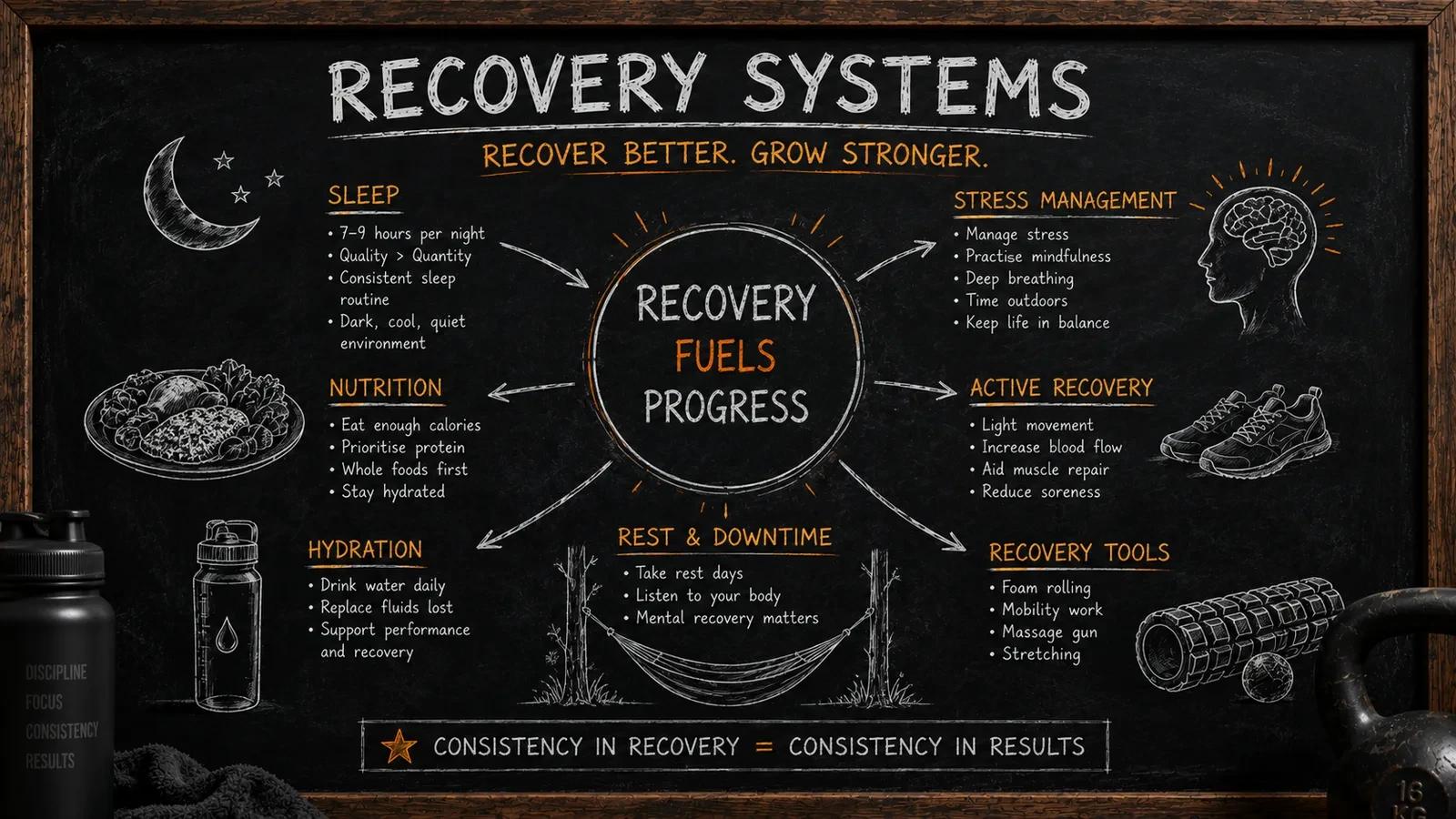
Rest days are not time off from training. They are the part of training where the growth actually happens. Your gym session creates the stimulus; the repair, the strengthening and the muscle you are chasing all get built in the hours and days between sessions. Most intermediate and advanced trainees need at least 1 to 2 full rest days per week from high-intensity work, and plenty do better on 3.
I am Dr Matt Walley, and I co-founded Inception Gym Christchurch with my wife Elise in 2022. I have a PhD, I am on our floor most days, and after years of watching members train I can tell you the single most reliable predictor of who makes progress is not who trains the hardest. It is who recovers on purpose.
Key takeaways
- Muscle is built between sessions, not during them; rest days are when adaptation completes.
- Most people need 1 to 2 full rest days a week, some 3, depending on volume, sleep, nutrition and life stress.
- Sleep is the highest-impact recovery tool there is. No supplement comes close.
- Overtraining shows up early as flat lifts, poor sleep, short temper and lingering soreness.
- Treat recovery as a scheduled discipline. Put it in the diary the same way you put in your sessions.
Why rest days make you stronger, not weaker
Here is the counterintuitive bit that trips up almost every keen trainee: the workout itself does not make you stronger. During a hard session your muscle fibres take mechanical damage at the microscopic level, glycogen depletes, the environment inside the cell turns acidic, and your nervous system accumulates fatigue at both the muscle and the central level. You leave the session slightly more broken than you arrived.
The rebuild is where it happens. After you finish, inflammation switches on (a signal, not a problem to be suppressed), satellite cells get recruited to repair fibres, protein synthesis climbs to rebuild damaged contractile proteins, and glycogen refills from the carbohydrate you eat. Give that process enough resource and enough time and the tissue comes back slightly more capable than before. That is adaptation. Repeat it for months and years and you get real, visible change.
That rebuild only completes if four things are present:
- Enough time between sessions for the repair cycle to finish.
- Enough protein and total calories to fuel the synthesis.
- Quality sleep, when most of your repair hormones are released.
- A nervous system that is not living in chronic stress.
Take any of those away and the cycle stays half-finished. Training hard on top of poor recovery does not buy you more adaptation. It buys you less, and eventually it buys you regression.
How many rest days do you actually need?
There is no single correct number, and anyone who gives you one without asking about your life is guessing. It depends on your training volume, intensity, exercise selection, age, how well you eat, how well you sleep, and how much stress you are carrying outside the gym.
What the evidence points to is the 1 to 2 full rest days per week I mentioned up top, with some trainees genuinely better on 3. Training seven days a week with no low-intensity or off days is fine for a short push, a training camp or a hard block, but it is not sustainable for most people with jobs, families and a commute.
The best training programme in the world, run in the best facility, gives you mediocre results if the recovery around it is an afterthought. Training and recovery are one system, not two.
A more useful frame than counting days off is asking how much systemic fatigue you are carrying and whether you are clearing it between sessions. Light movement on a rest day is usually better than lying completely still, which I will come back to.
Muscle recovery versus systemic recovery
Different muscle groups recover on different clocks. A biceps session produces low systemic fatigue and the biceps are usually good to go inside 48 hours. A heavy squat and deadlift day loads your nervous system, hormones and cardiovascular system so hard it can take 72 hours or more to come back from.
That is why muscle-group frequency and whole-body frequency are separate levers. You can train biceps every other day and be fine. You cannot deadlift near your limit every other day and stay healthy. Upper/lower and push/pull/legs splits exist precisely to solve this: they keep the same muscles off maximal loading on back-to-back days while still letting you train often enough to grow. If you want to see how that maps out, I have written a full breakdown in our training splits guide.
What are the signs of overtraining?
Overtraining, or more accurately overreaching (the early, reversible stage), is far more common than most gym-goers realise. The symptoms get written off as a lack of motivation, a run of bad days, or the start of a cold. Here is what I tell members to watch for.
Your lifts stall or go backwards
The clearest signal is a sustained drop in performance. If your numbers are not moving despite consistent training, or weights that felt fine last month feel heavy now, accumulated fatigue is the usual culprit. Look for the decline across several sessions, not one flat day.
Your sleep gets worse
Overreaching disrupts sleep, especially getting to sleep and staying asleep. It is a nasty loop: the person who needs rest most is stuck in the exact hormonal state (elevated cortisol, suppressed testosterone) that makes deep sleep harder to reach.
Your mood and temper shorten
Chronically high cortisol hits mood directly: irritability, less enjoyment, and in the worst cases something that looks like a low mood dip. If training feels fine but the people around you are getting the sharp edge of you, overreaching is worth a serious look.
Soreness and fatigue that will not shift
Normal soreness from a hard session clears inside 48 to 72 hours. Soreness that hangs on past that, or that is still there before your next session, points to incomplete tissue recovery. Feeling heavy and flat despite a full night's sleep and a rest day is your body telling you demand is outrunning capacity. If you are training through niggles, read our injury prevention and recovery guide before you push on.
A raised resting heart rate
If you track it, a resting heart rate sitting 5 to 7 beats per minute above your baseline for several days running is a known marker of overreaching or an oncoming illness. It is one of the few objective numbers you can watch, which is why wearables have become genuinely useful here.
Sleep is the highest-impact recovery tool you own
No supplement, no recovery gadget, no clever nutrition trick matches sleep. During deep sleep your growth hormone release peaks, protein synthesis runs high, and your nervous system does consolidation and repair that nothing you do awake can replicate.
Even partial sleep loss, six hours instead of seven to eight, measurably blunts muscle protein synthesis, lifts cortisol, drops testosterone and dulls the focus your training quality depends on. If I could only fix one variable for a struggling member, I would fix their sleep before I touched their programme.
Practical sleep basics I stand behind:
Keep consistent sleep and wake times. Your circadian rhythm sets your sleep quality, and an all-over-the-place schedule wrecks both duration and depth.
Sleep cool and dark. Your core temperature drops as you fall asleep; a room around 18 degrees Celsius helps that along. Light suppresses melatonin, so a genuinely dark room keeps the signal clean.
Cut blue light in the last 60 to 90 minutes. Screens delay melatonin. This is one of the highest-return, lowest-effort changes you can make.
Watch your training timing. Very intense sessions within two to three hours of bed can delay sleep onset thanks to raised core temperature and adrenaline. This is exactly where our 24/7 access earns its keep: if a 9pm session leaves you wired, our members can shift to an earlier slot without asking anyone's permission, because the doors are open every hour of every day.
Nutrition for recovery
The nutritional demands of recovery are not some separate science from the demands of training. Enough total calories, enough protein, sensibly spread across the day. What changes on a rest day is the calorie requirement, not the strategy: you burn less, so you can eat a little less, though most people chasing physique or performance goals are better keeping protein and calories steady across all days because it is simply easier to stick to.
- Protein: 1.6 to 2.2 grams per kilogram of bodyweight a day gives you the raw material for muscle protein synthesis. Spread it across three to five meals or shakes rather than one or two big hits.
- Carbohydrates: refilling glycogen after training needs dietary carbs. A post-session meal with real carbohydrate alongside protein restores glycogen faster than protein on its own.
- Anti-inflammatory eating: chronic low-grade inflammation drags recovery down. Plenty of vegetables, fruit, omega-3 sources like oily fish, and minimally processed whole food track with better recovery.
One thing I have learned running a gym inside a wider group: members progress faster when the nutrition and the training talk to each other. Inception Group runs nutrition, our supplement store, body scans and the gym under one roof for exactly this reason. For the fundamentals, start with our gym nutrition basics and protein intake guide.
Active recovery beats lying on the couch
Complete stillness is usually worse than gentle movement. Easy activity on a rest day increases blood flow to muscle, keeps joints mobile, nudges you toward the parasympathetic (rest-and-digest) state, and helps mood and sleep. It does not add meaningful fatigue.
- Light walking is the most accessible tool there is. A 20 to 45 minute easy walk does real work for circulation.
- Easy swimming or cycling does the same job.
- Mobility and flexibility work, static stretching, yoga, foam rolling, all sit comfortably on rest days and support joint health without eating into recovery.
- Very light technical practice, rehearsing movement patterns rather than loading them, can double as active recovery while sharpening your technique.
How to use a deload week
A deload is a planned drop in training volume, intensity, or both, usually for a week. The point is to let accumulated fatigue clear while you keep the movement patterns grooved. Deloads earn their place after four to eight weeks of progressive training, when fatigue is masking the fitness you have actually built underneath.
A simple deload cuts your training volume by 40 to 50 percent while keeping the same exercises. If you normally run four sets, drop to two. Keep the weight moderate rather than very heavy or very light. When you come back the week after and your previous weights feel lighter with better performance, that rebound is the clearest possible proof the deload was the right call.
Here is the mindset shift I push hardest with members: recovery is a scheduled discipline, not a reward you take when you finally feel wrecked. The trainees who plan their rest days and deloads the same way they plan their sessions are the ones still progressing a year later. The ones who wait until they are broken to rest are the ones I see plateau, get hurt, or quietly disappear. Put recovery in the diary. Defend it like a training slot.
Tracking recovery with body composition data
Your subjective feeling is a poor gauge of what is really happening. You can feel great while quietly digging an overtraining hole, and you can feel flat and sore right in the middle of a strong adaptation. The mirror and the bathroom scale lie to you in both directions.
Objective data cuts through it. Every Inception member gets free body composition scans that track lean mass and fat mass separately, which gives you real evidence of whether your training and recovery are actually working. If lean mass is climbing across six to eight week intervals, your recovery is doing its job. If it is flat or slipping despite consistent training, something in the recovery stack needs a change, and the data tells you where to look instead of leaving you guessing.
Regular scans also take the sting out of daily variance. A rough training week does not erase months of physiological progress; the trend line shows you what the mirror on a bad morning never will.
Recovery is something you build, not something that happens to you
Recovery is not passive. It is a set of choices you make outside the gym: sleep, nutrition, stress management, movement quality and structured programming. Every one of them is a lever you control. The best programme in the best facility still underdelivers if the recovery around it is left to chance.
If you want to train somewhere the fundamentals of recovery are actually made easy, come and see us. Our 24/7 access at Tower Junction means you can time your sessions around your sleep, our free body scans give you the data to know whether your recovery is working, and there are 3,000+ free car parks so getting in and out is never the hard part. Book a free trial and train the way progress is actually made: hard sessions, real rest, and the discipline to do both on purpose.
---
Want the data behind your recovery? [Book your free body scan in Christchurch](/free-body-scan-christchurch), or [explore Inception Gym memberships](/memberships) and start training with recovery built in.