Training · Strength
Free weights vs machines: which builds more muscle
Free weights vs machines, settled honestly by a gym owner. When volume and effort match, both build muscle. Here is how I combine them at Inception Gym Christchurch.
By Dr Matt Walley · 5 June 2025
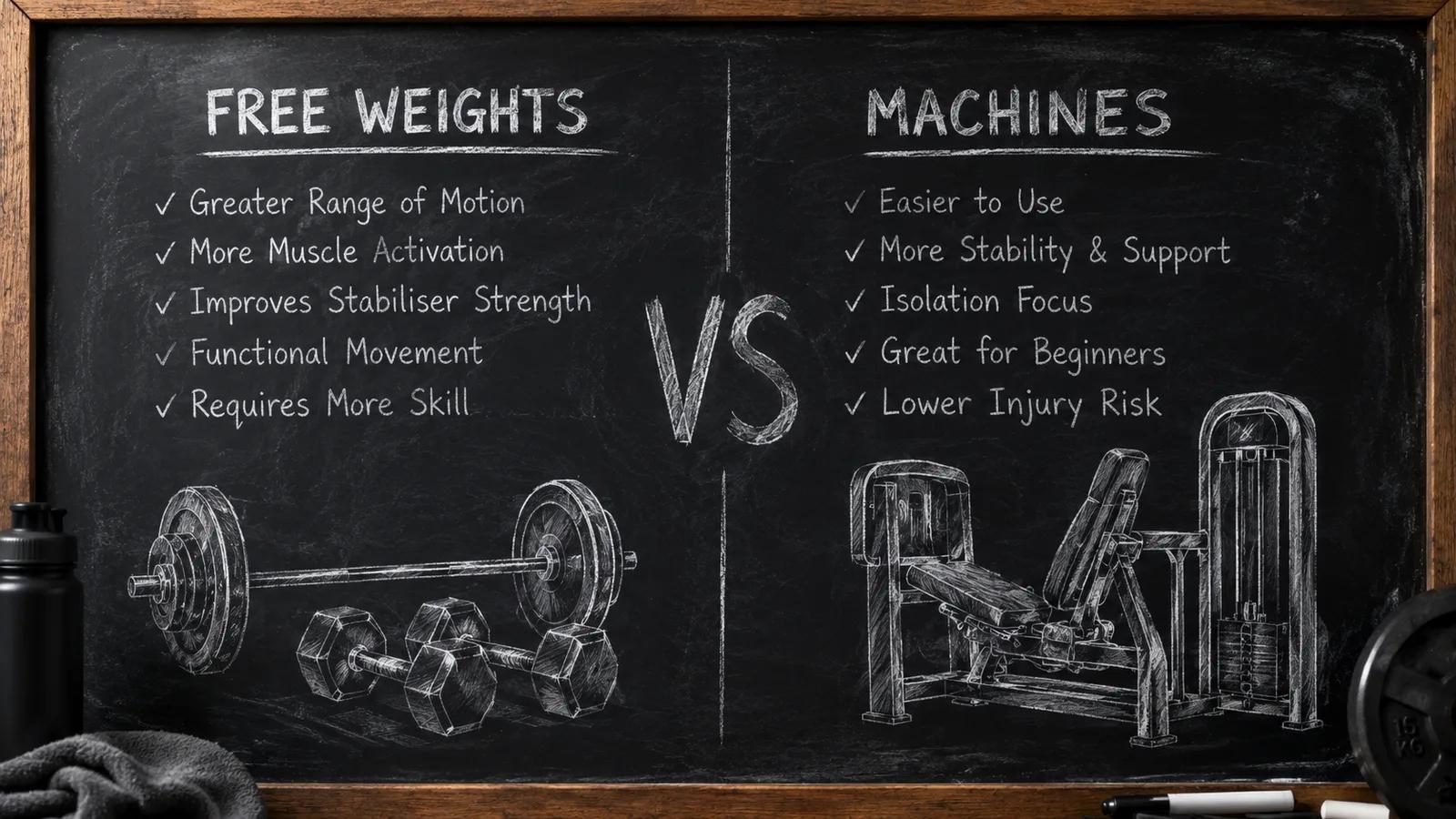
Free weights vs machines is the wrong fight. When training volume and effort are matched, the research finds similar muscle growth from both, so the smart question is not which one wins, it is which tool does which job and how you combine them. I get asked this on our floor most weeks, and the honest answer is rarely the one people are hoping for.
I am Dr Matt Walley, and my wife Elise and I built Inception Gym in Christchurch in 2022. I stocked our floor with both a serious free weight area and 43 plate-loaded machines on purpose, because after years of coaching I stopped believing either camp had the whole answer.
Key takeaways
- Match volume and effort, and free weights and machines grow muscle at similar rates.
- Free weights win on transferable strength, coordination, and stabiliser recruitment.
- Machines win on safe intensity near failure, isolation, and constant tension.
- The best programmes use compounds as the foundation and machines as targeted tools.
- Progress is real only if you measure it, which is why our members get free body scans.
What free weights actually are
Free weights are any implement that moves freely through space: barbells, dumbbells, kettlebells, trap bars. The load is not guided by a track or pivot, so your muscles have to control it in several directions at once. The squat, deadlift, bench press, overhead press, and row have anchored strength programmes for over a century because they work.
What machines actually are
Machines are resistance equipment with a fixed or guided movement path. Pin-loaded machines use a weight stack and a pin. Plate-loaded machines take standard weight plates on a loading post. Cables sit in between, guiding the line of resistance while still letting you vary the angle. Leg press, lat pulldown, chest press, leg extension, leg curl, seated row, and pec deck are the everyday examples.
The case for free weights
Free weights earned their reputation, and I am not about to argue with a century of results.
Coordination and neuromuscular demand
When you squat a barbell, you are not just loading quads, hamstrings, and glutes. You are recruiting stabilisers through the hips, core, and upper back to keep the bar path honest. That demand trains your nervous system, not just your muscle fibres, and over time it builds strength that transfers to sport and daily life.
Range of motion built around you
Free weights let you move through a range of motion that suits your own structure. A tall member with long femurs squats differently to a shorter one, and a barbell lets both find a stance and depth that fits. Plenty of machines are built around an average body that does not match everyone who sits in them.
Versatility
A barbell and a rack of dumbbells cover hundreds of exercises. For varying your stimulus without owning dozens of machines, nothing matches free weight versatility.
The case for machines
If free weights were simply better at everything, no serious gym would spend a cent on machines. Every high-level bodybuilder and strength coach I respect uses them heavily, and that tells you plenty.
Isolation without compensation
Machines isolate a target muscle far better than a compound lift can. Take the leg extension against the squat. The squat is brilliant, but it shares the load across hamstrings, glutes, and stabilisers. If your quads specifically are lagging, the leg extension delivers loading the squat cannot replicate. Same logic for a lagging chest with a pec deck instead of hoping the bench catches up.
Safer intensity near failure
As you approach failure, free weights get dangerous. A missed barbell bench can end with the bar on your throat without a spotter or pins. A missed rep on a plate-loaded chest press is just a missed rep. Since proximity to failure is one of the strongest drivers of hypertrophy, being able to push hard safely is a real advantage.
Learning curve
Free weight lifts carry a genuine technical learning curve. The squat, hinge, and press need months of practice before you can load them heavily enough to matter. Machines let a beginner train with meaningful load immediately, in a guided environment, while the movement patterns are still being built.
Constant tension
Cable and plate-loaded designs often hold resistance through the whole range. A dumbbell curl peaks at the mid-point and loses tension top and bottom, while a cable curl keeps tension the whole way. For pure hypertrophy, tension across the full range is worth having.
What does the research actually say?
More nuanced than the internet wants it to be. Studies comparing matched free weight and machine protocols keep finding similar hypertrophy when volume and effort are equated. The muscle does not know whether the resistance comes from a barbell or a guided track; it only knows it is being challenged.
Where free weights consistently pull ahead is transfer to strength performance and coordination. Where machines pull ahead is getting you close to failure safely. For pure muscle growth, a well-programmed combination of both beats either one alone.
The debate ends the moment you stop choosing sides and start using everything on the floor with intent.
How I actually program it
Here is my first genuine bias, earned on the floor rather than from a textbook. I have watched too many capable lifters spend their first year religiously avoiding machines because a forum told them machines were for the timid. They arrived at month twelve with respectable barbell numbers and a physique full of gaps, because they never once loaded a lagging muscle in isolation. The barbell purists cost themselves a year of targeted growth to win an argument nobody was judging.
The flip side is just as real. My second bias: the members who live entirely on machines almost always plateau on total strength, because they never ask their body to stabilise anything. They can leg press a house and still wobble under a moderate front squat. Both extremes are leaving results on the table for the sake of an identity.
A programme I would happily put my name to looks like this.
Foundation: compound free weight movements
- Barbell squat or Romanian deadlift for the posterior chain
- Barbell or dumbbell bench press for chest and shoulders
- Bent-over row or dumbbell row for back thickness
- Overhead press for shoulder development
These build the most mass per unit of time and lay the neuromuscular foundation everything else sits on. We keep 2 squat racks on the floor and I am deliberate about that number, because honest specs matter more than a marketing figure.
Targeted volume: machine and cable isolation
- Leg extension and leg curl to hit quads and hamstrings directly
- Cable crossover or pec deck for chest isolation with constant tension
- Lat pulldown and cable row for back width and detail
- Cable or machine lateral raises for shoulder width
These let you push specific muscles harder, closer to failure, more safely.
Sequencing
Compounds early, when your nervous system is fresh and your technique is sharp. Machine and isolation work later, when accumulated fatigue makes heavy free weight work less productive and more risky. You can read more on this in my plate-loaded machines guide and on picking between the big leg movements in hack squat vs leg press.
What we built at Inception
Our floor carries 92 machines across 72 variants, 43 of them plate-loaded, alongside a full free weight area with dumbbells up to 70kg, inside 800 sqm. The depth is deliberate: I wanted a facility where any sensible methodology works without compromise.
My third genuine observation from running the place: the plate-loaded machines are the quiet heroes for two groups I did not fully anticipate. The first is members chasing progressive overload who love the feel of loading real plates without the balance tax of a free barbell. The second, and this one I care about most, is members returning from injury. A plate-loaded machine lets them rebuild strength in a controlled groove long before they are ready to trust a loaded bar again, and I have watched that controlled path bring people back who would otherwise have quietly stopped training. If you are working around something, my notes in training around injuries go deeper.
If you want to see the full inventory before you commit, the equipment list lays out exactly what is on the floor.
Practical recommendations
Beginner. Mix compound machine movements (leg press, lat pulldown, chest press) with lighter free weight work while you build technique. The machines give you a proper stimulus while the patterns come together.
Intermediate. Compound free weights are your primary stimulus, machines are accessory volume. Get your squat, hinge, push, and pull strong, then use machines to address weak points.
Advanced. You already know this. Periodise your free weight intensity, use machines to extend sets safely, and treat isolation as the finishing layer, not the foundation.
Training around an injury. Machines are often the smarter short-term choice. They hold strength and volume in a controlled range while you heal, and cut the stabilisation demand that might aggravate the problem.
Tracking whether it is working
Whichever way you lean, progress only counts if you measure it. Every Inception member gets free body composition scans that show muscle mass changes over time, which is the real signal. Scale weight alone is a notoriously unreliable proxy for muscle, and the scan replaces guesswork with data.
The bottom line
Free weights build foundational strength, recruit stabilisers, and transfer to real performance. Machines allow safe intensity, effective isolation, and consistent tension through the range. Both are essential; neither is sufficient alone. The question was never free weights vs machines, it is how to use each with intent inside a programme built around your goals.
At Inception you get both in the depth to do exactly that, backed by a 5.0 rating across 1,090+ Google reviews. Book a free trial and put both to work, or view membership options to get started. Stop choosing sides, and start using everything available to you.