Equipment · Chest
Incline Chest Press: Building the Upper Chest with Machines and Free Weights
The right incline chest press angle is 30 to 45 degrees, not steeper. I break down upper chest anatomy, barbell versus machine pressing, and how I programme it at Inception Gym Christchurch.
By Dr Matt Walley · 15 March 2025
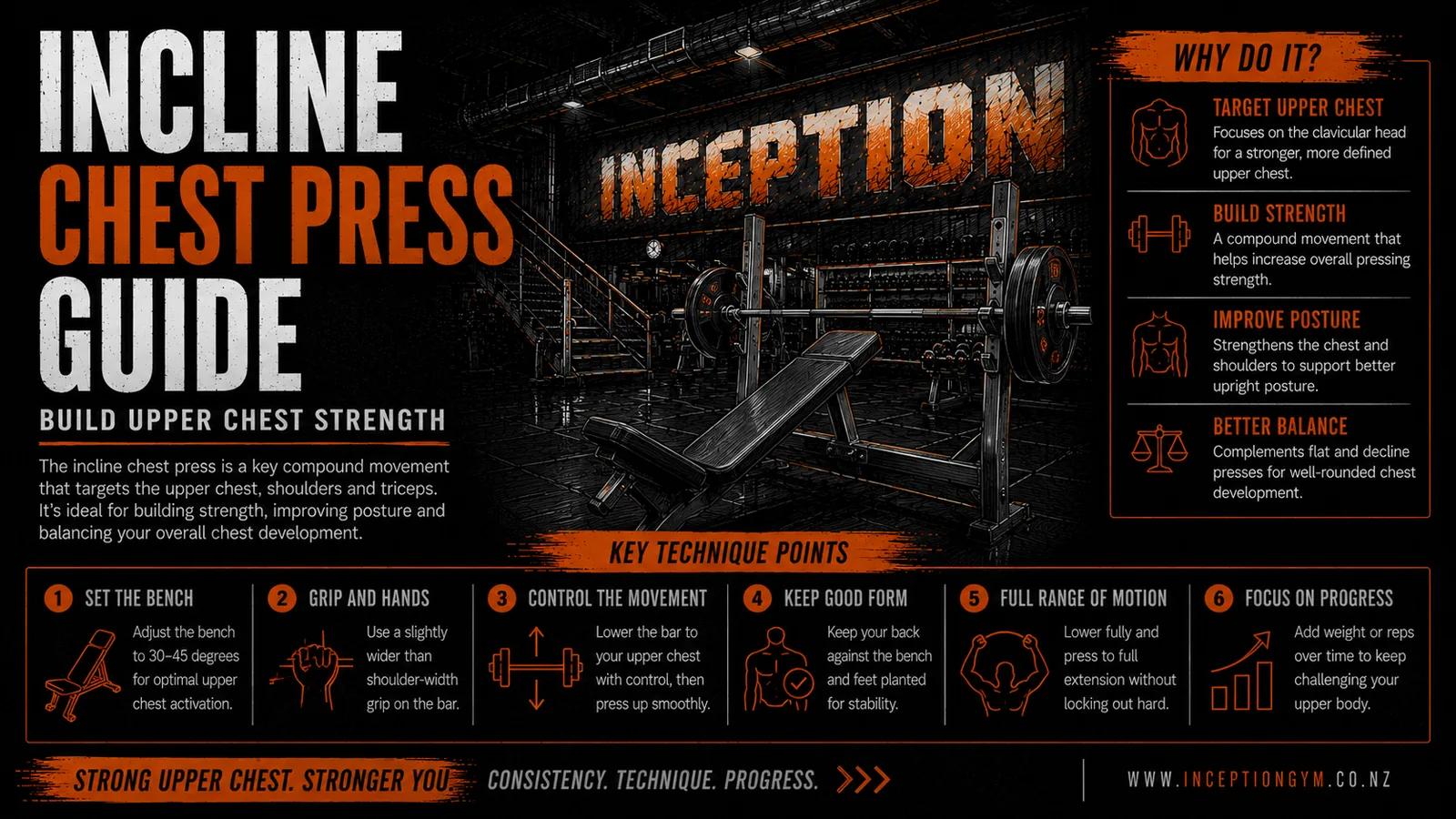
Set your incline chest press between 30 and 45 degrees, start at 30, keep your elbows 45 to 75 degrees from your torso, use a full range of motion, and do most of your working sets in the 8 to 15 rep range. That is the honest short answer to the question I get asked more than almost any other on our training floor.
I am Dr Matt Walley, and my wife Elise and I have run Inception Gym in Addington since 2022. The upper chest is one of the most visually defining areas of the physique and one of the most stubborn to build. You can bench press for years and still have a chest that looks complete from the front but lacks fullness across the clavicular region. This guide covers the anatomy, the angle question, barbell versus machine pressing, and how the equipment at Inception Gym supports it.
Key takeaways
- The upper (clavicular) pec has its own fibre direction, so incline pressing trains a genuinely different region, not just a bench variation.
- 30 to 45 degrees is the useful window. Steeper turns the lift into a front-delt movement.
- A well-designed plate-loaded incline machine builds the correct angle into its geometry, so you cannot set it wrong.
- Match your pressing volume with pulling volume, and progress the load without shrinking the range.
Why does the incline angle matter for upper chest?
The pectoralis major is not a single-function muscle. It has two heads with different fibre orientations and different jobs.
The clavicular head (upper pecs) originates along the medial clavicle and inserts into the humerus. Its primary functions are shoulder flexion, horizontal adduction and medial rotation. The fibres run downward and outward from the collarbone.
The sternocostal head (lower and mid pecs) originates along the sternum and ribs and covers most of the visible chest.
For the clavicular head to be preferentially recruited, the line of force has to align with those fibre directions. A flat press loads the sternocostal fibres. An inclined press, with the arms driving upward, aligns with the clavicular fibres and pulls more work into the upper pecs. Incline pressing is not a flavour of flat pressing. It targets a different part of the muscle.
The angle question
The incline angle changes which fibres are emphasised, and the popular gym advice here has usually been wrong.
Common mistake: too steep an incline
The most common error I see people make is setting the bench too steep, above 45 degrees and creeping toward vertical. At those angles the movement shifts from chest-dominant to shoulder-dominant. The front deltoid becomes the primary mover and clavicular pec recruitment actually drops compared with a more moderate angle.
If you have been pressing at a steep angle and wondering why your upper chest is not responding, the angle is almost certainly the culprit. This is the single most common fix I hand out on the floor.
The useful range: 30 to 45 degrees
Research on pec activation across incline angles generally supports 30 to 45 degrees for maximising clavicular pec activation while limiting the shift toward shoulder dominance. Within that range, anatomy matters. Lifters with a larger pec attachment, longer clavicles or different shoulder proportions may find a slightly different angle suits them.
My recommendation: start at 30 degrees. Train there for several weeks and assess whether you feel the upper chest distinctly. If it feels too flat, nudge up to 35. Do not go above 45 for upper chest work.
Why machine angles are often right out of the box
Well-designed plate-loaded incline press machines have the press angle built into the geometry. The arc of the handles, the seat rake and the position of the weight all correspond to a correctly angled incline press.
The honest advantage of a good incline machine over an adjustable bench is simple: you cannot set the angle wrong. The machine holds you at the angle its engineers already got right.
That is a real edge for anyone still learning where their upper chest lives.
Barbell incline press: strengths and limitations
The barbell incline press is the classic compound for upper chest development. Loaded on a bench at the correct angle, it is effective and proven.
Strengths
- Loading capacity. A barbell lets you load heavy, which matters for progressive overload over time.
- Full pectoral stretch. With the bar at the chest, the pecs are stretched under load, and that loaded stretch drives a strong hypertrophic stimulus.
- Bilateral demand. Both hands grip one bar, so strength imbalances show up quickly.
Limitations
- Wrist, elbow and shoulder stress. The fixed wrist position bothers some lifters, particularly with wrist inflexibility or a history of shoulder impingement. The bar cannot rotate to accommodate natural wrist travel.
- Shoulder position at lockout. At the top the elbows lock and the shoulder sits in a position some people find uncomfortable, especially with a close grip.
- Spotter requirement. Heavy barbell pressing without a spotter carries risk that machine pressing does not.
- Setup complexity. Unracking and reracking on an incline takes care, particularly when you train alone, which plenty of our 24/7 members do.
Plate-loaded incline press machines
Inception Gym has two plate-loaded incline chest press machines, and they differ from the barbell in a few ways that matter.
Rotating handles
Quality plate-loaded incline machines have handles that rotate through the press arc, letting your wrists find their natural position throughout the movement. That removes the fixed-wrist stress of the barbell and is far kinder to sensitive wrists.
Convergent press path
Many of our plate-loaded machines have a convergent path, meaning the handles move toward each other as you press. That mirrors dumbbell pressing and produces a stronger pec contraction at the top than a barbell allows, where the hands cannot converge. You get a loaded stretch at the bottom and a real squeeze at the top.
Independent arm movement
Some plate-loaded incline machines run each arm independently. That stops your dominant side carrying the weaker one and ensures both are equally challenged. Independent arms also allow a slight torso rotation into each rep, adding range through the chest. When I am watching someone with a lopsided bench, this is where I send them.
Training to failure safely
On a machine with a safety stop, training to muscular failure or near-failure is safer than on a barbell. That lets you chase higher-intensity sets without the risk of a failed barbell rep pinning you.
Dumbbell incline press: the middle option
Between the barbell and the dedicated machine sits the dumbbell incline press. Dumbbells give you wrist freedom, a natural hand position, and let the arms converge at the top, plus a loaded stretch through the bottom.
The trade-off is the awkward setup at heavier weights and the stabilisation demand, which can cap the absolute load you use compared with a machine. With dumbbells up to 70kg at Inception Gym, the dumbbell incline press is a genuinely practical option, particularly for moderate sets in the 8 to 15 rep range.
If you want to understand where machines earn their place against free weights more broadly, I go deeper in free weights versus machines and in the chest training machine guide.
How should you programme incline pressing?
Volume
The clavicular head responds to progressive volume within a recoverable range. For most trained lifters, 12 to 20 sets per week for chest is a reasonable target, with a meaningful share on upper chest work. I unpack weekly set targets properly in the training volume guide.
A chest session with both flat and incline pressing might look like this.
Session A (upper chest priority):
- Plate-loaded incline press: 4 sets of 8 to 10
- Flat bench press (barbell or machine): 3 sets of 8 to 10
- Cable fly (low to high, upper chest emphasis): 3 sets of 12 to 15
- Dips (slight forward lean for chest focus): 3 sets of 10 to 12
Session B (lower and mid chest priority, incline maintenance):
- Flat bench press: 4 sets of 6 to 8 (strength focus)
- Plate-loaded incline press: 3 sets of 10 to 12
- Pec deck or cable fly: 3 sets of 12 to 15
Rotating priority across sessions keeps both regions of the pectorals developing in proportion.
Rep ranges
Upper chest hypertrophy responds well to moderate rep ranges. Work mostly in the 8 to 15 range on incline pressing, with occasional heavier sets in the 5 to 8 range for strength maintenance.
Incline presses also respond to higher-rep sets at 15 to 20, particularly on machines where failure is safe. Those sets create metabolic stress and time under tension that add to the mechanical tension from your heavier work.
Progressive overload
Consistent progress needs progressive overload. On the plate-loaded incline machine, track the plate load and rep count each session. When you complete every rep across every set with controlled technique and a full range, add weight next time.
Do not buy that weight with range of motion. A partial rep at a heavier load does not train the upper chest better than a full range at a lighter one. It just flatters your logbook.
Common mistakes
- Flaring the elbows too much. Elbows flared 90 degrees from the torso stress the shoulder joint. A 45 to 75 degree flare is friendlier and still loads the pec.
- Bouncing off the chest. A controlled touch or slight pause with a full stretch beats a bounce for both hypertrophy and shoulder health.
- Shortening the range. Stopping short of full extension removes the contraction. Reach full extension without hyperextending the elbows.
- Neglecting scapular position. Keep the shoulder blades retracted and slightly depressed throughout. Let them protract as you press and you shift load onto the shoulders.
Connecting chest training to the rest of your programme
Upper chest development does not happen in isolation. It sits inside a balanced upper body programme that also addresses back, shoulders and arms in proportion. The rule I hold people to is simple: match your pulling volume to your pushing volume, so every set of incline pressing is balanced by an equivalent set of rowing or pulling.
At Inception Gym our back and pulling equipment sits right alongside the chest pressing options, so building balanced upper body programming is easy. If you want a set of eyes on your technique and a plan built around your goals, our personal training team in Christchurch does exactly that, and every member gets a free body composition scan to track whether the work is actually adding tissue.
Related guides: cable crossover exercises, Smith machine exercises.
The best way to feel the difference between a well-angled machine and a badly set bench is to press on one. Come and try both. Book a free trial, find our two plate-loaded incline machines on the floor at Tower Junction, 65 Blenheim Road, Addington, and I will happily point you to the right angle for your build.
---
Inception Gym has two plate-loaded incline chest press machines alongside a full range of chest training equipment, dumbbells up to 70kg, and 24/7 member access. We hold a 5.0 rating across 1,090+ Google reviews. Tower Junction, 65 Blenheim Road, Addington, Christchurch. [Explore all equipment](/facilities/equipment) or [see membership options](/memberships).