Equipment · Machines
Smith Machine Exercises: 12 Movements I Program on Our Floor
Dr Matt Walley on 12 Smith machine exercises that actually earn their place: technique cues, when to use the Smith machine over free weights, and how I use it at Inception Gym Christchurch.
By Dr Matt Walley · 27 November 2024
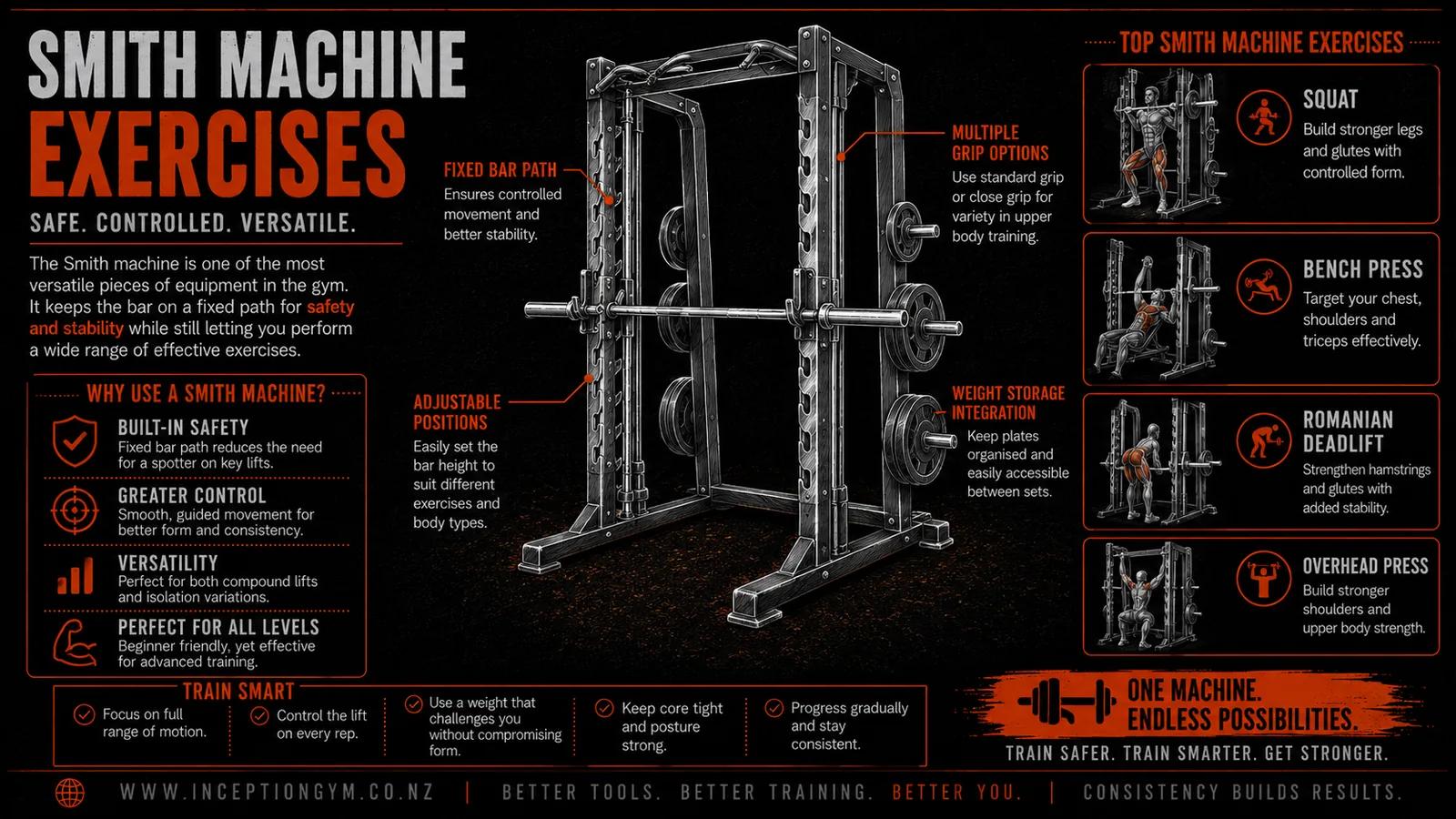
The Smith machine is a specialised tool, not a crutch. Used well, these 12 Smith machine exercises let you train quads, glutes, chest, and back to genuine failure without a spotter, and load isolation work harder than a free barbell safely allows.
I am Dr Matt Walley, and I co-founded Inception Gym Christchurch with my wife Elise in 2022. I am on our floor most days, and I watch how members actually use the Smith machine. The purists dismiss it as a beginner's toy. The people who lean on it for everything miss its real value. Both are wrong, and I will show you exactly where it earns its keep.
Key takeaways
- The Smith machine's fixed bar path removes stabiliser demand: a trade-off, not a flaw.
- Its single best use is pressing to failure alone, because you can rack the bar at any point.
- It shines for quad-biased squats, hip thrusts, calf raises, and heavy isolation.
- Free weights still win for conventional deadlifts, overhead squats, and true full-body coordination.
- Our 800 sqm floor carries the Smith machine alongside 92-plus machines and two squat racks, so you never have to choose one tool for everything.
What does a Smith machine actually do?
A Smith machine is a barbell fixed to vertical rails that guide the bar through a linear, sometimes slightly angled, path. Safety hooks let you rack the bar at any point in the range of motion. The counterbalanced bar on ours sits well under a standard 20kg Olympic barbell, so factor that in when you compare loads.
The fixed path removes the stabilisation demand of a free weight movement. It also means the bar cannot deviate to follow your natural joint mechanics. That is the whole trade-off in one sentence: less stabiliser work, more predictable and controllable loading.
The Smith machine is not a lesser barbell. It is a different tool, and the lifters who get the most from our floor are the ones who stop arguing about it and start using it for the four or five things it does better than anything else.
Here is my first genuine bias, formed from years of watching people train: most lifters who dismiss the Smith machine have never used it for its actual strengths. They tried to conventional-deadlift on it, felt the bar fight their hips, and wrote the whole thing off. That is like judging a leg press by trying to snatch with it.
12 Smith machine exercises worth programming
1. Smith machine squat
The Smith machine squat lets you set your feet slightly in front of your body rather than directly under the bar. That forward foot placement shifts more load onto the quads and takes some strain off the lower back.
- Technique: Feet 15 to 30cm in front of the bar, about shoulder-width apart. Chest up, descend to at least parallel, drive through the heels. Because the bar path is fixed, you can pour everything into leg drive.
- Best for: Quad-biased training, lifters managing a cranky lower back, learning squat mechanics early.
2. Smith machine Romanian deadlift
The Romanian deadlift here targets hamstrings and glutes through a hip hinge, with the fixed path keeping coordination demands low so you can load it and chase the stretch.
- Technique: Feet hip-width, bar against the thighs. Hinge at the hips, push them back, lower the bar down the legs. Flat back, feel the hamstrings lengthen, then drive the hips forward to stand.
- Best for: Hamstring and glute work, lifters new to the RDL pattern, training close to fatigue without a spotter.
3. Smith machine bench press
This is the exercise I point people to first. Benching to failure on a free barbell without a spotter is a gamble most lifters take reluctantly. On the Smith machine you rotate your wrists and the hooks catch the bar, so pushing to a genuine last rep alone is safe.
- Technique: Set the bench so the bar path meets your mid-chest. Grip slightly wider than shoulders, lower under control, press. Position the bench carefully so your natural pressing arc lines up with the bar's linear path.
- Best for: Solo training to failure, building pressing volume safely, beginners grooving the press.
4. Smith machine incline press
Incline pressing hits the upper chest and front delts. The Smith machine lets you dial the angle in and push hard without a spotter watching the bar.
- Technique: Bench at 30 to 45 degrees, positioned so the bar meets your upper chest. Same rules as flat: controlled descent, full range, drive at the top.
- Best for: Upper chest development inside a complete chest programme, solo work.
5. Smith machine shoulder press
Overhead is where the fixed path matters most as a consideration. A strictly vertical bar path does not perfectly match the natural arc of a press, so some people find it uncomfortable. A bar with a slight backward angle, or careful positioning, sorts most of that out.
- Technique: Shoulder-width grip, bar at the top of the chest. Press to full lockout, lower under control. If the wrist or shoulder complains, shift your foot and hip position relative to the bar to find cleaner alignment.
- Best for: Shoulder work when a heavy dumbbell press is impractical, training to failure alone.
6. Smith machine bent-over row
The Smith machine row lets you lock into a hinge and think only about the pull, without policing bar balance the way a free barbell row demands.
- Technique: Feet hip-width, hinge to roughly a 45-degree torso angle, grip at shoulder width, pull to the lower chest. Drive the elbows back and squeeze the shoulder blades together at the top.
- Best for: Back development, high-rep rowing where fatigue makes free weight balance a fight.
7. Smith machine reverse grip row
Flip to a supinated grip and you shift emphasis from upper back and rear delts toward the lower lats and biceps. This variation is awkward to load on a straight barbell because of the grip and wrist demands.
- Technique: Set up as for the bent-over row, but rotate to an underhand grip. Pull to the upper abdomen rather than the lower chest.
- Best for: Lower lat development, grip variety, elbow comfort for lifters the supinated grip suits.
8. Smith machine hip thrust
The hip thrust is a primary glute builder, and the Smith machine gives you a stable bar so you can focus entirely on the drive instead of wrestling a rolling barbell into place.
- Technique: Upper back on a bench, feet flat, bar across the hip crease with a pad. Drive the hips to full extension, squeeze the glutes hard, lower under control.
- Best for: Glute development, anyone who has fought to stabilise a free barbell hip thrust.
9. Smith machine split squat
The Bulgarian split squat is one of the best single-leg movements there is. The Smith version lets you pour effort into leg drive without also balancing a free barbell on a narrow base.
- Technique: Rear foot on a bench, bar across the upper back. Lower until the rear knee nearly touches the floor, then drive through the front heel.
- Best for: Single-leg strength, fixing left-right imbalances, when heavier loads make free weight split squats impractical.
10. Smith machine calf raise
The standing calf raise is the most natural Smith movement of the lot. The vertical bar path lines up perfectly with the calf raise pattern.
- Technique: Balls of the feet on a raised surface, a plate works well, bar across the upper back. Drop the heels as far as you can, rise to full plantar flexion, hold the top.
- Best for: Calf development. Here the Smith machine is unambiguously the right tool.
11. Smith machine good morning
The good morning is a hip hinge that loads hamstrings, glutes, and lower back through a demanding range. The Smith version gives you controlled loading and the safety of racking at any point.
- Technique: Feet hip-width, bar across the upper back. Hinge forward with a flat back until the torso is roughly parallel to the floor, then drive the hips forward.
- Best for: Posterior chain work, building hip hinge strength, supplementing deadlift and squat work.
12. Smith machine shrug
Trap work through the shrug is well served here, letting you focus on the vertical movement with no balance or positioning distraction.
- Technique: Stand inside the machine, bar at hip height. Grip, stand tall, shrug the shoulders straight up toward the ears. No rolling. Lower under control.
- Best for: Upper trap development inside a complete back and neck programme.
When is the Smith machine the right choice?
- Training without a spotter. Any press taken near failure is safer on the Smith machine. Racking at any point removes the risk of a failed rep with no way out. This is the single reason I would defend the machine to anyone.
- Isolation where stabilisation is not the point. If you are trying to overload one muscle, taking stabilisers out of the equation lets you load the prime mover harder.
- Injury or mobility limits. The fixed path lets you modify movements to keep training volume around a limitation: a squat foot position that spares the back, a press angle that dodges impingement.
- Beginners learning a pattern. Removing the balance challenge lets a newer lifter groove the primary mechanics first, then add complexity.
Here is a bias I hold that goes against a lot of gym-floor orthodoxy: I would rather see a nervous beginner build twelve confident weeks of Smith machine squats and presses than have them intimidated away from the rack entirely. Confidence compounds. A pattern learned without fear transfers to the free barbell later. Many of the people who now train hard in our free weight area started exactly there, and I have watched that path play out on our floor since 2022.
When are free weights the better choice?
The Smith machine is not the answer for everything, and I will not pretend otherwise. Movements that depend on a natural, shifting bar path, the conventional deadlift and the overhead squat, exercises where full-body coordination is the actual training goal, and any lift where the fixed path fights your individual mechanics are all better on free weights.
A good programme uses both. I build my own training around free weights for the heavy compound strength work, where stabilisation and natural mechanics matter, and reach for the Smith machine for volume and isolation. If you want the wider picture on that decision, I wrote a longer piece on free weights versus machines, and our plate-loaded machines guide covers the heavy-yet-fluid gear that fills the gap between the two.
The Smith machine inside a complete floor
Our gym at Tower Junction, 65 Blenheim Road, Addington runs 92-plus machines across 72 variants, 43 of them plate-loaded, alongside dumbbells to 70kg and two squat racks, all inside an 800 sqm purpose-built floor. The Smith machine sits within that full free weight and machine setup, not as a substitute for it. That is the point: on our floor you never have to make one tool do a job it was not built for.
We are open 24 hours, 7 days, 365 days a year, so you can train the way that suits you, spotter or no spotter. If you want a hand programming any of these movements, our team is on the floor during staffed hours and happy to talk technique. That is also part of why we hold a 5.0 rating across 1,090+ Google reviews: people get looked after here.
Come and use it
Related guides: the incline chest press guide, shoulder training machines.
If you want to try these 12 exercises on our own machine, claim a free trial at Inception Gym and I will make sure someone shows you around the floor. Prefer to walk in with a plan built around your body first? Book a free body composition scan and we will train from real numbers, not guesswork.