Equipment · Chest
Every chest machine at Inception Gym: a training guide
I walk you through every chest press machine at Inception Gym Christchurch, flat to incline to cable crossover, and how to programme each for real chest growth.
By Dr Matt Walley · 3 August 2025
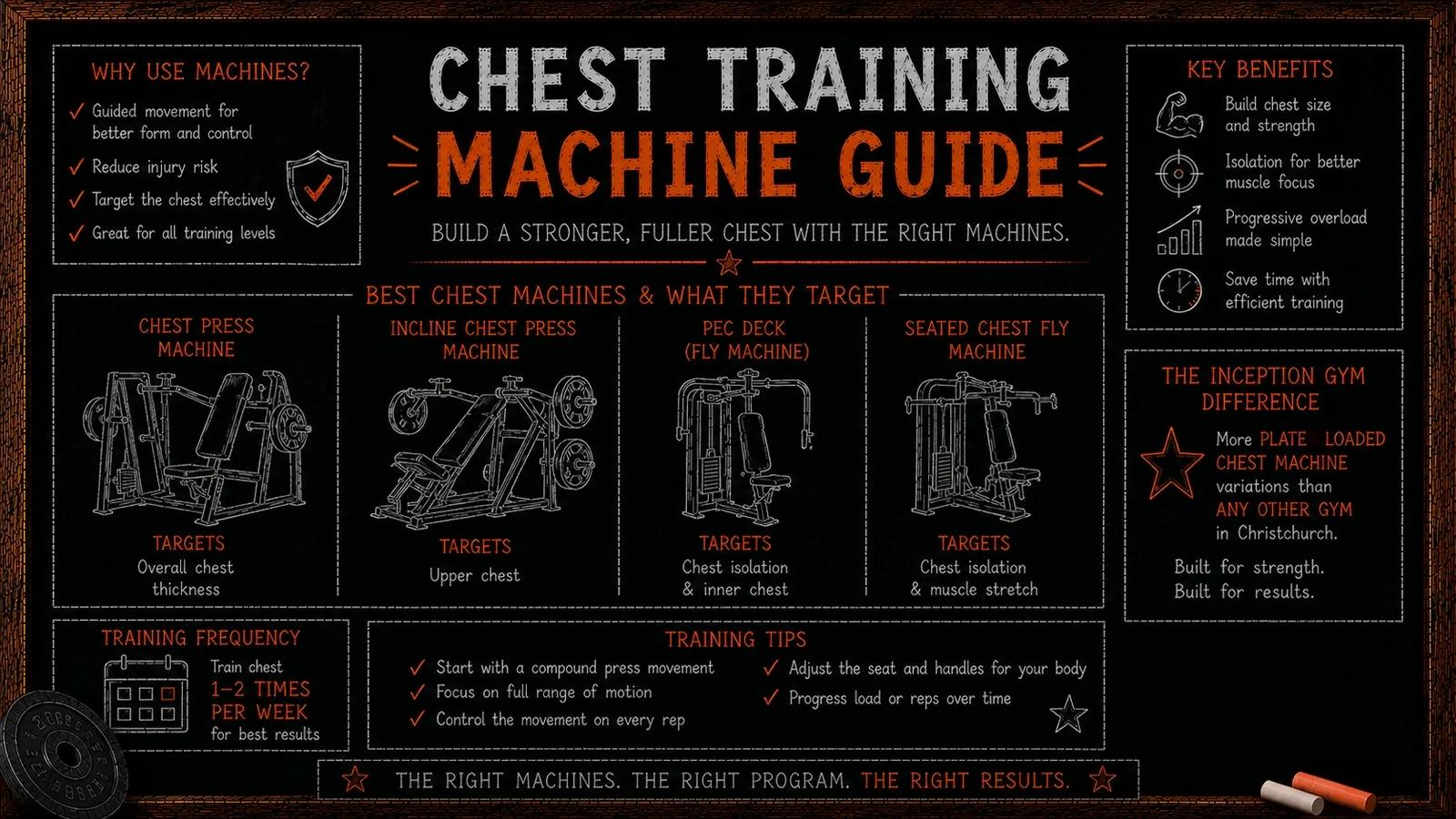
The best chest machine setup trains the pec major across every angle: flat, incline, and decline pressing for mass, plus fly work for isolation. At Inception Gym Christchurch we run all of it, plate-loaded and pin-loaded, so you can build a complete chest without ever queuing for a single bench.
I am Matt, and I co-founded Inception Gym with my wife Elise in 2022. I am on the floor most days, and the chest line-up is one I specced myself. Here is exactly what we have, what each chest machine targets, and how I would programme it.
Key takeaways
- A complete chest programme needs flat, incline, and decline pressing plus fly work. No single machine covers it.
- Plate-loaded presses have no stack ceiling, so you keep loading as you get stronger.
- The pec deck and cable crossover isolate the chest without the triceps stealing the work.
- We keep multiple copies of the popular chest pieces, so the floor rarely bottlenecks.
Why does machine-based chest training work?
For decades the bench press was treated as the only chest exercise worth talking about. Barbell, dumbbells, and that was largely the conversation. The science of hypertrophy has moved on, and so has my thinking about what actually drives chest growth.
The pectoralis major responds best to training across a full range of motion, loaded hard at the stretched position, hit from multiple angles, with enough volume to force adaptation. No single exercise does all of that. A good chest programme mixes free-weight pressing with machine work to cover every angle and maximise the growth signal.
At Inception Gym Christchurch the chest machines cover flat, incline, decline, and fly movements in both plate-loaded and cable configurations, so a full multi-angle session is possible without waiting on one bench.
The pec deck is the most underrated machine on our floor. If I could only keep one isolation piece for chest, it would be that, no contest.
Chest anatomy, quickly
A short primer so you train with intention rather than going through the motions.
Pectoralis major, sternal head. The large lower portion, responsible for most chest mass. Best stimulated by flat and slight decline pressing plus mid-range cable work.
Pectoralis major, clavicular head. The upper chest, running from the collarbone. Targeted by incline pressing and upward cable movements. Usually under-developed because flat pressing alone neglects it.
Pectoralis minor. Sits under the pec major, not visible, but important for shoulder stability and posture.
Serratus anterior. Often ignored. Runs along the ribcage and protracts the shoulder blade. A full lockout on a machine press, where you let the shoulder blades travel forward, helps develop it.
These distinctions are why varying angles is not variety for its own sake. Different angles shift tension between portions of the muscle that simply cannot all be maximally trained from one position.
Flat chest press machines
Plate-loaded flat chest press
Often the best place to start a chest session. With no stack ceiling you can load it to your real pressing capacity and keep adding plates as you get stronger. This is one of my personal favourites, and it is why 43 of our 92-plus machines are plate-loaded: I never wanted a member to hit the top of a pin stack and stall.
Targets. Sternal head of the pec major primarily, with anterior deltoid and triceps assisting.
How to use it. Set the seat so your hands sit at roughly mid-chest height on the handles. Retract your shoulder blades and hold that retraction the whole set. Press to a full lockout without losing chest tension, then control the descent into a full stretch.
Programming. Use this as your primary chest exercise on days you are not barbell benching. 4 sets of 6 to 10 reps with progressive load works well.
Seated chest press, pin-loaded
Ideal for higher-volume work, drop sets, and training close to failure where fast weight changes help.
Targets. Same primaries as the flat press, with a slightly more upright torso on most machines nudging emphasis toward the upper sternal and clavicular fibres.
Programming. Sets of 12 to 20 reps as a second or third movement. Also handy for mechanical drop sets.
Incline chest press machines
Plate-loaded incline press
Upper chest is where most members fall short. The clavicular head needs incline pressing, and the plate-loaded version lets you load it as heavily as your strength warrants. When I built the chest area I put the incline pieces front and centre for exactly this reason.
Targets. Clavicular, upper head of the pec major, with more anterior deltoid than flat pressing.
How to use it. The angle is usually fixed at 30 to 45 degrees. Set the seat so your hands grip at upper chest or lower collarbone height. Press in a straight line without flaring the elbows excessively, which dumps load onto the front delts.
Programming. If your upper chest lags, do this first while your nervous system is fresh. 3 to 4 sets of 8 to 12 reps.
Seated incline press, pin-loaded
Same incline pattern with faster adjustments. Useful when training with a partner on a different weight.
Decline chest press and dips
Decline chest press machine
The decline angle shifts emphasis to the sternal and lower pec, and often lets you move more weight than flat or incline thanks to the mechanical advantage.
Targets. Lower sternal fibres of the pec major.
Programming. Decline completes a three-angle pressing approach: incline, flat, decline. Not every session needs all three, but including decline work keeps the lower chest from lagging.
Assisted dip machine
The dip is one of the best lower chest movements there is. On the assisted machine a counterweight partly supports your bodyweight, so it works at any strength level.
Targets. Lower pec major, triceps, anterior deltoid.
How to use it. Lean forward slightly to bias the chest over the triceps. Descend until you feel a chest stretch, then press back up. The forward lean is the whole cue; stay upright and this becomes a triceps exercise.
Programming. A finisher or a primary movement. Vary the assistance to target different rep ranges.
Fly machines and pec deck
Pec deck
The pec deck isolates the pec major without meaningful triceps or deltoid help, so you can train the chest directly to fatigue. Watching newer members, this is the piece where the penny drops on what a chest contraction actually feels like, because nothing else is doing the work for them.
Targets. Pec major across the full range, with emphasis on adduction, bringing the arms across the body.
How to use it. Set the pad so your elbows and upper arms sit at shoulder height. The movement is an arc, not a press. Lead with the elbows or forearms depending on the design, and squeeze at the contracted position. Do not let the elbows drift behind your torso, which stresses the shoulder.
Programming. Excellent as a finisher or a pre-exhaustion movement. 3 sets of 12 to 20 reps. The burn at higher reps is the direct chest stimulus.
Cable fly, low, mid, and high pulley
The cable crossover lets you fly from multiple angles by moving the pulley. One of the most versatile chest tools we have.
Low pulley fly. Targets the upper and clavicular pec. Great for the upper chest shelf.
Mid pulley fly. Targets the mid sternal region. Closest to the classic dumbbell fly.
High pulley fly. Targets the lower sternal and lower chest. The cable holds continuous tension through the arc, unlike dumbbells, which lose tension at the top.
How to use it. A fly is an arc, not a press. Keep a slight, fixed bend in the elbows. The movement comes from the shoulders. Feel the stretch at the start and the squeeze at the finish.
Programming. Cable flies add volume and variety without much joint stress. They work well as finishers or supersetted with pressing. If you want to go deeper on cable work, I broke it down in the cable crossover exercises guide.
How do I programme a chest session?
A good chest session usually runs three movements:
- One heavy press (plate-loaded flat or incline): 4 sets of 6 to 10 reps
- One complementary press at a different angle: 3 sets of 8 to 12 reps
- One fly or crossover for isolation across the full range: 3 sets of 12 to 20 reps
That structure hits the chest from multiple angles, balances mechanical and metabolic stress, and keeps the session tight.
Example session A, upper emphasis.
- Plate-loaded incline press: 4 x 8
- Flat chest press machine: 3 x 10
- Low cable fly: 3 x 15
Example session B, overall development.
- Plate-loaded flat press: 4 x 8
- Pec deck: 3 x 12
- High cable fly: 3 x 15
Rotate between the two across training weeks to keep the stimulus fresh and hit every portion of the chest. If you want the wider principles behind this, my progressive overload guide covers how to keep adding stimulus over time.
Common chest training mistakes
Flat pressing only. Flat press exclusively and your upper chest will lag; your physique will show it. Include incline work every week.
Not training close to failure. Machines are a safe place to push near muscular failure. Finishing with 5 reps in the tank does not create enough stimulus. Aim for 1 to 3 reps left at the end of a working set.
Rushing the eccentric. The lowering phase is where the muscle is most loaded at a stretched length, and that stretch under load is a strong driver of growth. Take 2 to 3 seconds to lower on every press.
Skipping fly patterns. Presses and flies work the chest differently. Presses involve the elbows; flies are pure shoulder adduction. If you only press, you miss the movement that isolates the chest through its main function.
Feeding the growth
Growing any muscle needs adequate protein and a calorie environment that supports muscle protein synthesis. Members can use the Supplement Solutions store on-site, with the full Inception Labs range at member pricing. Members also get free body composition scans, so you can see whether the work is adding muscle rather than guessing. Book one at our free body scan page.
For a personalised plan, Inception Nutrition runs PhD-led coaching built around your body composition data, your training, and your lifestyle.
Come and use the chest floor
Related guides: the incline chest press guide, Smith machine exercises.
If you want to feel the full chest setup before committing, a free trial gives you 24 hours of full access, part of our 24-hour, 7-day, 365-day membership. Come in during any session, run the plate-loaded presses, the pec deck, and the cable crossover, and find what works for you. It is one reason we hold a 5.0 rating across 1,090+ Google reviews, and I would back our chest line-up against any gym in Christchurch.
The complete picture
Chest training done well is pressing from multiple angles, fly work for isolation, and training consistently close to failure with progressively heavier loads. The right equipment makes that straightforward.
At Inception Gym Christchurch every chest exercise you need is on the floor, in multiple configurations, plate-loaded and pin-loaded. Ready when you are.