Equipment · Machines
Cable crossover exercises: 15 moves that cover the whole body
Dr Matt Walley's guide to 15 cable crossover exercises for every muscle group, with first-hand technique and programming notes from the cable stations at Inception Gym Christchurch.
By Dr Matt Walley · 18 August 2025
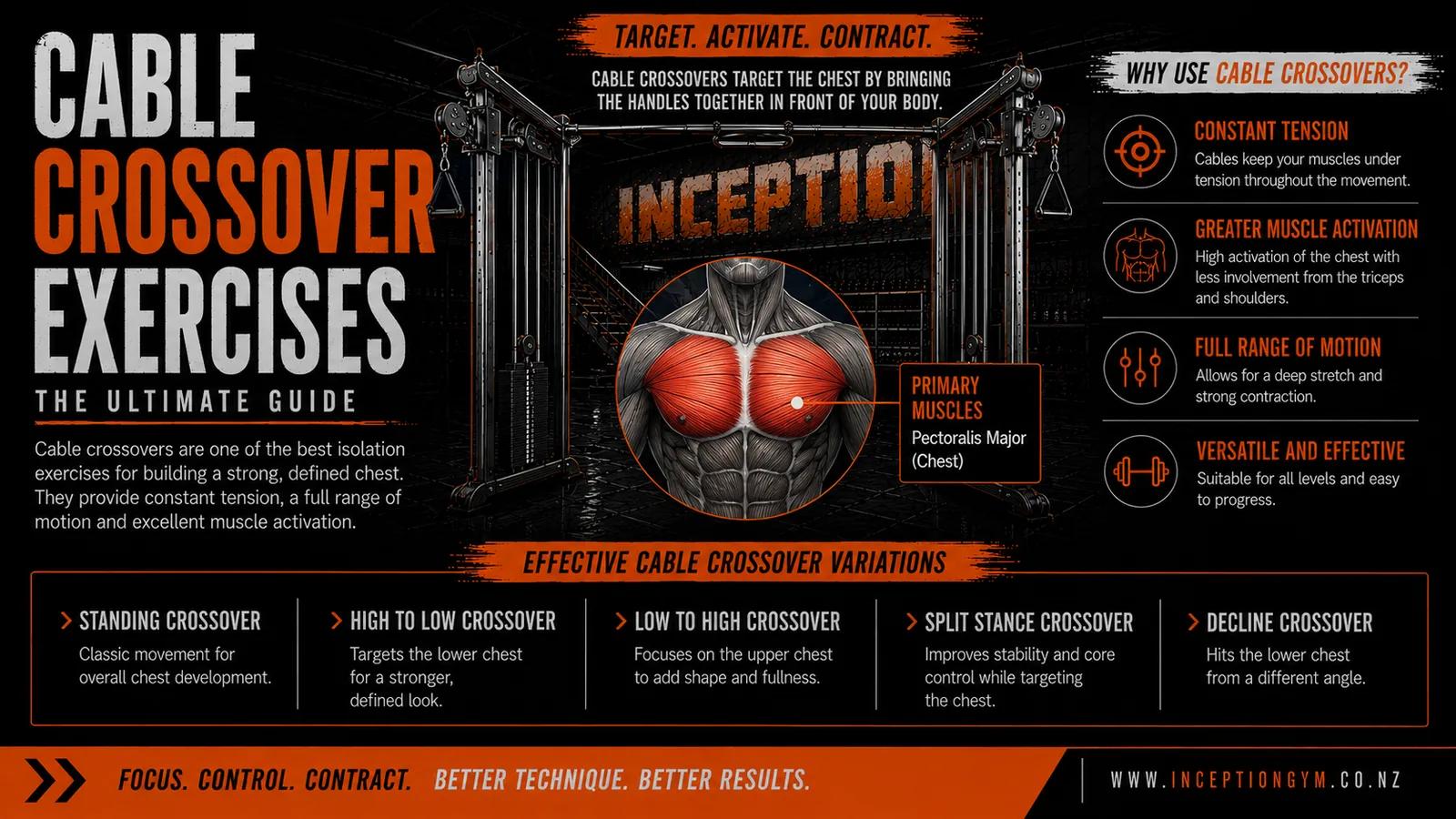
If I could keep only one piece of equipment on our floor, it would be the cable crossover. It lets you set resistance at any height, use any attachment, and load a muscle from angles a barbell simply cannot reach, which is why I use it to train the whole body.
I am Dr Matt Walley, and I co-founded Inception Gym Christchurch in 2022 with my wife Elise. I am on the floor most days, so this is not a copied list of cable crossover exercises: it is the fifteen moves I actually watch members build results with, station by station.
Key takeaways
- Cables hold tension through the entire range, unlike free weights that go slack at the top or bottom.
- One dual-cable crossover plus a functional trainer covers chest, back, shoulders, arms, glutes, and hamstrings.
- The best cable work sits at the start (activation) or the end (volume) of a session.
- Every station on our floor carries a full attachment set, so you rarely wait, even at peak.
Why is the cable machine the most versatile piece in the gym?
The cable crossover is the most versatile piece in the gym because the pulley moves and the load does not care about gravity. Set the pulley low, mid, or high, clip on a rope, bar, handle, or ankle strap, and you have built a new exercise by changing nothing but angle and body position.
Free weights only ever pull one direction: down. Cables pull in whatever direction the pulley faces, so you can load a muscle across a line that dumbbells and barbells can never copy. That single fact is why one station can cover an entire training split.
At Inception Gym Christchurch the cable setup is a floor-to-ceiling dual-cable crossover plus a dual-pulley functional trainer, sitting inside a 92-machine floor. I deliberately specced two independent stations rather than one, and in three years of watching peak-hour traffic that decision is why I almost never see a queue for cable work.
The cable crossover is the only piece on the floor where a beginner and a national-level lifter can train side by side, on the same station, and both get exactly what they need.
Chest: cable fly variations
1. Low cable fly (upper chest)
Set the pulleys to the lowest position. Stand in the centre of the station, take a handle in each hand, and sweep both arms up and inward in a wide arc, crossing at about eye height.
Why it works. The upward angle loads the clavicular (upper) chest head, which flat pressing barely touches. Cable tension holds through the whole arc, where a dumbbell goes slack near the top.
Technique tip. Keep a fixed, slight elbow bend and think of the movement as a hug. Pause and squeeze at the top.
Programming. 3 sets of 12 to 15 reps. My favourite upper-chest detail work after heavy pressing.
2. Mid cable fly (mid-chest)
Set the pulleys to roughly shoulder height. Stand centred, step slightly forward, and bring both handles together in front of your chest with arms about horizontal.
Why it works. Targets the sternal head of the pec major through the mid-range, and the constant tension feels nothing like a dumbbell fly.
Programming. 3 sets of 12 to 15 reps. A strong finisher or a superset partner for any press.
3. High cable fly (lower chest)
Set both pulleys high, above your head. Step forward, hinge slightly at the hips, and drive both handles down and inward, crossing at hip height.
Why it works. The downward line under load hits the lower sternal fibres. Most chest programmes ignore the lower chest entirely, and this angle fixes that.
Programming. 3 sets of 15 reps. Neglected by nearly everyone, and it sharpens the lower chest line.
Back and pulling: cable rows and pullovers
4. Seated cable row (close grip)
Set the pulley low, sit facing the stack, and use a close neutral-grip V-bar. Pull to your lower chest, drawing your elbows back past your torso, and squeeze the shoulder blades together at the end of each rep.
Why it works. Constant tension through the full range, including the stretched position at arm extension. Targets the rhomboids, mid-traps, and mid-back.
Technique tip. Do not round the lower back at the start. Hold a neutral spine throughout.
Programming. 4 sets of 10 to 12 reps. A primary back-thickness builder.
5. Wide-grip cable row
Same setup as the seated row, but swap to a straight bar with a wider, pronated grip. The wider grip changes the elbow path and shifts emphasis to the upper back and rear delts.
Programming. 3 sets of 12 reps. I rotate members between close and wide grip across the week.
6. Single-arm cable row (standing)
Set the pulley low, stand facing or side-on to the stack, and row with one arm at a time. Let the working shoulder rotate slightly forward at the start and back at the contraction.
Why it works. One arm at a time means the strong side cannot rescue the weak side. The thoracic rotation adds a functional piece that bilateral rowing loses.
Programming. 3 sets of 10 to 12 reps per side.
7. Cable straight-arm pulldown
Set the pulley high, stand facing the stack with arms extended overhead, and pull a bar or rope down to your thighs using only the shoulder joint, elbows straight throughout.
Why it works. It isolates the lats with no biceps involvement, and it teaches the lat-engagement pattern before you ever touch a lat pulldown.
Technique tip. Start the movement by depressing the shoulder blades. If you feel it mostly in the triceps, you are pushing, not pulling from the lats.
Programming. 3 sets of 12 to 15 reps. A great lat warm-up or finisher.
Shoulders: cable raises and face pulls
8. Cable lateral raise
Set the pulley to the lowest position, stand side-on with the handle in your far hand, and raise your arm out to shoulder height with a slight elbow bend.
Why it works. The horizontal pull keeps continuous tension across the whole raise, including the bottom position where a dumbbell gives you essentially nothing.
Technique tip. Control the descent over 2 to 3 seconds. The eccentric is where a large share of the growth stimulus lives.
Programming. 4 sets of 15 to 20 reps per side. In my opinion the single best lateral-delt exercise on the floor.
9. Cable face pull
Set the pulley to about face height, clip on a rope, and grip both ends overhand. Pull toward your face, letting your hands separate as they reach your temples. Finish with elbows above shoulder height and hands beside your head.
Why it works. It trains the rear delts and external rotators, two of the most neglected muscles in any gym, and it protects the shoulder by counteracting the internal rotation heavy pressing builds.
Technique tip. Drive the elbows up and back. Do not just haul the rope at your nose.
Programming. 4 sets of 20 reps. I want this in every upper-body session.
10. Cable front raise
Set the pulley low, stand facing away from the stack with a handle in one hand, and raise your arm forward to shoulder height.
Why it works. Targets the anterior delt, with tension at the bottom where a dumbbell front raise has almost none.
Programming. 3 sets of 15 reps. The front delt already gets hammered by pressing, so use this in moderation.
Arms: bicep and tricep cable exercises
11. Cable bicep curl (straight bar or EZ bar)
Set the pulley low, face the stack, grip underhand, and curl to shoulder height. The cable holds tension at the stretched bottom and the contracted top, which no barbell or dumbbell does.
Why it works. Continuous tension through the range is the whole point of a cable curl. I am also a firm believer in loading the biceps hard at full stretch, and the cable lets you keep tension in that lengthened position better than a free weight.
Technique tip. Pause briefly at full arm extension so every rep starts from a genuine stretch.
Programming. 3 to 4 sets of 12 to 15 reps. A reliable finisher for arm day.
12. Cable hammer curl (rope attachment)
Set the pulley low, use a rope, and curl with a neutral grip, palms facing each other. At the top you can pull the rope ends apart for extra brachialis contraction.
Why it works. The neutral grip targets the brachialis and brachioradialis, which adds thickness and pushes the biceps peak up. Most lifters skip neutral-grip curls entirely.
Programming. 3 sets of 12 reps.
13. Overhead cable tricep extension
Set the pulley low, stand facing away from the stack, grip a rope overhead, and extend your arms forward and up. Keep your elbows pointing forward throughout.
Why it works. The overhead position is the only way to fully stretch and load the long head of the triceps, the largest of the three heads and the one most people undertrain.
Technique tip. Finish at full elbow lockout, not at 90 degrees. Drive to a dead-straight arm.
Programming. 3 to 4 sets of 12 to 15 reps. I put this in every triceps session.
14. Cable tricep pushdown (rope)
Set the pulley high, hold the rope in both hands, keep your elbows tucked, and push down to full extension, flaring the ends apart at the bottom.
Why it works. The rope flare at the bottom gives the lateral head a contraction a straight bar cannot match. This is the pushdown I coach first.
Programming. 3 to 4 sets of 12 to 15 reps. One of the most dependable triceps builders on the floor.
Legs and core: cable exercises for the lower body
15. Cable pull-through (glutes and hamstrings)
Set the pulley low, face away from the stack, reach through your legs for the rope handle, and stand tall by driving your hips forward. It is a hip hinge: hips back on the way down, hips through on the way up.
Why it works. It loads the glutes and hamstrings through a hinge with constant tension, and it is the safest way I know to teach the hinge before a member loads an RDL or deadlift.
Technique tip. The movement is all hips. Keep the torso stiff and do not turn it into a squat.
Programming. 3 sets of 15 reps. Excellent glute and hamstring work in a lower-body session.
How should you program cable exercises?
Cable exercises earn their place differently depending on where they sit in a session.
As warm-up or activation. Light cable work at the start primes specific muscles. Cable lateral raises wake up the side delt before pressing. Face pulls before any upper-body press improve shoulder position and rear-delt recruitment.
As primary exercises. Loaded heavy and programmed with enough volume, cable rows and fly variations can absolutely anchor a session.
As accessory or finishing exercises. Lighter isolation work at the end adds volume with almost no recovery cost. The pump from high-rep cable work is a real signal, not a cosmetic one.
In supersets. Cables make supersets practical because there is nothing to load or unload. Pair a pushdown with a curl, or a face pull with a lateral raise, and you double session density without adding time. If you want the full picture on weekly load, I wrote a companion piece on training volume and sets per week.
Getting the most from Inception Gym's cable stations
One thing I insisted on when we built the floor: two independent cable stations, not one shared unit. That is a floor-to-ceiling dual-cable crossover and a dual-pulley functional trainer, both inside our 800sqm facility, so two people can run completely different exercises at once and neither waits.
Every station carries a full attachment set: straight bars, EZ bars, D-handles, rope attachments, V-bars, and ankle straps for lower-body work. If you have ever given up on a cable exercise because the attachment you needed was clipped to another machine across the room, you will feel the difference here.
If you want a hand building a cable-based programme, my team is on site during staffed hours, Monday to Thursday 9am to 7pm and Friday and Saturday 10am to 2pm (unstaffed Sundays and public holidays), and members train around the clock, 24 hours a day, every day of the year. Come and train with us on a free trial and put a few of these to the test in person.
Nutrition
Variety from the cables is only half the equation. What you build on the floor still has to be fed, which means adequate protein and sensible overall nutrition.
Our on-site Supplement Solutions store carries the full Inception Labs range at member pricing, including Collagen Whey Protein for recovery and Valor Pre-Workout for cable-heavy sessions. Members save up to 40% year-round. Every Inception member also gets free body composition scans, so you can actually see whether the training and nutrition are moving the numbers.
Start training at Inception Gym
Related guides: the chest training machine guide, shoulder training machines.
To see the full cable setup and the rest of the 92-machine floor, visit the facilities and equipment page. When you are ready to try it yourself, book a free trial for 24 hours of full gym access at no cost, or view membership options from $18.90 a week and find the plan that fits your goals. We have earned a 5.0 rating across 1,090+ Google reviews by getting details like this right, and I would back our cable floor against any gym in Christchurch.