Training · Programming
Training Volume: How Many Sets Per Week to Build Muscle
How much training volume you actually need to build muscle: sets per muscle per week, how to distribute it, and how to progress it. A practical guide from Dr Matt Walley at Inception Gym Christchurch.
By Dr Matt Walley · 12 July 2026
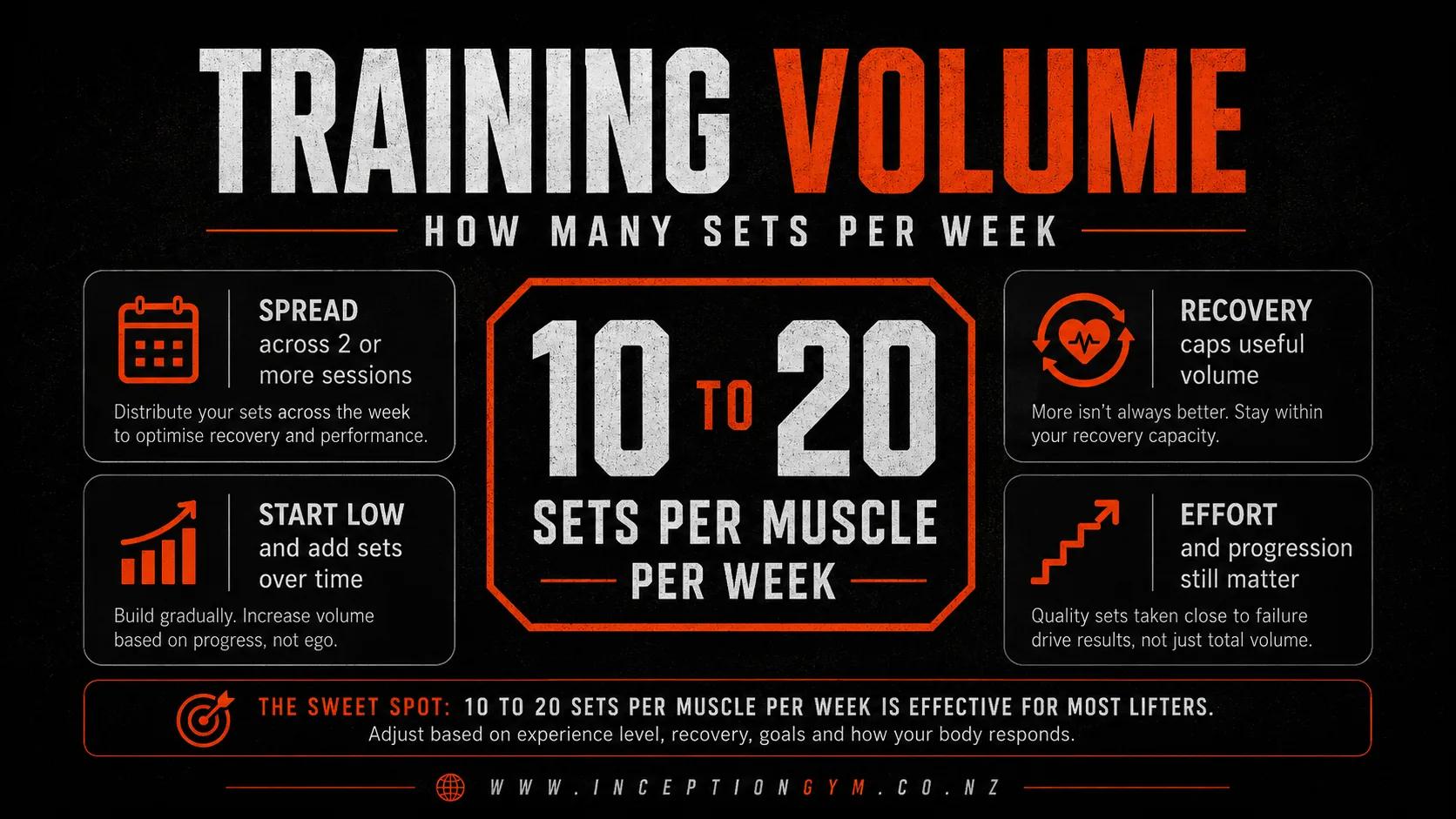
Most trainees build muscle on roughly 10 to 20 hard sets per muscle group per week, spread across two or more sessions. Beginners grow on less, often 8 to 12 sets. Start near the bottom of that range and add sets only when progress actually stalls.
I am Matt, I run Inception Gym in Christchurch, and I have watched more people plateau from too much training volume than too little. That is the summary. The rest of this guide explains what counts as a set, why the range is a range, how to distribute your work across the week, and how to read the signs that you have too much or too little.
Key takeaways
- Count training volume as hard sets per muscle group per week, not reps or time in the gym.
- 10 to 20 hard sets per muscle per week suits most intermediates; beginners grow on 8 to 12.
- Split that volume across two or more sessions rather than one brutal day.
- Recovery, meaning sleep, food and life stress, sets the real ceiling.
- Add sets only when progress stalls, never because motivation spiked.
What does training volume actually mean?
Training volume is the total amount of hard work a muscle receives, and the most practical way to count it is sets per muscle group per week. Not total reps, not tonnage, not minutes on the floor. Sets taken close to failure are the unit that research and years of coaching have converged on, because a hard set of 6 reps and a hard set of 15 reps produce broadly similar growth per set when both finish within a few reps of failure.
Volume sits alongside two other drivers of hypertrophy: effort and progression. A set only counts toward your weekly tally if it is genuinely hard, meaning you stop somewhere around 0 to 3 reps short of failure. Ten honest sets beat twenty half-effort sets every time. And volume only produces growth if the loads or reps climb over the weeks, which is the whole subject of progressive overload.
The 10 to 20 set range, and why it is a range
For most intermediate trainees, somewhere between 10 and 20 hard sets per muscle per week is where growth happens efficiently. Two concepts explain the spread.
Minimum effective volume is the least work that still produces growth. For a muscle you only want to maintain or slowly improve, this can be surprisingly low: a handful of hard sets a week holds tissue you have already built and can still add a little. This matters during busy periods. Dropping from 16 sets to 6 for a month does not erase your progress, and I tell members that every December.
Maximum recoverable volume is the ceiling: the most work you can do and still recover from before the next session. Push past it and output drops, joints ache, sleep sours and growth stalls or reverses. That ceiling is individual. It depends on training age, sleep, food, stress and which muscle you are talking about. Smaller muscles like biceps and lateral delts tolerate more weekly sets than movements that tax the whole system, like heavy squats and deadlifts.
Your productive zone sits between those two lines, and it moves. After a deload it is wider. During a stressful work month it narrows. Treat 10 to 20 as a starting map, not a rulebook.
The lifters who grow for years are not the ones chasing the highest set count. They are the ones who turn the dial up slowly and always leave themselves somewhere to go.
Beginners need less than they think
If you are in your first year of consistent training, you do not need 20 sets per muscle. Around 8 to 12 hard sets per week per muscle group, built mostly from compound lifts, is plenty. New lifters grow on modest volume because almost any consistent stimulus is novel to their muscles, and their limiting factor is usually technique and effort, not workload.
The most common mistake I see on our floor is a newer lifter copying the programme of someone five years ahead of them. High volume without the work capacity to support it just produces soreness and skipped sessions, and a skipped session builds nothing. Start low, master the movements, and earn the right to add sets. My hypertrophy training guide covers how the other variables, rep ranges, exercise selection and proximity to failure, fit around volume.
Progress volume gradually, never max it out from day one
Volume is a resource you spend, and the sensible way to spend it is slowly. If 12 sets a week is producing measurable progress, adding more gains you nothing except extra fatigue. Volume increases are for when progress stalls, not for when you walked in feeling motivated.
A progression I trust looks like this:
- Start a block at or slightly above your minimum effective volume, say 10 to 12 sets for a priority muscle.
- Hold that for 3 to 4 weeks while pushing load and reps up.
- If progress continues, change nothing. If it stalls and recovery feels fine, add 1 to 2 sets a week for that muscle.
- When performance starts dipping across sessions, you have found your current ceiling. Back off for a week, then resume at a moderate volume.
This is the part most programmes skip, and it is the part I care about most. The lifter who opens at 22 sets per muscle has no lever left to pull and usually no recovery left either. Restraint early is what buys you room to grow later.
Should you distribute volume across sessions?
Yes. Sixteen sets of chest in a single Monday is worse than eight on Monday and eight on Thursday, for two reasons.
First, set quality collapses within a session. By set ten for the same muscle, your output has dropped far enough that the later sets pile on fatigue without adding much stimulus. Second, the muscle-building response to a session is elevated for roughly 24 to 72 hours afterwards; training a muscle twice a week simply triggers that response more often.
For most people this means moving away from the classic one-muscle-per-day layout once weekly volume climbs. An upper/lower split four days a week, or a full-body setup three days, hits every muscle at least twice and keeps per-session volume in the productive zone. My guide to training splits walks through which structure fits which schedule, and our 24/7 access at Tower Junction means you can spread that work across the week rather than cramming it.
How to count your sets
Counting is where people get lost, so keep it simple:
- Direct sets count fully. A set of dumbbell curls is one set for biceps.
- Heavy indirect work counts partially. Rows and pulldowns hit biceps hard; chin-ups arguably count as direct biceps work. Pressing hits triceps and front delts. A reasonable rule: count a compound as roughly half a set for the secondary muscles it trains.
- Warm-up sets do not count. Only sets taken within a few reps of failure go on the tally.
- Junk sets do not count either. If you stopped 6 reps short because the machine was busy and you rushed, that set did very little.
Run this count for a normal week and most lifters find their totals are lopsided: 20-plus effective sets for chest and arms, 6 for hamstrings, 4 for side delts. Honestly, fixing that distribution does more for most people than adding volume anywhere. I have redirected members from adding more chest work to simply training the muscles they had been quietly ignoring, and their physiques changed faster for it.
Recovery caps how much volume is useful
Volume only works if you recover from it. Muscle is built between sessions, not during them, and three things set your ceiling.
Sleep. Consistently short sleep reduces training output, blunts recovery and shifts body composition the wrong way. If you sleep six hours a night, your maximum recoverable volume is meaningfully lower than the same lifter on eight.
Food. Building muscle requires adequate protein, roughly 1.6 to 2.2 grams per kilogram of bodyweight per day, and enough total energy to fuel the work. High volume in a steep calorie deficit is a fast route to stalled lifts. If you are training through a GLP-1 medication or an aggressive cut, this matters even more; I cover that in strength training on GLP-1 medications.
Managing the stress budget. Training stress stacks with life stress. During heavy work periods, cutting volume 30 to 40% and holding intensity keeps you progressing rather than digging a hole. Planned easier weeks matter too; my guide to rest days and recovery covers how to structure them, and every member gets free body composition scans so you can watch whether your volume is actually adding muscle rather than just fatigue.
Where the gym makes volume practical
There is a logistical side to volume that programmes rarely mention: accumulating 15 quality sets for a muscle requires the right equipment when you need it. Waiting ten minutes between stations turns a 60-minute session into 90, and most people respond by cutting sets, usually the ones for the muscles they already neglect.
I designed the floor here specifically to remove that constraint: 92-plus pieces of equipment, 72 machine variants, 43 of them plate-loaded, across 800 sqm at Tower Junction in Addington. With multiple pressing stations, multiple rowing options and two squat racks, you can run your planned volume without redesigning the session around whoever got there first. Members mention exactly this in the 1,090+ Google reviews behind our 5.0 rating. You can view the full equipment list to see how your programme maps onto the floor.
A practical starting prescription
If you want a number to walk in with:
- Beginners: 8 to 12 hard sets per muscle per week, each muscle trained twice, mostly compounds.
- Intermediates: 12 to 16 sets for priority muscles, 8 to 10 for maintenance muscles, split over 2 to 3 sessions per muscle.
- Advanced: 14 to 20 sets for one or two focus muscles per block, other muscles held near maintenance to free up recovery.
Hold the number steady, push the weights up, and add sets only when progress stops and recovery says you can afford it. Volume is a dial, not a badge.
Come and put it into practice
If you want to run real weekly volume without waiting for a station, come and train on our floor. Start with a free trial at Tower Junction in Addington, or book your free body composition scan so we can measure whether the volume you are running is actually building muscle. I am usually on the floor, and I am happy to help you count your sets.