Equipment · Shoulders
Shoulder Training Machines: Build Bigger Shoulders with the Right Equipment
Every shoulder machine at Inception Gym Christchurch explained by owner Dr Matt Walley: presses, lateral raises, rear delt work, and how to programme balanced deltoids. 5.0 across 1,090+ Google reviews.
By Dr Matt Walley · 6 December 2024
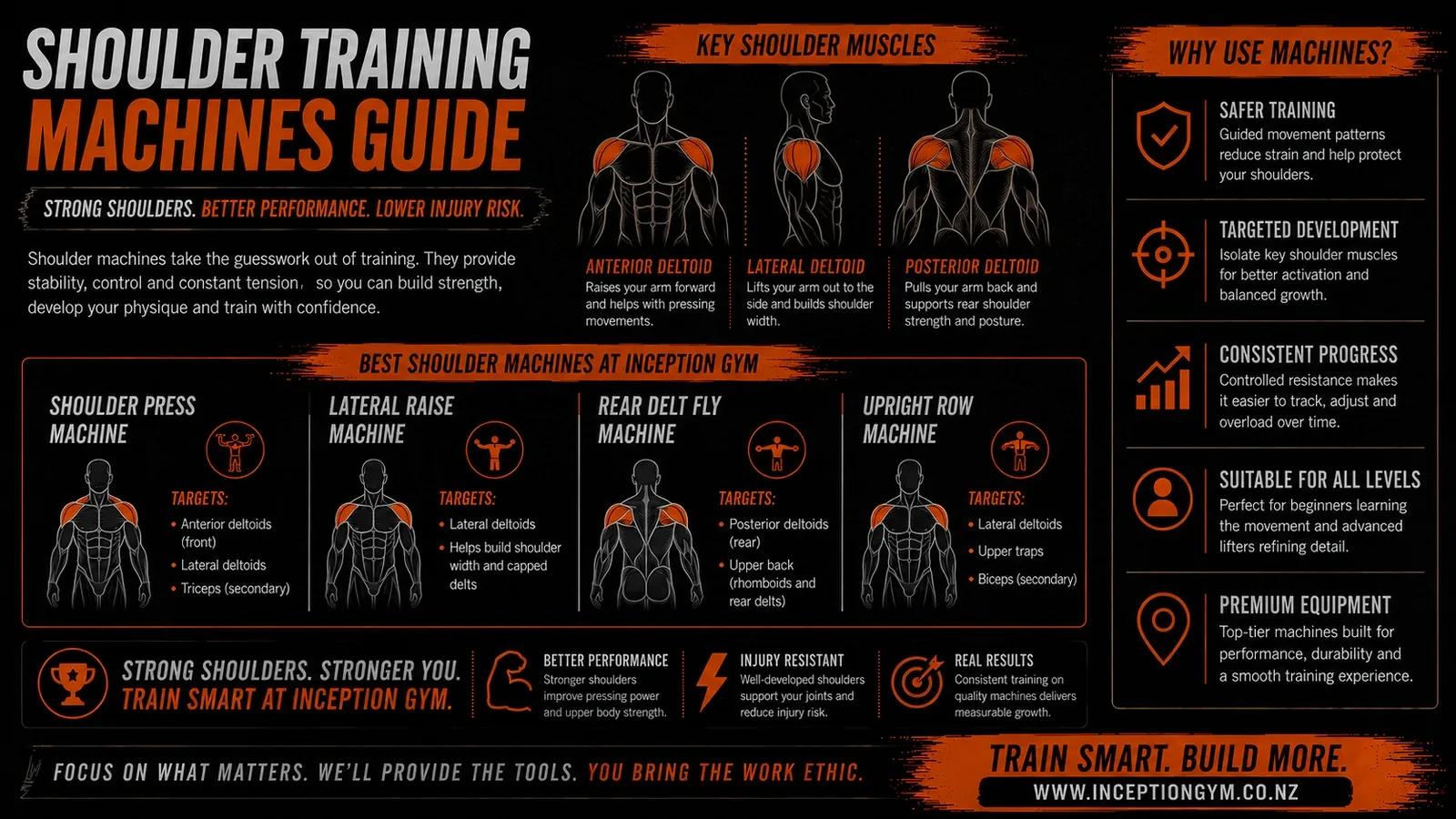
The best shoulder training machines are the ones that load the side and rear deltoids under constant tension, not just the presses that already dominate most people's programmes. On my floor that means the plate-loaded shoulder press for strength, a dedicated lateral raise machine and cable stack for the side delt, and a reverse pec deck plus face pulls for the rear. Get those working together and you build the round, three-dimensional shoulder that pressing alone never delivers.
Key takeaways
- Shoulders have three heads (front, side, rear) that need separate work; pressing only trains one of them well.
- Machines and cables beat dumbbells for lateral and rear delts because they hold tension where dumbbells lose it.
- Most members are front-heavy: fix it with equal volume on side and rear delts.
- I keep every shoulder tool at Inception Gym Christchurch within a few metres so a full deltoid session flows without waiting.
Why are shoulders so hard to train well?
Shoulders are one of the most visually telling muscle groups and, in my experience watching people train, one of the most consistently mistrained. The joint has a huge range of motion and three distinct deltoid heads that respond to different angles. Load only one of them and the shoulder looks flat no matter how strong you get.
The pattern I see almost daily on our floor in Addington is front-heavy shoulders. People press hard, chest and overhead, and the anterior delt gets hammered from every direction. The side and rear heads, the ones that actually create width and depth, get an afterthought at the end of the session if they get anything at all.
If your shoulder day is mostly presses, you are training the one head that already gets worked by every chest and overhead movement you do, and starving the two heads that give shoulders their shape.
That is the real problem, and it is a programming problem before it is an equipment problem. The equipment just makes the fix easier. We are part of a 92-machine floor with 43 plate-loaded pieces at Tower Junction, and the shoulder selection covers every head across multiple movement patterns. This guide walks through each machine and how I would programme it.
Shoulder anatomy in plain terms
The deltoid has three heads, each with a different job:
- Anterior deltoid (front): brings the arm forward and up. Involved in all pressing. Usually overtrained.
- Lateral deltoid (side): raises the arm out to the side. Responsible for shoulder width and the capped look.
- Posterior deltoid (rear): draws the arm back and externally rotates it. Critical for posture, shoulder health and depth from the side. Almost universally undertrained.
- Rotator cuff: four small stabilisers that hold the humerus in the socket. Not a hypertrophy target, but you protect it or you pay for it.
Here is the honest cause of most imbalanced shoulders. Pressing recruits the front delt heavily. Most members do plenty of pressing and very little dedicated lateral or rear work. The result is a front-heavy shoulder that looks flat from the side and pulls the posture forward.
Shoulder press machines
Plate-loaded shoulder press
The plate-loaded shoulder press has no stack ceiling, so it stays the primary machine for overhead pressing strength.
- What it targets: anterior and lateral delts primarily, with upper trap and triceps assisting.
- How to use it: set the seat so the handles start at about ear height or slightly lower. Press through a full range. Do not arch the lower back to cheat the weight up; keep the core braced.
- Pressing angle: most plate-loaded units use a slight forward lean, which lowers impingement risk and feels more natural for most shoulder structures.
- Programming: 3 to 4 sets of 8 to 12 reps, usually first in the session.
Seated shoulder press (pin-loaded)
The pin-loaded version is faster to adjust between sets, which makes it my pick for drop sets, higher-rep work or managing fatigue late in a session.
- Programming: a strong second pressing movement after the plate-loaded version. 3 sets of 10 to 15 reps.
Smith machine overhead press
The Smith gives a fixed vertical path, useful for lifters learning the overhead pattern or working around shoulder discomfort, since it removes some of the stabiliser demand of a free barbell. If you want more options on this frame, I break them down in our Smith machine guide.
- Programming: good for beginners or during a phase of shoulder recovery.
Which lateral raise machine is best?
For the side delt, a machine or cable beats dumbbells, and this is the single biggest equipment upgrade most people are sleeping on.
Plate-loaded lateral raise
One of the most underused machines on my floor and one of the most effective for building the lateral delt. It gives a guided arc with tension held through the whole movement.
- What it targets: lateral deltoid.
- Why it matters: with dumbbells, tension at the bottom (arm by your side) is nearly zero, so the muscle only works hard in the top half. A lateral raise machine or cable keeps resistance on the delt the entire range.
- How to use it: slight bend in the elbow, lead with the elbow rather than the hand, raise to shoulder height (about 90 degrees) and no higher, keep the traps out of it, and control the descent over 2 to 3 seconds.
- Programming: 3 to 4 sets of 12 to 20 reps. Moderate load with clean form beats heavy load with sloppy mechanics here every time.
Cable lateral raise (low pulley)
From a low pulley the cable holds continuous tension through the full range. Honestly, if I had to pick one side-delt exercise, this would be it.
- How to use it: stand side-on to the stack, hold the handle in the hand furthest from it, raise out to shoulder height with the slight elbow bend, and control the way down.
- Unilateral benefit: one arm at a time keeps the two sides balanced.
- Programming: pairs beautifully as a superset with rear delt work. 3 sets of 15 to 20 reps per side.
Rear deltoid machines
Reverse pec deck (rear delt machine)
The reverse pec deck is the most effective machine for directly hitting the posterior delt. Seated facing the pad, it turns the reverse fly into a supported, stable movement.
- What it targets: posterior deltoid primarily, with mid-trap and rhomboid help.
- How to use it: sit facing the pad, grip the handles with arms at shoulder height, keep a slight elbow bend, and drive the elbows back and slightly down in an arc. Squeeze at the end and feel the mid-back working. Do not let the elbows drop below shoulder height.
- Programming: 3 to 4 sets of 12 to 20 reps. The rear delt responds far better to higher reps and a real mind-muscle connection than to heavy loads with momentum.
Cable face pull (rope, high pulley)
The face pull is one of the most valuable things you can do for shoulder health and rear delt development. It directly counters the internal rotation and forward loading that heavy pressing creates.
- What it targets: rear delts, external rotators, mid and lower traps.
- How to use it: set the pulley at eye height, hold the rope overhand, and pull toward your face, letting the hands separate and the elbows flare. Finish with the hands beside your temples and elbows above shoulder height, then squeeze.
- Programming: put face pulls in every shoulder session. 3 to 4 sets of 15 to 20 reps. They improve posture, protect the joint and build the rear delt without aggravating impingement.
Band pull-apart and external rotation work
Band work earns a mention. We keep resistance bands available for warm-ups and accessory sets, and external rotation movements are how you keep the rotator cuff strong over years, not just weeks. Cheap insurance for a joint that does not forgive neglect.
Trap machines
The upper trapezius sits between the neck and shoulders, and when it is well developed it adds real presence to the upper body.
Shrug station or Smith machine shrug
Load dumbbells (we run up to 70kg) or use the Smith with a solid load, and elevate the shoulders straight upward, squeezing the traps at the top.
- Programming: 3 to 4 sets of 12 to 15 reps. Do not roll the shoulders; a straight vertical motion is safer and works better.
How do you programme balanced shoulders?
Most members need to shift the balance of their shoulder training toward the side and rear heads. Here is a session I am happy to put my name to:
- Plate-loaded shoulder press: 4 sets of 8 to 10 reps (front and side focus)
- Lateral raise machine: 4 sets of 12 to 15 reps (side delt isolation)
- Reverse pec deck: 4 sets of 15 to 20 reps (rear delt)
- Cable face pull: 3 sets of 20 reps (rear delt, health and posture)
- Cable lateral raise: 3 sets of 15 reps per side (side delt, constant tension)
That gives roughly equal volume to front, side and rear, which is what produces the rounded, three-dimensional shape pressing alone cannot.
Weekly frequency: most members do well training shoulders once or twice a week. Remember the delts get indirect work from chest pressing (front), back rowing (rear) and trap work, so count that volume when you plan direct sets. If you want the bigger picture on how much is enough, I cover it in our guide to training volume.
Common mistakes I see on the floor
- Too much pressing, not enough lateral work. If your shoulder programme is mostly presses, you are building the front delt at the expense of the shape-defining side head. Lateral raises deserve equal volume to pressing.
- Skipping the rear delt. Weak rear delts mean rounded posture, higher impingement risk and a flat profile from the side. Every session, no exceptions.
- Going too heavy on lateral raises. The side delt is a small muscle. Heavy raises turn into trap shrugs and momentum. Drop the weight, kill the swing, feel the muscle.
- Pressing through pain. Discomfort in a press is a signal, not a hurdle. I would rather you address it early than train through it and lose months.
Nutrition for shoulder growth
Building three-dimensional shoulders takes the same nutrition as any muscle goal: enough protein, enough total calories, and real recovery between sessions. Nothing exotic.
Our on-site Supplement Solutions store carries the Inception Labs range at member pricing year-round, and members get free body composition scans so you can actually see whether the muscle is going on. For structured guidance, Inception Nutrition runs PhD-led coaching built around your body composition data.
Train shoulders on the real equipment
Related guides: cable crossover exercises, the incline chest press guide.
The fastest way to understand this machine selection is to get your hands on it. My honest read after years on this floor: the members who build the best shoulders are the ones who stop treating side and rear delts as a footnote. The equipment to do it properly is here and rarely queued. Book a free trial and take a full deltoid session through the machines above.
When you are ready to stay, our membership options start at $18.90 per week on a 24-month plan, or $33.90 per week open-term with 28 days' cancellation notice. No joining fee on any plan, and Fitness Passport is accepted with no tag fees and no sign-up fees. We hold a 5.0 rating across 1,090+ Google reviews, and I would like your shoulders to be the next reason someone leaves one.