Training · Strength
Deadlift variations: from conventional to machine
Dr Matt Walley on deadlift variations: conventional, sumo, Romanian, trap bar, stiff-leg, and the plate-loaded deadlift machine at Inception Gym, and how to pick the right one for your body.
By Dr Matt Walley · 1 July 2025
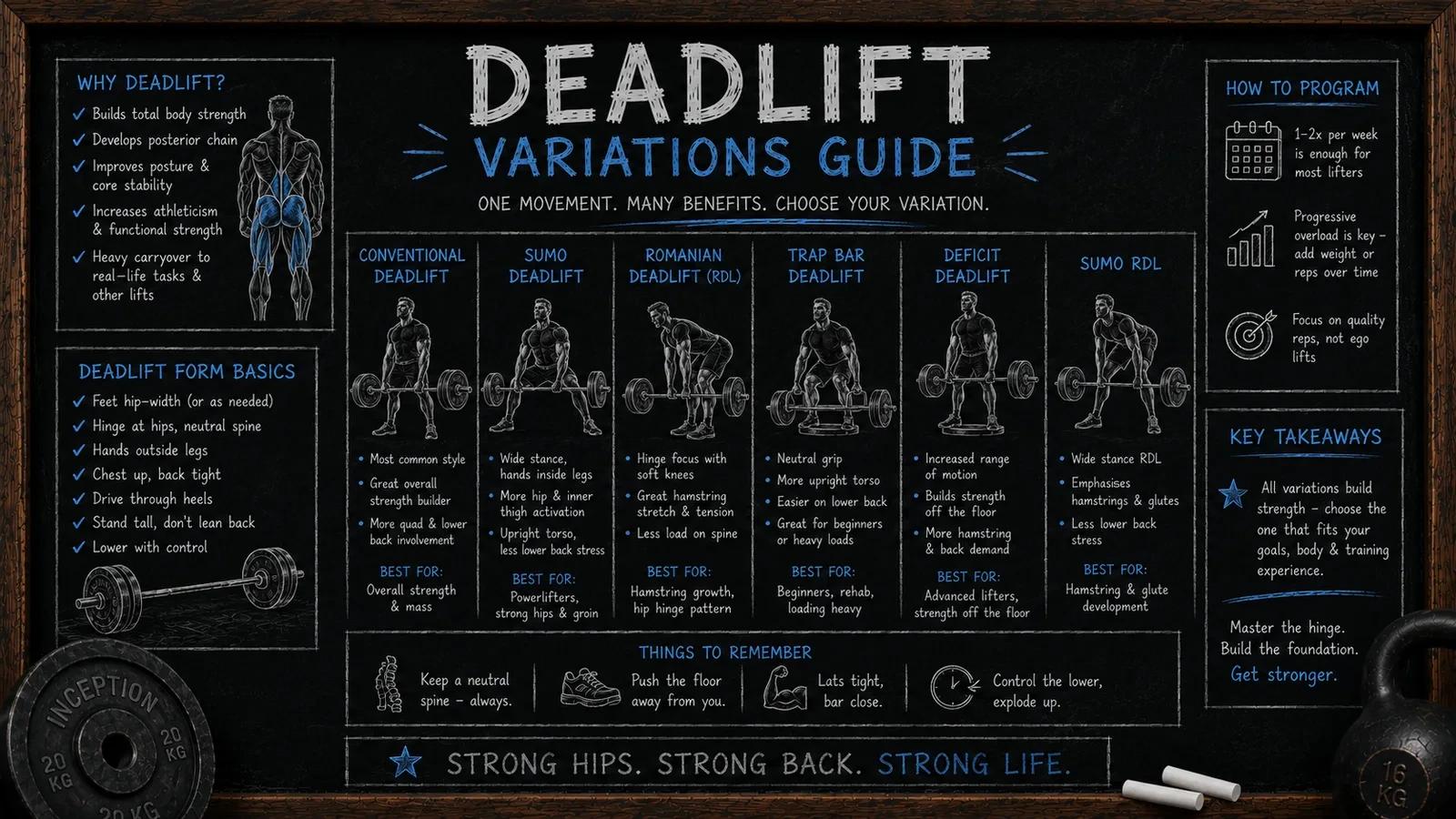
There is no single "correct" deadlift. The right deadlift variation is the one that loads your posterior chain hard while matching your build, your goals, and whatever your lower back can tolerate today. Conventional, sumo, Romanian, trap bar, stiff-leg, and the plate-loaded machine each move the emphasis around, and once you understand how, you can programme deadlifts that actually fit you.
I am Dr Matt Walley, and I co-founded Inception Gym Christchurch with my wife Elise in 2022. I have coached hundreds of members through their first pull and watched plenty of experienced lifters quietly fight a conventional deadlift that was never built for their frame. This guide is what I tell them on the floor.
Key takeaways
- Your femur, torso, arm length, and hip width decide which deadlift feels powerful and which feels like a fight.
- Most well-built programmes run 2 to 3 deadlift variations, not one hammered every session.
- The trap bar and the plate-loaded machine are the two variations I reach for most when a lower back needs protecting.
- Total weekly posterior chain volume matters more than how heavy any single pull was.
Why do deadlift variations matter?
No two people share the same anthropometry. Femur length, torso length, hip width, arm length, and ankle mobility all change how a given deadlift feels and how well it loads the muscle you are aiming at. A conventional deadlift that feels natural and strong for one member can be mechanically awkward, and frankly a bit dangerous, for someone built differently.
The variations also hit the posterior chain differently. Conventional and sumo are floor-to-lockout pulls that tax the whole chain. Romanians isolate the hamstrings. The trap bar pulls in the quads. The machine gives you loaded hip extension with far less spinal loading. Understanding those differences is what lets you choose well instead of just copying whatever the strongest person in the room is doing.
The strongest lifters I know are not loyal to one deadlift. They are loyal to their posterior chain, and they will use whatever variation loads it best that day.
Conventional deadlift
The conventional deadlift is the baseline every other variation gets measured against. Bar gripped just outside the legs, feet roughly hip-width, and you drive the floor away with a neutral spine.
Muscle emphasis
- Primary: erector spinae, glutes, hamstrings
- Secondary: quads, lats for stability, traps, forearm flexors
Mechanics
The bar has to travel a vertical path from floor to lockout. To do that, the hips must start where the shoulders sit over or just in front of the bar. If you have long femurs and short arms, that usually means a more horizontal torso, which loads the lower back harder. The single technical rule is a neutral spine throughout, especially as fatigue creeps in on later reps. Rounding the lower back under load is the main way people hurt themselves here.
Form cues
- Set the bar over mid-foot, grip just outside the legs
- Pull the slack out of the bar before you drive
- Drive your feet into the floor; do not think of pulling with the back
- Keep the bar in contact with your legs the whole way
- Lock out by driving the hips forward, not by leaning back
Who it suits
Lifters with shorter femurs and longer arms, who get a more upright torso for free, and anyone training specifically for powerlifting or raw posterior chain strength.
Sumo deadlift
The sumo uses a wide stance with the feet turned out, so you grip the bar inside your legs. That one change produces a genuinely different lift.
Muscle emphasis
- Primary: glutes, hip adductors, quads
- Reduced relative to conventional: lower back, hamstrings slightly
Mechanics
The wide stance shortens the distance between the bar and your hips, which lets the torso stay more upright and reduces the moment arm at the lower back. For lifters with wide hips or particular hip anatomy, sumo can feel meaningfully more natural and let you handle more load with less lumbar stress. It is legal in powerlifting and plenty of lifters hit their best pull this way. Here is a thing I have to correct constantly on our floor: sumo is not cheating and it is not the easy option. It is a mechanically distinct lift, and if your adductors are weak it will humble you fast.
Form cues
- Set up wide, toes turned out significantly
- Push the knees out over the toes the whole way
- Grip with a narrow overhand or mixed grip
- Drive the floor away while pushing the hips through at lockout
Who it suits
Lifters with wider hips, anyone who gets lower back discomfort pulling conventional, and anyone whose anatomy makes that upright sumo torso feel obviously better.
Romanian deadlift
The Romanian deadlift, or RDL, starts from standing rather than the floor and lives in the eccentric, the lowering phase of the hip hinge, to load the hamstrings. It is arguably the best single exercise for building hamstrings through a full range.
Muscle emphasis
- Primary: hamstrings, glutes
- Secondary: erector spinae, upper back for stability
Mechanics
Starting with the bar at hip height, you push the hips back with a neutral spine and lower the bar down the legs until you feel a strong hamstring stretch. Range is limited by hamstring flexibility, not by the bar hitting the floor. The slow, controlled descent is where the value is. Rush it and you throw away the whole point of the exercise.
Form cues
- Keep a soft bend in the knees throughout
- Push the hips back; do not just fold forward
- Keep the bar close to the legs at all times
- Lower until you feel a strong stretch, not until the back rounds
- Drive the hips forward to stand, squeezing the glutes at the top
Who it suits
Almost everyone. It is one of the safest, most accessible deadlift variations, ideal for hypertrophy-focused training, injury resilience, and as a primary posterior chain movement for anyone who finds floor pulling problematic.
Trap bar deadlift
The trap bar, or hex bar, puts you inside the frame rather than behind it, so the load sits centred on your body. That changes the mechanics a lot.
Muscle emphasis
- Primary: quads, glutes, hamstrings, more evenly shared than conventional
- Reduced relative to conventional: lower back, notably
Mechanics
The centred load lets the torso stay upright, which brings the quads in and cuts the moment arm at the lumbar spine. Studies comparing trap bar and conventional pulls consistently show lower peak forces at the lower back with the trap bar while keeping similar or higher peak power. That makes it a great pick for athletic strength work, for anyone managing a sensitive lower back, and for beginners learning the hinge, where the forgiving mechanics help technique land faster.
Form cues
- Step inside the frame, feet hip-width
- Hinge at the hips to grip the handles
- Drive the floor away with the torso relatively upright
- Lock out fully, then lower under control
Who it suits
Athletes wanting combined lower body development, lifters managing lower back issues, and beginners. If your anthropometry fights the conventional pull, the trap bar is often the honest answer. In my experience it is the single most under-used bar in most commercial gyms, and it is the one I put nervous first-timers on before anything else.
Stiff-leg deadlift
The stiff-leg deadlift keeps the legs straighter than a conventional pull, which increases the hinge range and drives more load into the hamstrings and lower back. It carries more lower back risk than the RDL and is better suited to intermediate and advanced lifters.
Muscle emphasis
- Primary: hamstrings, lower back
- Secondary: glutes
Key difference from the RDL
Where the RDL caps range to protect the hamstrings, the stiff-leg lets the bar reach the floor, adding range and loading potential, but with more lower back involvement. I treat it as an accessory for advanced lifters chasing hamstring development, not as a primary deadlift for most people.
Plate-loaded deadlift machine
Our plate-loaded deadlift machine gives you a guided version of the hip extension pattern that sits underneath every deadlift, and this is where machine pulling genuinely beats the barbell for certain jobs.
What it offers
- Controlled path. The machine guides the movement, drops the skill demand, and lets you just focus on the contraction.
- Reduced spinal compression. The design loads hip extension while keeping direct compressive load off the lumbar spine.
- Safe training to failure. A failed barbell rep can be dangerous; here you can push to true muscular failure with negligible injury risk.
- Posterior chain overload. It is built for the higher-rep, hypertrophy sets that get ugly and unsafe with a barbell once fatigue and technical breakdown set in.
Honestly, this machine changed how I programme posterior chain work for older members and anyone rehabbing a cranky back. It lets them keep training hard without their lower back being the limiting factor, and that is the difference between someone staying consistent and someone quietly quitting. It is one of 43 plate-loaded machines on our floor; you can see the full equipment inventory for the complete range, and it pairs well with the rest of our plate-loaded catalogue.
Who it suits
- Anyone managing lower back sensitivity who still wants real posterior chain volume
- Hypertrophy training built on high reps and training to failure
- Supplementary work alongside conventional or trap bar deadlifts
How do I choose the right deadlift variation?
Match the variation to the goal rather than to ego. Here is the framework I use with members.
- General strength and power. Conventional or trap bar as your primary, with Romanians for hamstring development.
- Powerlifting. Conventional or sumo, both legal in competition, supported by Romanians and rack pulls.
- Athletic performance. Trap bar leads, with conventional and Romanians as support.
- Posterior chain hypertrophy. Romanians primary, machine deadlifts for extra volume.
- Lower back sensitivity. Trap bar or the machine, with Romanians as accessory.
- Beginner. Trap bar or Romanian first; add conventional once your form is solid.
If you want a hand mapping this to your own build, our team runs through it on the free trial, and a free body composition scan gives us an honest starting point for where your posterior chain sits right now.
Programming deadlift variations
A typical week might look like this.
- Primary pull day. Conventional or trap bar, heavy, 3 to 5 sets of 3 to 6 reps.
- Accessory day. Romanian deadlift, moderate load, 3 to 4 sets of 8 to 12 reps for the hamstrings.
- Optional higher-frequency day. Machine deadlift for volume, 3 to 4 sets of 12 to 15 reps.
Total weekly posterior chain volume matters more than any single session. Spreading that volume across variations and rep ranges builds the chain more completely than grinding heavy conventional pulls every time. If you want the deeper logic here, our training volume guide breaks down weekly set targets.
Supporting your deadlift training
Heavy hinging is demanding on recovery. Adequate protein for muscle repair, sleep for hormonal recovery, and where it fits, supplements that support connective tissue all matter for anyone pulling heavy regularly.
Inception Labs Collagen Whey combines whey isolate with bovine collagen peptides to support connective tissue alongside muscle recovery, and it is stocked in our on-site Supplement Solutions store with member pricing. For anyone training around an injury or an individual limitation, our sister service Inception Nutrition runs PhD-led coaching that ties training planning to evidence-based nutrition.
Come and pull with us
If you are new to serious deadlift work or just want to stop fighting a bar that was never built for you, come in and try it. We are open 24 hours a day, 365 days a year at Tower Junction, with two squat racks, trap bars, and the plate-loaded deadlift machine all on the floor, and we hold a 5.0 rating across 1,090+ Google reviews. Book a free trial and let us find the deadlift variation that actually suits you.