Guides · Getting Started
Starting Your Fitness Journey: A Complete Beginner's Guide to the Gym
New to the gym? I'm Dr Matt Walley, and this beginner's guide covers your first workout, your first month, and building habits that last at Inception Gym Christchurch.
By Dr Matt Walley · 15 June 2024
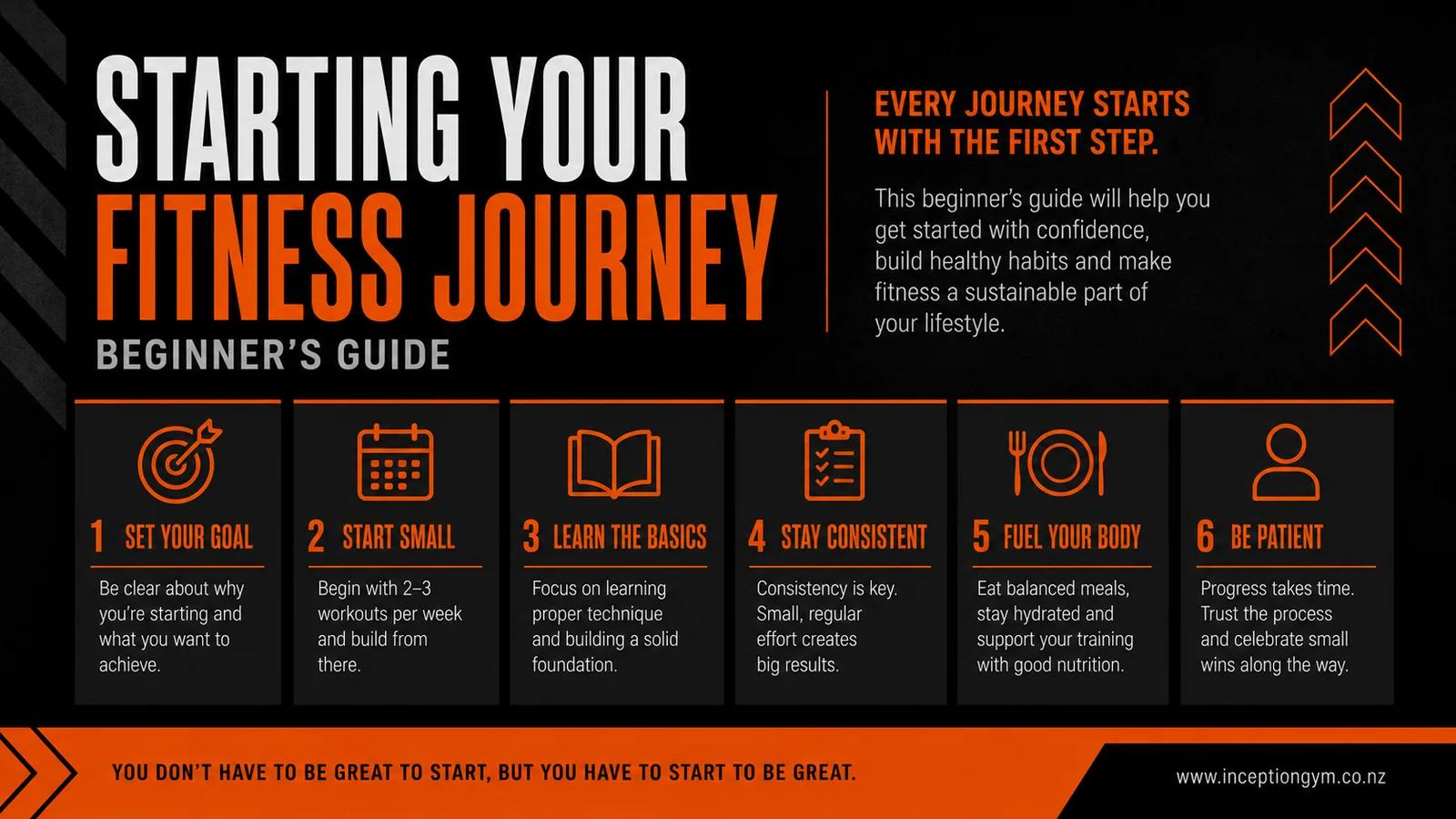
Starting your fitness journey as a beginner comes down to three simple things: train with machines that guide your form, go three times a week, and repeat the same short session until it feels automatic. Everything else is detail.
I'm Dr Matt Walley. My wife Elise and I built Inception Gym Christchurch in 2022, and I'm on our floor most days. I've watched hundreds of people walk in nervous on day one and walk out three months later wondering why they waited so long. This guide is what I'd tell you if you stopped me by the front desk.
Key takeaways
- Your first week is for learning, not lifting heavy. Three full-body sessions, machines only.
- Consistency beats intensity. Three days a week you actually keep beats five days you abandon.
- Track every session. Progressive overload is the whole game.
- Get a baseline body composition scan in week one. It's free for members and it catches progress the scale hides.
Why walking in feels harder than it is
Walking into a gym for the first time can feel like everyone is watching and everyone knows something you don't. I'll let you in on a secret from the operator's side of the desk: nobody is watching. The person squatting heavy next to you is thinking about their next set, not your technique.
That nervous feeling is real, and it passes faster than you expect. The difference between people who build a lasting habit and people who quit in a fortnight has nothing to do with genetics. It's environment, a realistic plan, and a place that doesn't make you feel judged for being new. We designed the whole gym around that last part.
The single biggest predictor of whether a beginner sticks is not how hard they train in week one. It's whether they felt welcome enough to come back in week two.
Why strength training matters most
If your picture of the gym is a row of treadmills, you're missing the part that actually changes your body. Strength training is the foundation. Training against resistance improves bone density, joint stability, metabolic health, body composition, mood and long-term independence as you age.
You don't need to become a powerlifter. You need to move against resistance, consistently, with a load that challenges you. On our floor that starts on simple, well-designed machines and progresses from there. If you want the deeper case for lifting over the decades, I've written it up in my training for longevity guide.
One thing I'll flag from years of intake conversations: women who start strength training tend to hesitate longest and then progress fastest. The longevity research keeps pointing the same direction, with female lifters showing meaningfully lower all-cause mortality than non-lifters. If that's you, read our piece on women and strength training before you talk yourself out of the free-weight area.
How do I choose the right beginner gym in Christchurch?
Four things matter when you're new. Everything else is marketing.
Equipment that guides you. You want a deep range of pin-loaded machines. These fix the movement path so you can learn to feel a muscle work without needing a spotter or perfect balance. We run 92+ machines across 72 variants inside an 800sqm floor, so a beginner is never stuck waiting or improvising. If you like specifics, browse the full equipment inventory.
A culture you can read before you arrive. Read the Google reviews. We hold a 5.0 rating across 1,090+ Google reviews, and a genuine share of them mention feeling welcome as a first-timer. That's not an accident of ours; it's the thing I care about most.
Hours that fit a life you're still figuring out. As a beginner you don't yet know when training fits. Our members have 24/7 access, 365 days a year, which removes the "the gym was closed" excuse entirely. More on why that matters in our 24/7 gym guide.
Real humans on site. We're owner-operated, and our team is on the floor during staffed hours (Mon-Thu 9am to 7pm, Fri-Sat 10am to 2pm, unstaffed Sundays and public holidays) for exactly the kind of quiet "how does this one work" question beginners are afraid to ask.
Your first week at the gym
The biggest mistake I see is doing too much, too soon. Week one is for learning, not for finding your limits.
Session 1: full-body introduction
Start on machines, not free weights. Pin-loaded machines guide you, so you can concentrate on feeling the right muscles instead of fighting for balance.
A simple starting routine:
- Leg press (3 sets of 12): quads, glutes, hamstrings. Set the seat so your knees hit roughly 90 degrees at the bottom.
- Chest press machine (3 sets of 12): chest, shoulders, triceps. Keep your back flat against the pad.
- Lat pulldown (3 sets of 12): back and biceps. Pull the bar to your upper chest, never behind your neck.
- Shoulder press machine (3 sets of 12): shoulders and triceps. Control the weight on the way down.
- Seated row (3 sets of 12): mid-back. Squeeze your shoulder blades together at the end of each rep.
Pick a weight where the last two reps feel genuinely hard but your form holds. If all 12 feel easy, nudge the weight up next time.
Sessions 2 and 3: repeat and refine
Run the exact same workout twice more that week, with a rest day between each. By session three the machines will feel familiar and you'll stop double-checking the seat height.
Rest days are not optional
Your muscles adapt between sessions, not during them. Three sessions in week one is plenty. Treat rest days as part of the programme, not a failure of willpower, and use them for a walk or some light stretching. Training every day as a beginner is the fastest route to burnout.
Building a routine you'll actually keep
Start with three days a week
Three sessions a week is enough to build real strength and shift your body composition, and it survives contact with a full-time job and a family. I'd rather you do three days for a year than five days for three weeks.
A simple three-day split once you're past week one:
- Day 1, upper body: chest press, lat pulldown, shoulder press, seated row, bicep curl, tricep pushdown
- Day 2, lower body: leg press, leg curl, leg extension, calf raise, hip abduction
- Day 3, full body: one exercise per major muscle group at moderate intensity
Track every session
Write down the exercise, weight, sets and reps. This is not optional admin; it's the mechanism. Progressive overload, gradually adding weight or reps over time, is what actually drives results. Without a log you're guessing.
Anchor training to your schedule, not your mood
Do not rely on motivation. Attach sessions to things you already do. "I train Monday, Wednesday and Friday at 6am before work" is a plan. "I'll go when I feel like it" is a wish, and wishes lose to a cold morning every time.
Ready to see the floor for yourself? Book a free 24-hour trial and walk through this exact first session before you commit to anything.
Nutrition basics for beginners
Three principles carry most of the weight here.
- Eat enough protein. Aim for roughly 1.6 to 2.0 grams per kilogram of body weight per day. For an 80kg person that's about 128 to 160 grams. Food first: lean meats, fish, eggs and dairy do most of the job, with supplements filling gaps. Our protein intake guide has the detail.
- Eat enough food overall. Undereating sabotages training. If you're lifting three times a week, your body needs fuel. Don't stack a brand-new programme on top of an aggressive calorie deficit.
- Stay hydrated. Dehydration quietly drags down performance and recovery. Drink through the day, not just during your session.
If nutrition feels like a fog, that's normal, and it's exactly why the Inception Group runs a PhD-led nutrition arm alongside the gym. You don't have to solve it alone.
The beginner mistakes I see most
Skipping the learning phase
Every exercise has a proper groove. Rushing heavy weight teaches your body sloppy patterns that are harder to unlearn than to learn right the first time. Prioritise technique over load for your first month. The strength follows.
Comparing yourself to everyone else
The person moving serious weight started precisely where you are. Comparison is the quickest way to feel discouraged. The only honest comparison is you this week versus you last week, which is another reason to keep that log.
Programme hopping
Pick a simple routine and hold it for at least eight weeks before you change anything. Consistency with a basic programme beats chaos with a "perfect" one every single time. If you want to understand the options before you settle, read training splits explained.
Ignoring recovery
Sleep is when muscle actually repairs. Aim for seven to nine hours. If you're training hard and sleeping badly, the results won't show up and you'll blame the wrong thing.
Going it alone when help is right there
Our team is on the floor during staffed hours and glad to help. Because Elise and I own and run the place, that attitude sets the tone. If you'd like structured guidance from the start, one of our personal trainers can build your first block around you.
Get a baseline body composition scan
One of the smartest things you can do in week one is get a baseline body composition scan. For our members these are free, every visit. A scan measures muscle mass, fat mass and body water across body segments, which is a far better signal than a bathroom scale.
Here's why it matters, and it's the observation I repeat most often on the floor: when you start lifting you'll often gain muscle and lose fat at the same time. The scale barely moves while your body genuinely changes shape. A scan catches exactly what the scale hides. This is why serious training is quietly retiring BMI as a useful measure.
Book your scan in week one, then repeat every six to eight weeks. Book a free body composition scan and give yourself a real starting line.
What your first month usually looks like
- Week 1: everything is new and you'll be sore after the first two sessions. That's DOMS, delayed onset muscle soreness, and it's normal. It fades as you adapt.
- Week 2: soreness drops. You set the machines up without checking. Confidence builds.
- Week 3: the weights start climbing. Movements that felt awkward feel natural, and you begin looking forward to sessions.
- Week 4: the habit is forming. Clothes often fit differently, and energy and sleep usually improve before the mirror does.
Why the environment does the heavy lifting
A gym should make you want to show up, not because of flashy marketing but because the equipment is good, the space is clean, and the people are decent. That's the whole job.
We built an 800sqm facility with 92+ machines, 43 of them plate-loaded and two squat racks, so beginners and seasoned lifters never have to compromise for each other. You'll find the right machine for your level, and you'll grow into the rest of the floor over time. We're at Tower Junction, 65 Blenheim Road, Addington, with 3,000+ free car parks and 24/7 member entry.
Ready to start?
Come and try it before you decide anything. Start with a free 24-hour trial and you'll get full access to every machine plus a complimentary body composition scan. When you're ready to join, our membership options start at $18.90 per week on a 24-month plan, or open-term at $33.90 per week with 28 days' cancellation notice. If your workplace is in the Fitness Passport network, we accept it with no tag fees and no sign-up fees, which is unique in Christchurch. I'll likely be on the floor. Come find me.