Equipment · Arms
Preacher Curl Machines: Why They Build Better Biceps Than Free Weights Alone
Why the preacher curl machine isolates the biceps better than standing curls: plate-loaded vs pin-loaded, setup and technique cues, rep ranges, and the options at Inception Gym Christchurch.
By Dr Matt Walley · 17 January 2025
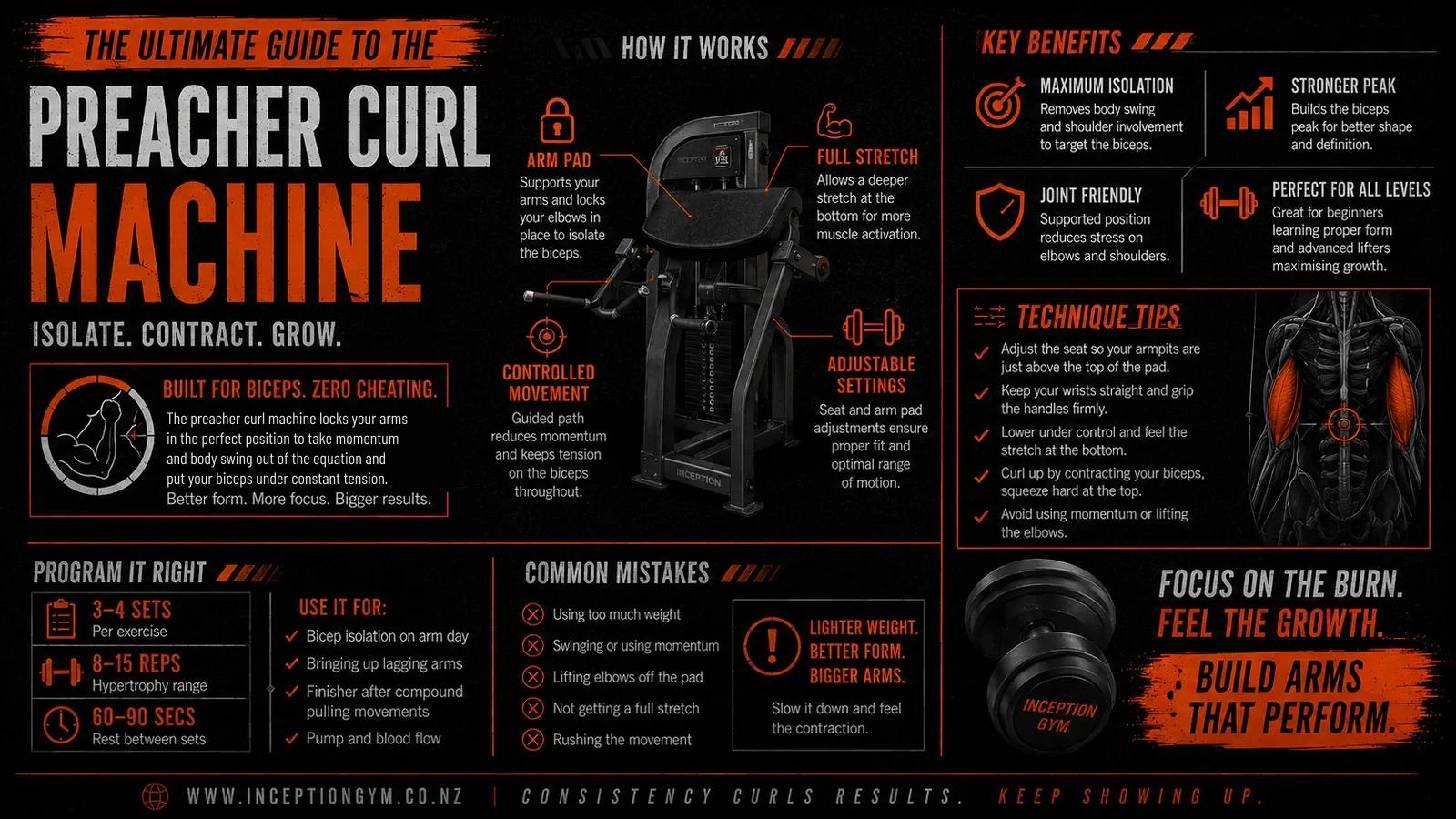
The preacher curl machine builds better biceps than standing curls because it braces your upper arm against a fixed pad, removing the elbow drift and shoulder swing that steal load from the muscle. Every kilogram runs through the bicep, and the stretched starting position is where most of the growth happens.
I am Dr Matt Walley, and I co-founded Inception Gym Christchurch with my wife Elise in 2022. I spend a lot of time on our floor, and the preacher curl is one of the machines I watch people use badly more than almost any other. Done right, it is the most honest bicep builder we own.
Key takeaways
- The preacher pad fixes your upper arm so the bicep is the only muscle that can move the weight.
- The stretched bottom position drives more growth than curling in a short range.
- The preacher angle preferentially loads the short head, which is the part most people under-train.
- We run both plate-loaded and pin-loaded preacher options on our floor; each has a job.
- Technique beats load every time on this machine. Ego wrecks it.
Why does the preacher position build better biceps?
The problem with a standing barbell curl is that the shoulder joint is free to move. As fatigue builds, the elbows drift forward, the shoulders shrug, and the back starts to swing. Each of those compensations shifts load off the bicep and spreads it somewhere else. You finish the set feeling like you worked hard, but the bicep was only under real tension for a handful of reps.
The preacher bench fixes the upper arm against an angled pad, usually 45 to 60 degrees. That removes the elbow drift and the shoulder involvement. The bicep is now the only structure that can move the forearm, so every kilogram on the bar or the stack runs through the muscle you are actually trying to grow.
There is also a mechanical reason it works so well. The bicep is a two-joint muscle: it flexes the elbow and it assists shoulder flexion. When the upper arm is braced forward on a preacher pad, the bicep starts each rep in a lengthened, stretched position. Training through a full range with emphasis on that stretch produces better growth than grinding away in a shortened range. The preacher curl delivers that stretch for free, which is exactly why I rate it.
Here is my honest opinion after four years on our floor: the preacher curl is the one arm machine where I would rather see someone use half the weight with a full stretch than double it with a bounce. The people with the best arms in our gym almost all curl lighter than you would expect.
Long head vs short head
The biceps brachii has two heads. The long head runs along the outer part of the upper arm and gives you the peak. The short head runs along the inner part and gives you width and thickness.
Because the preacher position places the arm slightly in front of the body, it preferentially loads the short head. That is a feature, not a flaw. Most people who train arms already do plenty of standing curls, hammer curls and incline curls, and all of those bias the long head. The preacher curl rounds the arm out by driving volume into the short head, which is usually the part that is lagging when someone tells me their arms are not filling out.
Plate-loaded vs pin-loaded preacher curl machines
At Inception Gym members can use both plate-loaded and pin-loaded preacher curl options, part of a floor that runs 92 machines with 43 of them plate-loaded. I deliberately bought both, and I want to explain why, because the difference matters more than most people assume.
Plate-loaded preacher curl machines
Plate-loaded machines use weight plates rather than a fixed stack. The main benefit is loading range: you can go very light for high-rep work or load it heavily for lower-rep strength sets. There is also a subtle difference in the resistance curve. Because a plate-loaded machine typically uses a direct lever arm, resistance is hardest in the mid-range of the curl, where the forearm is roughly parallel to the floor. That mirrors the sticking point most people already feel.
If you want to track progressive overload precisely, plate-loaded is the tool. Adding a 1.25kg or 2.5kg plate to each side is a far smaller jump than the next pin on a stack, and small jumps are what let you keep adding weight without your form falling apart.
Pin-loaded preacher curl machines
Pin-loaded machines use a weight stack with a selector pin, so changing load between sets is fast. That is genuinely useful in a time-limited session or for high-volume work with short rest, and given a lot of our members are Christchurch professionals training on a lunch break, that speed is not a minor thing.
Many pin-loaded preacher machines also use a cam or pulley that shapes the resistance curve to match the strength curve of the bicep. Instead of tension peaking at mid-range, a well-designed cam keeps tension more even through the whole movement. Some lifters get a noticeably better pump from that, and I have members who will only touch the pin-loaded unit for exactly that reason.
How do you use a preacher curl machine correctly?
The preacher curl is only as good as the technique you bring to it. Sloppy form still gets partial bicep activation, but it throws away the mechanical advantage you paid for by sitting down at the machine in the first place.
Setup
Set the seat height so that when your upper arms rest on the pad, your armpits are close to the top edge of the pad with no gap. Too high and your shoulder internally rotates and you feel discomfort instead of a stretch. Too low and your elbow loses contact at the bottom of the movement.
Grip the handles or bar at about shoulder width with a supinated grip, palms facing up. A neutral or hammer grip shifts the emphasis toward the brachialis and brachioradialis rather than the biceps brachii, which is a different exercise for a different day.
The rep
Start from the fully extended position. Do not slam into the lockout at the bottom; allow a controlled stretch without hyperextending the elbow. Drive the forearms up in a smooth arc, thinking about the bicep pulling rather than the hands yanking the weight. At the top, squeeze briefly, then resist the urge to let it crash back down.
Lower under control. The eccentric, the lowering phase, is where a large share of the growth stimulus comes from. Two to three seconds on the way down is a good target.
Common errors I fix on the floor every week
- Cutting the range short. People stop the descent before full extension because the stretch feels uncomfortable. That is precisely where the growth is. Ease into it if your tendons are sensitive, but do not permanently avoid the bottom.
- Gripping too hard. A white-knuckle grip fires up the forearm flexors and dampens the signal to the bicep. Firm but relaxed keeps the focus on the target muscle.
- Cheating at the top. A little shoulder shrug to move a stalled rep defeats the entire point of the machine. If you cannot finish the rep strictly, the weight is too heavy. This is the single most common thing I quietly correct.
Programming preacher curls
Bigger biceps take consistent progressive overload over months, not weeks. I treat the preacher curl as a complement to compound pulling and other curl variations, never a replacement. If you want the wider picture, our guide to arm training machines for biceps and triceps covers how the whole arm day fits together.
Volume
For most intermediate lifters, 10 to 16 sets of direct bicep work per week is productive. The preacher curl might account for 4 to 8 of those, with the rest coming from standing curls, incline curls, cable curls, and compound rows and pull-ups. If you want to go deeper on the numbers, our training volume guide breaks down weekly sets per muscle.
Rep ranges
Biceps respond to a spread of rep ranges. A structure I like:
- Heavy: 3 sets of 6 to 8 reps on the plate-loaded machine, full range, controlled eccentric.
- Moderate: 3 sets of 10 to 12 reps on the pin-loaded machine, slightly shorter rest.
- Pump: 2 to 3 sets of 15 to 20 reps, focused on the stretch and the squeeze.
Rest periods
Because the preacher curl is an isolation exercise with low systemic fatigue, 60 to 90 seconds of rest suits most sets. For heavy sets of 6 to 8, stretch it to 2 minutes so you actually recover.
Progressive overload
Track your weights and reps. When you can hit the top of your rep range across all sets with clean technique, add the smallest increment available. On a plate-loaded machine that might be 2.5kg total, 1.25kg per side. On a pin-loaded machine, one step up the stack. That sounds slow, but a 2.5kg increase every two or three weeks compounds hard over a training year, and slow honest progress is the only kind that lasts.
Beyond the machine
The preacher curl is one tool. Arm development is a whole-body project. Compound pulling like rows and pull-ups gives you serious bicep stimulus and lets you move more total weight than any isolation move, so make sure your programme carries enough pulling volume alongside the direct arm work.
Nutrition matters just as much. Muscle grows during recovery, not during the set. Adequate protein, roughly 1.6 to 2.2 grams per kilogram of bodyweight per day, gives your body the raw material for muscle protein synthesis. If you struggle to hit that, a quality protein can bridge the gap, and Inception Labs Collagen Whey Protein at our on-site Supplement Solutions store gives you whey isolate for recovery plus bovine collagen for joint health, at member pricing.
Want to know whether your arm work is actually adding muscle? Every Inception member gets free body composition scans so you can watch lean mass move instead of guessing in the mirror.
The verdict
The preacher curl machine is not a substitute for compound pulling, but it is the most effective tool I have for isolating the biceps brachii, particularly the short head. The fixed upper arm position removes the compensations, the stretched start maximises the growth stimulus, and having both plate-loaded and pin-loaded options lets you match the tool to the goal.
Related guides: the specialty bars guide, lat pulldown variations.
If you want to feel the difference between a real preacher curl and the swinging version you have been doing, come and use ours. Train free for 24 hours with full access to the floor, or see our membership options when you are ready to make it a habit. My machines are waiting, and so is Elise or I on most days.