Equipment · Free Weights
Specialty Bars Explained: Kabuki, Trap Bar, and Multi-Grip Options
A specialty bars guide from the owner of Inception Gym Christchurch: how the Kabuki, trap bar, and multi-grip bars reduce joint stress and let you keep training through niggles.
By Dr Matt Walley · 19 November 2024
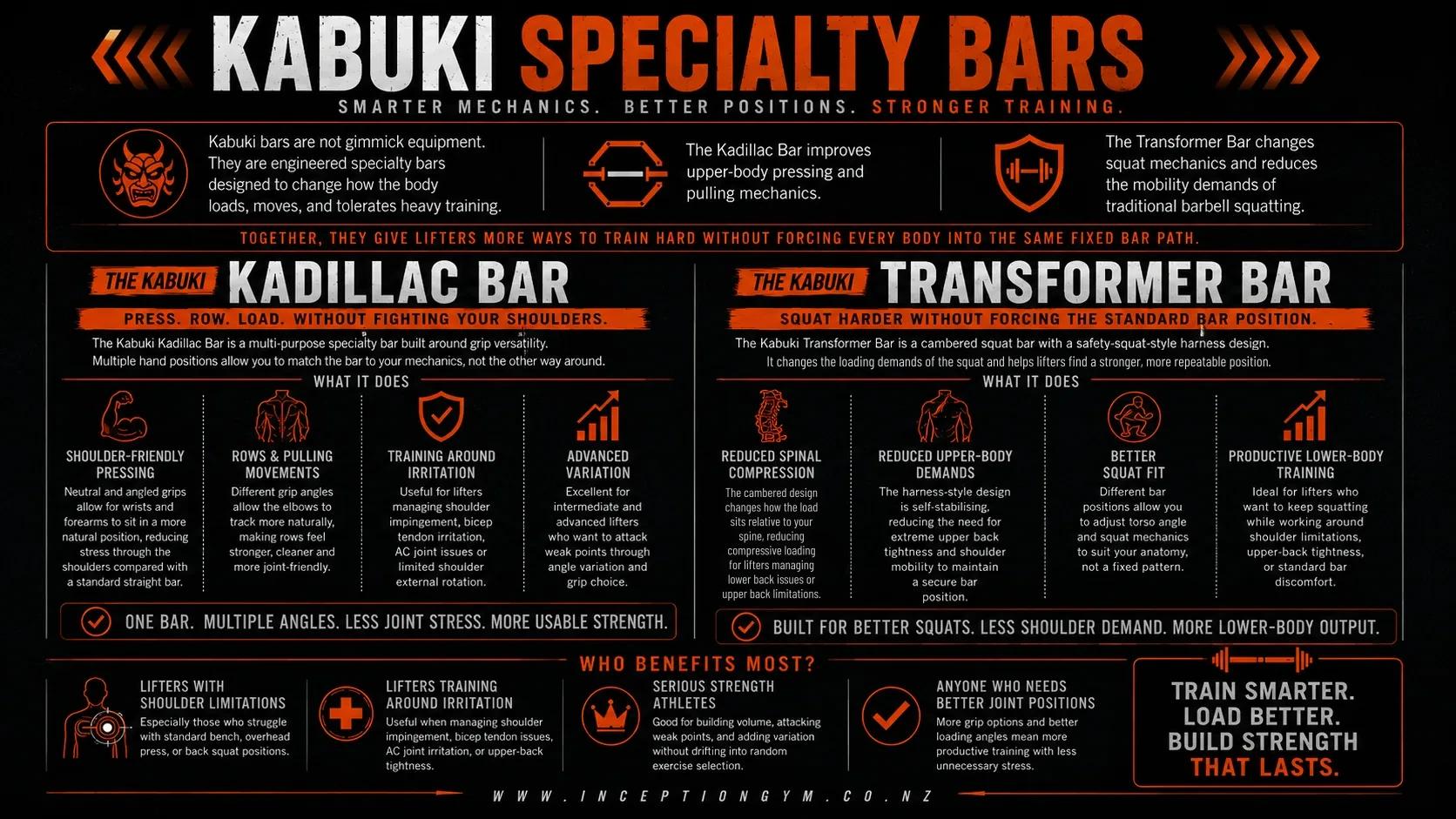
Specialty bars are not novelties. They are engineering solutions to real training problems: how to keep pressing when your shoulder is cranky, how to squat heavy without punishing your lower back, how to deadlift productively when conventional mechanics leave you sore in the wrong places. I put specialty bars on our floor at Inception because they are the difference between a member training around a niggle and a member stopping altogether.
I am Matt Walley, and I co-founded Inception Gym Christchurch in 2022. I am on our floor at Tower Junction most days, and this is my honest guide to the specialty bars we run, what each one actually does, and who should reach for it.
Key takeaways
- A specialty bar changes grip width, grip angle, load position, or bar path so the movement fits your body instead of forcing your body to fit the bar.
- The Kabuki Kadillac and the multi-grip bar rescue pressing volume when your shoulder will not tolerate a straight bar.
- The Kabuki Transformer bar takes compression off the spine while you keep squatting heavy.
- The trap bar centres the load, cutting the moment arm on your lower back and letting you hinge hard through a niggle.
- Use them strategically alongside the straight bar. Do not throw the straight bar out.
Why do specialty bars exist?
The standard straight Olympic barbell is a general-purpose tool. It has been the foundation of strength sport for over a century and it works for a wide range of movements. But a general-purpose tool carries specific constraints, and for a lot of people those constraints turn into real problems.
The three I see most often on the floor:
- Wrist and shoulder position during pressing. A fixed-width pronated grip on a straight bar demands a set amount of shoulder external rotation and wrist extension. For anyone with impingement, an old injury, or limited external rotation, that position ranges from uncomfortable to unsustainable.
- Bar path constraints during squatting. A straight bar on your back fixes the load vector relative to your centre of mass. Torso length, femur length, and hip anatomy mean the ideal bar path is genuinely different from one person to the next.
- Spinal loading in deadlifts and carries. A conventional bar sits in front of the body, which creates a moment arm that loads the lumbar spine. Move the load closer to your centre and you change the mechanical demand entirely.
Specialty bars address these by changing grip, orientation, load distribution, or path. The outcome is usually a movement that is biomechanically more appropriate for a specific person or a specific goal. That is the whole point.
The best bar is not the strongest-looking one. It is the one that lets you keep training hard this week, next week, and in ten years. That is the bar I want in a member's hands.
The Kabuki Kadillac bar
The Kadillac is a multi-purpose bar engineered by the Kabuki Strength team, and it is one of the more serious investments a gym can make in barbell quality. When I costed our equipment fit-out, bars like this were not the cheap option. I bought them anyway, because I would rather own a floor where a sore shoulder does not end someone's training block.
What it does
The Kadillac carries multiple grip positions: neutral handles, angled handles, and traditional pronated options. That versatility lets it work for:
- Shoulder-friendly pressing. Neutral or angled handles let the wrists and forearms sit in a natural rotation rather than the locked pronation of a straight bar. For impingement or rotator cuff issues, pressing on neutral handles noticeably drops the shear and compressive load at the joint.
- Rows and pulling. The same grip options let the elbows track a path that suits your mechanics instead of a fixed one.
- Loaded carries and odd loading. The handle configurations make it genuinely useful for farmers carry variations and unconventional work.
Who benefits most
- Lifters with shoulder impingement, biceps tendon irritation, or an angry AC joint who need to hold their pressing volume without feeding the injury.
- Anyone with limited shoulder external rotation who finds the straight-bar press position uncomfortable.
- Intermediate and advanced lifters attacking pressing weak points through angle variation.
The Kabuki Transformer bar
The Transformer bar is about squatting. It is a cambered squat bar with a safety-squat-style harness, and it rewrites the mechanical demand of the squat.
What it does
The bar sits across your upper back on shoulder pads while your hands hold handles in front of you. That produces a few distinct changes against a standard back squat:
- Reduced spinal compression. The camber shifts the bar's centre of mass relative to your spine, easing the compressive load that troubles lifters with disc history or upper-back limitations.
- Lower upper-body demand. Because the harness self-stabilises, it does not ask for the same upper-back tightness and shoulder mobility a back squat demands. People who cannot lock into a secure back-squat rack position can still squat productively here.
- Variable torso angle. The bar tolerates different torso positions, so it is easier to find a squat that fits your anatomy rather than forcing one pattern.
Here is a first-hand observation. The Transformer bar is one of the most under-used bars in the building, and it is a shame, because it is exactly what a lot of our over-40 members and desk-bound professionals need. If a straight-bar back squat lights up your lower back, this bar often lets you keep loading the legs the same day, no drama. I would rather see someone squat heavy on the Transformer than avoid squatting altogether. If you want the full breakdown of squat pattern selection, my leg day guide and the pendulum squat guide sit alongside this nicely.
Who benefits most
- Lifters with lower back or disc sensitivity where high-compression squatting is off the table.
- Anyone whose shoulder or upper-back mobility makes a back-squat rack position painful.
- Powerlifters and strength athletes using it as an accessory to build quad strength from a different angle.
The trap bar (hex bar)
The trap bar, also called a hex bar, puts you inside the frame instead of behind it. That one change in load position carries real mechanical weight.
What it does
When you deadlift with a trap bar, your hands are at your sides and the load is centred on you rather than out in front. That shifts several variables:
- Reduced moment arm on the lower back. A conventional deadlift forces a bar path that creates a large moment arm at the lumbar spine. The centred trap-bar load cuts that down, and biomechanics comparisons consistently measure lower peak lumbar force in the trap bar deadlift at matched load.
- More quad involvement. The centred load lets you hold a more upright torso, which pulls the quads into the lift. That makes it a strong pick for athletes who need posterior chain and quad development together.
- Higher handles cut the range demand. Most trap bars have a raised-handle option, which shortens the pull off the floor. That helps beginners and anyone with hip mobility limits.
Trap bar exercises beyond deadlifting
The trap bar is more versatile than most lifters realise:
- Loaded carries. Held at your sides for a farmers walk, it is one of the most joint-friendly ways to load a carry.
- Jump training. The centred load makes it excellent for loaded jump squats, which is why athletic programmes lean on it.
- Romanian deadlift. The hip-hinge pattern translates cleanly to a trap bar RDL.
Who benefits most
- Lifters managing lower-back sensitivity who want to keep heavy hip hinging.
- Athletes needing quad and posterior chain work in the same movement.
- Beginners learning to hinge, where the forgiving mechanics make technique stick faster.
The multi-grip Olympic bar
A multi-grip bar, sometimes called a Swiss bar or football bar, runs a set of parallel handles at various widths along a horizontal frame. Like the Kadillac, it solves the wrist and shoulder problem in pressing, through a different design.
What it does
The parallel handles let you press with a neutral grip, palms facing each other, which sits the shoulder in a far more comfortable position than the pronated grip of a straight bar. That matters for:
- Bench press variations. Neutral-grip pressing reduces the external rotation required and often clears up impingement-style pain in pressing.
- Overhead pressing. The neutral overhead option is kinder to the shoulder than a pronated overhead press.
- Close-grip work for triceps. The narrower handles let you train close-grip pressing with far less wrist strain.
I will be blunt about why I run both the multi-grip bar and the Kadillac when one could arguably cover the job. Members have different shoulders, and small differences in handle spacing and angle are the difference between pain-free and not. Depth of choice is the whole reason people drive past three other gyms to train with us. That is also why we hold 92 machines across 72 variants, 43 of them plate-loaded, in an 800 sqm floor. Options are the product.
Who benefits most
- Any lifter with shoulder discomfort during straight-bar pressing.
- Lifters wanting pressing variation without feeding an injury.
- Anyone whose wrists object to the fixed pronation of a straight bar.
How do you integrate specialty bars into training?
The best approach is not to bin your straight-bar work. It is to use specialty bars with intent.
- For injury management. If a shoulder issue makes straight-bar pressing painful, swap your main press for a neutral-grip option on the Kadillac or multi-grip bar and hold your volume. Keep straight-bar work wherever you are pain-free.
- For movement quality. If mobility or proportions limit your squat, run the Transformer bar as a primary squat while you build the mobility a back squat needs.
- For posterior chain with a sensitive back. Make the trap bar your primary deadlift variation while you manage a lower-back issue.
- For advanced variation. Even injury-free, intermediate and advanced lifters gain from specialty bars as supplementary movements. Different angles and load positions build strength across a broader range of mechanics. If you want to structure that properly, pair this with my free weights vs machines guide.
This is the same logic behind everything on our floor. The most defensible thing about Inception is not one flashy bar; it is the depth that lets a beginner, a masters athlete, and a competing powerlifter all train hard in the same room without compromise. That depth is why we are, in my honest and slightly biased view, the best gym in Christchurch, and it is backed by a 5.0 rating across 1,090+ Google reviews.
Come and use them
If you are unsure how to set up or use any of these bars, grab me or one of the team during staffed hours at Tower Junction, Addington, and we will walk you through it. That is what we are here for.
Related guides: back training machines at Inception, arm training machines for biceps and triceps.
The simplest way in is a free trial: come in, put your hands on the Kadillac, the Transformer, the trap bar, and the multi-grip, and feel the difference on your own joints. If you want a plan built around your body and any niggles you are carrying, book a free body composition scan and we will start from real numbers. I will see you on the floor.