Equipment · Legs
The Pendulum Squat: Why This Machine Is a Game Changer for Leg Training
The pendulum squat delivers deep-range quad training with minimal spinal stress. What it is, how it differs from the leg press and hack squat, and how I programme it at Inception Gym Christchurch.
By Dr Matt Walley · 10 February 2025
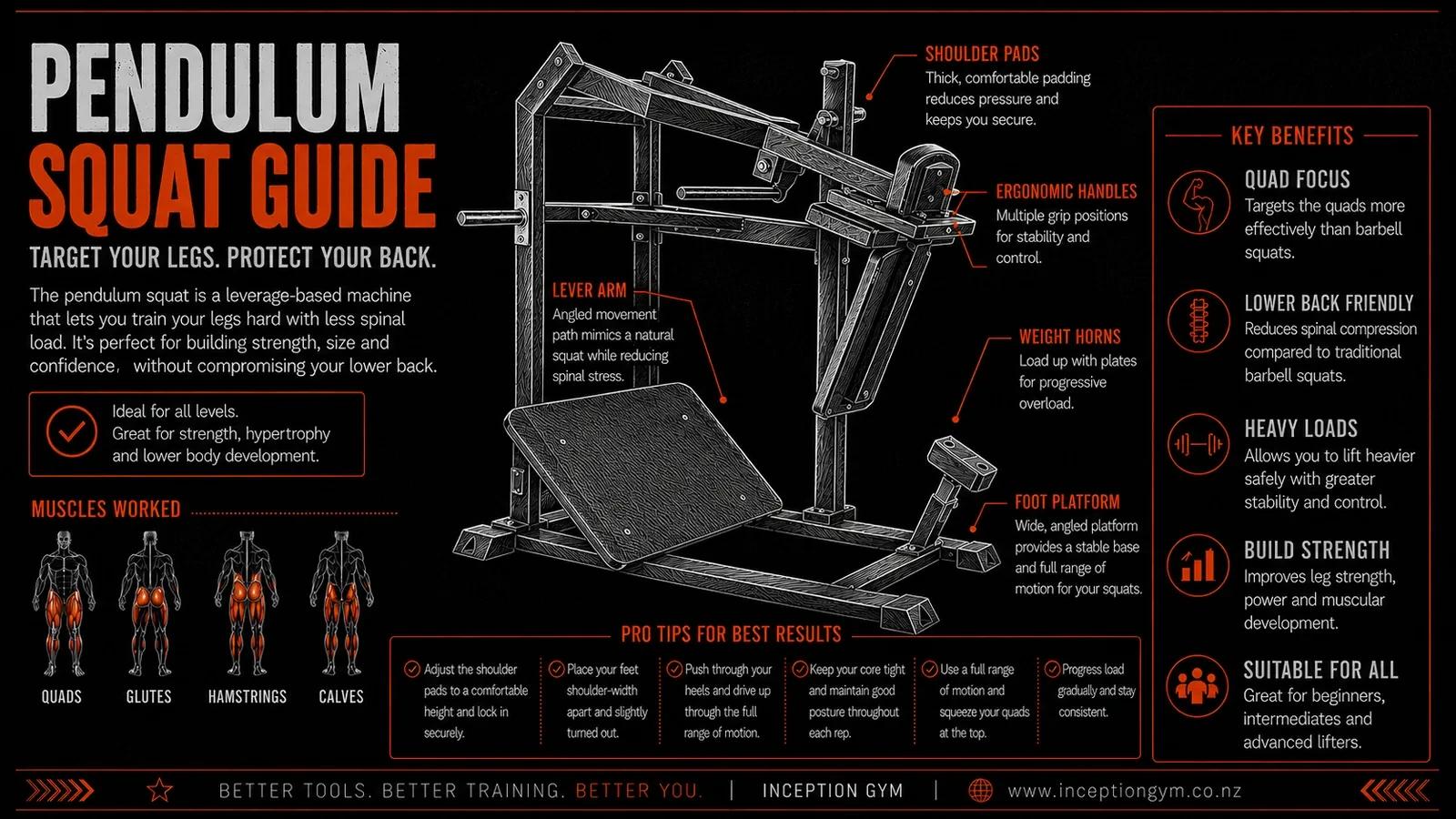
The pendulum squat is a plate-loaded machine that moves the resistance through a curved arc instead of a straight track, so it loads your quads deeply at the bottom while taking the barbell off your spine. It is the single best machine I own for building serious leg size without grinding down your lower back.
I put a pendulum squat on our floor at Inception Gym Christchurch because almost no gym in the city has one, and after two years of watching members train on it I am more convinced than ever it earned its footprint. This guide covers what a pendulum squat is, why the biomechanics beat the leg press and hack squat, who it helps most, and exactly how I programme it.
Key takeaways
- The pendulum squat loads the quads hardest at peak knee flexion, where most machines go easy on you.
- The load sits on your shoulders through pads, not axially through your spine, so it is far kinder to your lower back than a barbell squat.
- The heel-elevated platform lets most people hit a depth their ankle mobility would never allow under a barbell.
- It is one of the few in Christchurch, and it slots into a leg day as either the main lift or high-rep finisher.
What is a pendulum squat?
A pendulum squat is a plate-loaded squat machine where the resistance arm swings through a pendulum arc rather than sliding along a linear track. The shoulder pads and foot platform hang off a pivot point, so as you sit down the weight travels in a circular path around that pivot.
That arc is the whole point. It produces a loading pattern that feels far closer to a real squat than a leg press or hack squat, while still giving you the balance and safety of a machine. You are not fighting to stay upright, you are just squatting.
The foot platform is angled, heels raised relative to the toes. That built-in heel elevation keeps your torso more upright and lets your knees travel forward over your toes, which is exactly the range most people lose in a free squat because their ankles will not cooperate.
Why do the biomechanics beat a leg press or hack squat?
Here is where the pendulum squat separates itself from the two machines people assume it is a copy of. It is not.
Leg press comparison
The leg press supports your back at an angle and has you press the weight away along a fixed track. The range is locked, the resistance curve does not match how a squat actually loads, and there is almost no demand on your trunk. It loads the quads in a knee-dominant press with very little hip movement. Useful, but it is a different tool. I break the two down side by side in my hack squat vs leg press guide.
Hack squat comparison
The hack squat pins your back to a pad and runs you along a fixed straight line. It is more squat-like than the leg press, but the fixed track means your body has to conform to the machine instead of the machine accommodating you. For some lifters that creates awkward joint angles, especially at the turnaround from descent to ascent.
What the pendulum does differently
Because the pendulum moves through an arc, it follows the natural path your hips and knees want to take rather than forcing them onto a straight line. The pads support you without dictating your joint positions. It feels like a squat, not a mechanical press.
The arc also changes the resistance curve. At the very bottom, when your knees are most bent, the geometry loads the quads hard. That spike in tension at deep knee flexion is the reason lifters keep coming back to it, and it is the reason I chose this machine over adding a second hack squat.
How does the pendulum squat target the quads?
Your quadriceps are four muscles: rectus femoris, vastus lateralis, vastus medialis and vastus intermedius. To grow them you need knee flexion under load through a meaningful range. The pendulum squat delivers on three fronts.
- Greater depth. The heel-elevated platform and forgiving arc let most people reach a depth they cannot touch under a barbell. More depth means more range through the quad, and range is one of the most reliable levers for growth.
- Reduced posterior chain involvement. A barbell squat pulls in a lot of glute and hamstring, especially out of the hole. The supported position on the pendulum keeps the load parked on the quads instead of leaking into the hips.
- Consistent tension across the range. The arc holds real tension on the quads through the whole rep, including near the top where many squat variations give you a rest you did not ask for.
After two years on our floor, the pendulum squat is the machine I point new members to when they say they want bigger legs but their back has always talked them out of squatting.
Is the pendulum squat easier on your back?
Yes, and this is the part that matters most for longevity. A barbell squat drives load straight down your spine through the bar on your upper back, compressing the vertebral column. With good technique and sensible loading that is manageable for most people, but it is a real demand on your lower back and core rep after rep, year after year.
The pendulum squat routes the load to your shoulders through pads, not axially down your spine. Your torso stays largely free of that compression. The result is high-intensity quad work without the spinal tax.
Who benefits most
- Anyone with a history of lower back injury or disc issues
- Taller lifters who find barbell squat geometry genuinely awkward
- Older athletes who want to keep quad volume high without the wear of heavy barbell squatting
- Anyone managing cumulative spinal stress across a training week
- Athletes in other sports who cannot afford a tweaked lower back
None of this means the pendulum squat replaces the barbell. If you squat well and your back is healthy, the barbell squat is still a foundational movement. But the pendulum fills a role the barbell cannot: heavy, deep, high-quality quad training with a fraction of the spinal demand. That is exactly the sort of trade-off I think about when I plan training for lifters over 40 and anyone training for the long game.
Technique
Setup
Set the shoulder pads onto your upper traps, the same place a high-bar barbell squat sits. Feet roughly hip to shoulder width on the platform. Play with toe angle. Most people find a slight toe-out, around 20 to 30 degrees, gives more comfortable depth and better quad engagement.
The descent
Unlock the machine and lower under control. Keep your weight spread across the whole foot rather than drifting onto toes or heels. Stay upright, the raised heel makes that easy. Sink to full depth, or the deepest point where you can hold a neutral spine and comfortable joints.
Target depth. More depth means more range through the quad. If your mobility and joints allow, aim for thighs approaching or reaching parallel with the floor. The arc accommodates that far more comfortably than a barbell ever will.
The ascent
Drive through the full foot and push the weight back up through the arc. Keep the knees tracking over the toes, not caving in. At the top, do not fully lock out between reps if you are chasing continuous tension.
Breathing and bracing
Inhale and brace at the top before you descend. Hold the brace down and through the first part of the drive back up. Exhale as you near the top. Bracing matters less here than under a barbell, but it still steadies you.
How should you programme the pendulum squat?
It works as either your main quad lift or a secondary movement, and I use it both ways depending on the member.
As a primary quad movement
Treat it with the respect you would give a barbell squat. Work in the 6 to 12 rep range with genuinely hard weight, and add load when you can finish the top of your rep range with clean form.
Example primary slot:
- Pendulum squat: 4 sets of 8 to 10
Follow with a leg curl for hamstring balance and a single-leg or isolation move for extra volume.
As a secondary movement
Pair it with a barbell lift in the same session. The barbell gives you the heavy, neurally demanding stimulus. The pendulum piles on isolated quad volume without adding to the spinal bill.
Example pairing:
- Barbell squat: 4 sets of 5 to 6 (strength focus)
- Pendulum squat: 3 sets of 10 to 15 (hypertrophy, higher rep)
High-rep pendulum work after heavy barbell squats is effective precisely because the machine keeps you safe when fatigue is chewing into your stability and focus.
Volume
The quads are a big muscle group with a large appetite for volume. Fifteen to twenty hard sets a week across two leg sessions is a sensible target for most people. The pendulum squat can carry 6 to 10 of those depending on what else is in the leg day. If you want more on managing weekly load, I go deeper in my training volume guide.
Where can you train on a pendulum squat in Christchurch?
On our floor. The pendulum squat sits inside a room of 92 pieces of equipment across 800 sqm at Tower Junction, 43 of them plate-loaded, with a full range of pin-loaded and plate-loaded machines so you can run a serious leg programme without waiting or compromising. You can see the full inventory on the equipment page.
If you want a leg protocol built around the pendulum squat and the rest of the floor, our personal trainers in Christchurch will build one around your training and your history. And every member gets a free body composition scan to track whether the work is actually turning into muscle.
The bottom line
The pendulum squat fills a specific role: deep-range, high-quality quad training with minimal spinal stress. For anyone managing a cranky back, for older lifters protecting their longevity, and for anyone who wants to pour volume into their legs without the injury risk of heavy barbell squatting, it is one of the most useful machines I have ever put on a gym floor.
Related guides: belt squat benefits, leg extensions and hamstring curls.
Come and try it. Book a free 24-hour trial and put a set in yourself, or check the membership options if you already know you want in. We are rated 5.0 across 1,090+ Google reviews, we are open 24 hours a day, and I am often on the floor myself. Come find me and I will show you how the machine works.
---
Inception Gym is located at Tower Junction, 65 Blenheim Road, Addington, Christchurch. 24 hours, 7 days, 92 pieces of equipment including the pendulum squat. [Book a free trial](/memberships/free-trial) or [claim your free body scan](/free-body-scan-christchurch).