Equipment · Legs
Belt squat benefits: the spine-friendly leg builder
Belt squat benefits explained by Dr Matt Walley: how it loads your legs hard while sparing your spine, and who gets the most from it at Inception Gym Christchurch.
By Dr Matt Walley · 5 September 2025
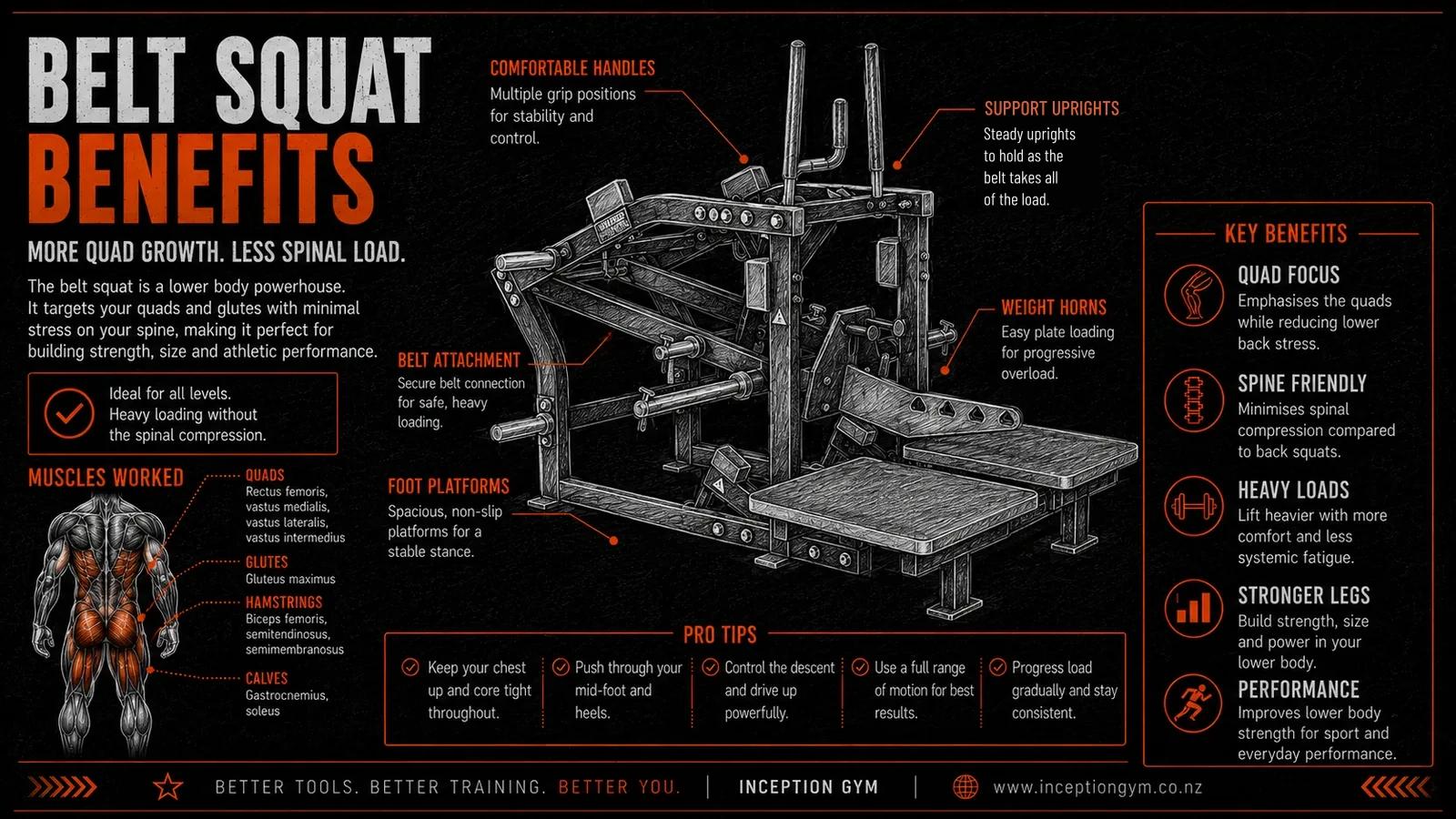
The belt squat loads a full squat pattern through a belt around your hips instead of a bar across your back, so your legs, glutes, and hips work against heavy resistance while your spine carries none of the external load. That single property is why I put a plate-loaded belt squat on our floor: it is the most valuable leg machine we own for lifters with back issues, tall lifters, and anyone managing decades of training under their belt.
Key takeaways
- The belt squat gives you real leg loading with zero axial compression on the spine.
- It is the tool that keeps people with back issues, tall lifters, and older athletes training legs hard.
- Set the belt at the iliac crest, not the waist, or you defeat the whole point.
- It pairs cleanly with our pendulum squat: one spares the spine, the other isolates quads.
- I chose it for training value, not floor familiarity, and it earns its space every day.
What are the benefits of a belt squat?
The belt squat is one of the most under-used pieces of kit in strength training, and I think that is a mistake. The biomechanics case has been solid for decades, yet it still rarely turns up on a commercial gym floor.
The reason is almost never about training. Belt squat machines are expensive, they take up real floor space, and they need a quick explanation for members who have never used one. Those are business considerations. When you buy equipment for what it does rather than what people already recognise, the belt squat earns its place fast. We run a lot of experienced lifters, professionals over 35, and people training around old injuries, and I bought it for exactly that room. You can see where it sits in the full equipment list.
The belt squat is not a rehab consolation prize. It is the machine that lets a strong lifter with a cranky back keep training legs like a strong lifter.
The core idea: load without spinal compression
In any squat with the load on your back or shoulders, the weight travels through your spine to your hips and legs. That is axial loading: vertical compression on the vertebral column. With good technique and sensible load management it is fine, and even beneficial for spinal health. Heavy barbell squatting does not damage a healthy spine when done correctly, and I want to be clear about that.
But axial loading has limits. For someone with disc issues, an old lower back injury, spinal stenosis, or simply high cumulative load from years of training, barbell squatting becomes a compromise. You drop weight, drop volume, or drop frequency to manage the back. Every one of those reduces the leg stimulus that you actually came for.
The belt squat solves it. The load attaches to a belt around the hips, not the back. The spine carries no compression from the external weight, the torso stays free and unloaded in a natural position, and the legs, hips, and posterior chain do the work. The spine is out of the equation, and that is not a minor difference. It changes what is possible in leg training for a lot of people.
How a belt squat machine works
The common design is a platform raised off the ground with a plate-loading system below. You stand on the platform with a hip belt attached to the resistance, and as you squat, your hips drop below platform level so you get full depth with no ground interference.
Some designs use a lever arm or cable to transfer the load. The essential feature is always the same: the load pulls from the hips, not the shoulders.
Setup matters more than people expect. The belt sits at hip level around the iliac crest, not at the waist. Too high and it pulls on the lower back rather than the hips, which quietly reintroduces the exact problem you were avoiding. Set correctly, it creates a clean downward pull that lets you squat naturally.
Who benefits most from a belt squat?
People managing lower back issues
This is the use case that makes the belt squat essential rather than optional. Someone who cannot barbell squat because of disc issues, lumbar pain, or an old lower back injury can often belt squat without restriction or discomfort. The movement loads the legs in a full squat pattern without touching the problem area.
I have watched members who had written off heavy leg training rediscover it on this machine. For that group it is not a regression. It is the tool that lets real progressive leg work continue despite a back limitation that would otherwise cap everything below the waist.
Tall lifters
Long-legged lifters face mechanics that shorter lifters do not. A long femur forces more forward lean to stay balanced, which loads the lower back more even with perfect technique. Plenty of tall lifters find the lower back is always the limiter: it fatigues before the legs have been pushed anywhere near hard enough.
Belt squatting removes the geometry problem. The torso sits as upright as feels natural, the hips settle where they need to, and the legs work to capacity without the back being the bottleneck.
Lifters prioritising longevity
If you train with a long-term view, managing cumulative spinal stress is a sensible goal. Decades of heavy barbell squatting stack up real axial load. Swapping some of that volume for belt squats, or running the belt squat as your primary quad and posterior chain movement for a block, keeps intensity high while giving the spine a lower-stress period. This is not about avoiding challenge, it is load management over a long career, and it sits at the heart of how I think about training for longevity.
High-volume leg blocks
During hypertrophy blocks where leg volume is high, the belt squat lets you keep total volume up without the spinal cost of doing all of it on a barbell. The legs get full stimulus, the back gets relative recovery. If you want the theory behind how much is enough, our guide to training volume and sets per week lays it out.
Older athletes
Muscle mass declines with age and resistance training is the most effective intervention we have. As training age climbs, so does the importance of protecting joint and structural health. The belt squat lets older athletes train lower body hard without the cumulative spinal load of conventional barbell work, which is one reason it comes up so often when I talk about training intelligently after 40.
Technique
Belt position
Belt at the iliac crest, the widest part of the hips. Play with the exact height to find the position that gives the most natural torso angle and the most comfortable mechanics for your proportions. This is the single setting people get wrong, so give it a minute before you load up.
Stance
A stance slightly wider than a conventional squat works well for most people. The hip pull tends to encourage hip-width or slightly wider foot placement, with toes turned out 20 to 30 degrees.
Torso position
Because the spine is unloaded, you have real freedom in torso angle. Slight forward lean if your proportions need it, very upright if you prefer. Neither is wrong as long as the movement feels good and you hit depth. The upright torso that comes naturally on the belt squat is why it biases the quads, while the glutes and hamstrings still contribute, without the lower-back demand a barbell imposes.
Depth
The raised platform exists specifically to let you hit full depth without the floor getting in the way. Use it. Deep squats here are accessible for most people regardless of ankle mobility, because the torso-free position lets you adjust. Work toward thighs at parallel or below to get full quad involvement.
The descent
Lower slowly and under control, two to three seconds. Controlled eccentric loading is where a lot of the muscle and tendon adaptation lives. Dropping the weight is wasted work and it raises the risk of knee discomfort at the bottom.
The drive
From the bottom, drive through the heels and push the floor away. Think about pushing the hips up and through rather than just straightening the legs. That cue keeps it squat-like instead of turning into a straight-leg press.
Belt squat vs other quad machines
We also run a pendulum squat, which sits in a different role in the leg toolbox. Knowing when to reach for each is how you programme both well.
Belt squat strengths.
- Complete spinal unloading
- Natural, unconstrained movement mechanics
- Full posterior chain engagement, with glutes and hamstrings contributing more than on the pendulum squat
- A genuine primary squat substitute for people with back issues
Pendulum squat strengths.
- Strong quad isolation through the arc mechanics
- Convenient plate loading from a fixed machine
- A slightly more quad-dominant loading profile
- A different stimulus that complements the belt squat in the same programme
Using both across a training week covers different aspects of lower body development. A session with the belt squat as the primary movement and the pendulum squat as a secondary quad piece is a structure plenty of our experienced members use. If you are weighing machine versus barbell more broadly, our take on free weights versus machines is worth a read.
Programming belt squats
The belt squat works across a wide rep range. Heavy work at 4 to 8 reps builds strength and neural drive. Moderate work at 8 to 12 reps is the hypertrophy sweet spot. Higher reps at 15 to 20 develop muscular endurance and give a different training quality.
Example leg session.
- Belt squat (primary): 4 sets of 6 to 8 (strength)
- Belt squat (finisher, same movement): 1 set of 15 to 20 (metabolic)
- Romanian deadlift: 4 sets of 8 to 10 (hamstring and posterior chain)
- Leg extension: 3 sets of 12 to 15 (quad isolation)
- Lying leg curl: 3 sets of 12 to 15 (hamstring isolation)
That structure gives you serious quad, hamstring, and posterior chain volume while keeping spinal loading to only the Romanian deadlift. Want it dialled to your history and goals? Book a free trial and I will happily point you at the setup that fits your body on the day.
Carrying the habit across a training life
What makes the belt squat genuinely important is not just what it does for your training today, it is what it enables long-term. The members I watch train intelligently for decades look different from those who train recklessly for a few years and then stop because of injury.
The ability to train hard in your 50s and 60s depends partly on decisions you make in your 30s and 40s about structural load. Treating the belt squat as a regular tool, not just a rehab option, is one of those decisions, and it is one I make for myself.
Come and try it
Related guides: hack squat vs leg press, the hyperextension and lower back guide.
The belt squat is already on our floor at Tower Junction, alongside the pendulum squat and the rest of our 92-plus pieces, in an 800 sqm room that runs 24 hours a day, 7 days a week. We are the highest-rated gym in New Zealand at 5.0 across 1,090+ Google reviews, and I would rather you felt the machine under load than took my word for any of this. Book your free trial or claim a free body composition scan to see where your legs stand before you start. The belt squat is waiting.
---
Inception Gym at Tower Junction, Christchurch has a plate-loaded belt squat alongside a pendulum squat, part of the 92-plus pieces of equipment on the floor. [View the full equipment list](/facilities/equipment) or [explore membership options](/memberships).