Equipment · Legs
Hip Thrust Machine: The Best Way to Build Stronger Glutes
The hip thrust machine gives you cleaner glute loading and easier progressive overload than a barbell. Here is how I set it up at Inception Gym Christchurch, rated 5.0 across 1,090+ Google reviews.
By Dr Matt Walley · 31 March 2025
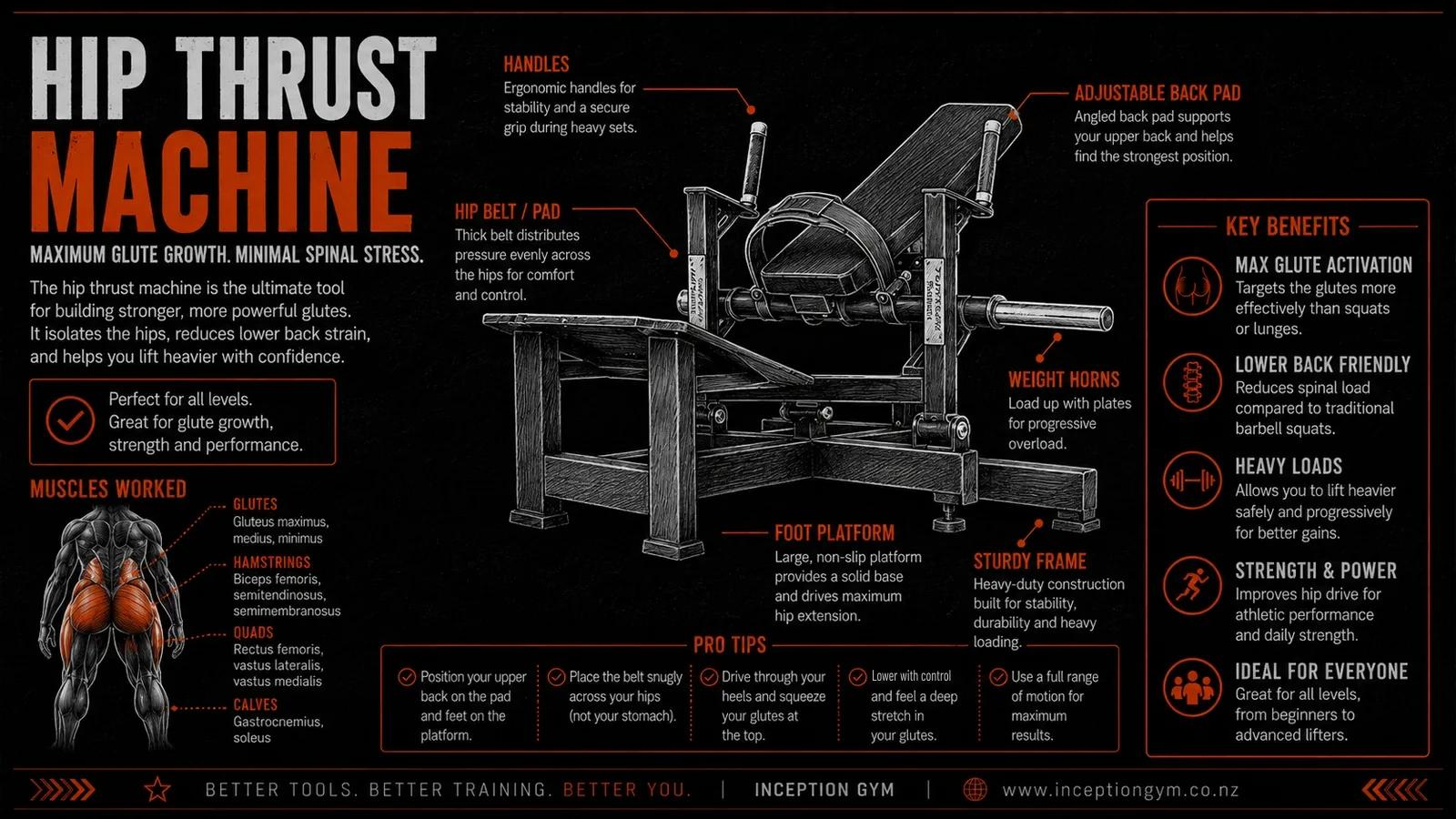
The hip thrust machine is the best way to build stronger glutes for most people because it loads the muscle hardest exactly where it is strongest, at full hip extension, and it makes progressive overload easy in a way the barbell version never does. I am Dr Matt Walley, and I bought both a plate-loaded hip thrust machine and a dedicated glute bench for our floor because I got tired of watching good lifters give up on barbell hip thrusts for reasons that had nothing to do with their glutes.
Key takeaways
- The hip thrust loads the glute at full extension, where it is strongest, which is why it out-recruits the squat and deadlift for direct glute work.
- A plate-loaded machine fixes the barbell version's real problems: the bar rolling, the padding, and the slow setup.
- Small plate jumps make progressive overload precise, which is the whole game for glute growth.
- At Inception we run both a plate-loaded hip thrust machine and a dedicated Bret Contreras glute bench, so you can train either way.
- Two direct sessions a week, taken close to failure across 8 to 15 reps, is a sane starting point for most members.
Why does the hip thrust build glutes so well?
The glutes are the largest muscle group in the body, and they are chronically undertrained. Most people load them hard in the bottom of a squat and then wonder why the shape does not come.
The reason the hip thrust works comes down to where the resistance peaks. In a squat or deadlift, the glute is working hardest at the bottom, when the hip is deeply flexed and the muscle is in a lengthened, weak position. By the time you stand fully upright, the load is barely challenging the glute at all.
The hip thrust reverses that. The load is heaviest at the top, when the hip is fully extended and the gluteus maximus is at its strongest and most contracted. You are hitting the muscle hard exactly where it can produce the most force. Dr Bret Contreras built much of his EMG research career demonstrating this, and his work is the reason the movement went from a fringe exercise to a staple.
If glute development is your goal and you are not hip thrusting, you are training the one muscle you care about in the one position where it is weakest. That is backwards.
Barbell hip thrusts: effective but genuinely awkward
I have nothing against the barbell hip thrust. It works. But anyone who has programmed it seriously knows the friction.
You are on the floor, rolling a loaded bar up your legs, padding it across the hip crease, and trying to seat it in the same spot every set. The pad protects your hip bones but it also makes the loading position imprecise, so it drifts set to set.
Then there is stability. Light, the bar sits still. Heavy, it wants to roll forward and back, so now you are managing bar position on top of driving your hips. That split attention is where technique quietly falls apart. For a beginner at moderate load it is fine. For an advanced lifter chasing real weight, it becomes the limiter, and it is not the glutes doing the limiting.
How the hip thrust machine solves it
A dedicated machine keeps every biomechanical advantage of the movement and deletes the annoyances.
At Inception Gym Christchurch our setup includes a plate-loaded hip thrust machine and a dedicated Bret Contreras glute bench with wedges. I deliberately bought both, because some members want the fixed, no-fuss machine and others want to load a barbell in the movement's original form. Both live on the same floor, which you can see on our equipment page.
The plate-loaded hip thrust machine
The machine has a fixed resistance arm that drives straight through the hip extension vector. You set your upper back against the pad, the loaded arm sits across your hips, and the path is locked to pure hip extension. Bar stability stops being a variable at all.
- Consistent loading position. The arm contacts the same spot every rep. No rolling, no re-seating.
- Fast loading and unloading. You slide plates on and off. You are not deadlifting a loaded bar off the floor before every set.
- Precise progressive overload. Going from 60kg to 62.5kg is trivial, and those small jumps are exactly how glutes grow over months.
- Setup measured in seconds. You sit, you go. That matters more than people admit, because the easier a good exercise is to start, the more often it actually gets done.
That last point is the real one. I have watched the plate-loaded machine turn hip thrusts from a "someday" exercise into a twice-a-week habit for people who never touched the barbell version, purely because the friction is gone.
The Bret Contreras glute bench and wedges
For members who want the barbell variation, the dedicated glute bench beats an improvised flat bench every time. The height, padding and angle put your upper back where it belongs, and the wedges fix your feet so your shin angle is correct at the top. It keeps the freedom to load precisely with standard plates while removing most of the awkwardness that makes people abandon barbell hip thrusts.
How do you do a hip thrust with correct technique?
Machine or barbell, the cues are the same.
Setup
Set your upper back against the support with the edge at roughly shoulder-blade level. Feet flat, hip-width, shins close to vertical when your hips are fully extended. If your shins lean forward or back at the top, move your feet. The load, bar or machine arm, sits in the hip crease, never on the lower abdomen or thighs.
The movement
Start with hips lowered and the glutes stretched. Drive through your heels and push the hips up until your body forms a straight line from knees to shoulders. Squeeze the glutes hard at the top. That squeeze is not a motivational cue, it is the peak contraction that produces the strongest growth signal. Lower under control through the same range, and keep a little tension at the bottom rather than fully relaxing.
Common technique errors
- Overarching the lower back at the top. Drive to a straight line, not as high as you can. Hiking the hips past neutral just dumps load onto the lumbar spine.
- Pushing through the toes. That shifts the work to the quads. Drive through the heels and feel it in the posterior chain.
- Rushing the lowering phase. A controlled two to three second descent keeps tension where you want it.
- Feet too far forward or back. Too far and the hamstrings take over. Too close and your knees bend too sharply to reach full extension.
How should you programme hip thrusts?
The hip thrust is one piece of a full lower-body plan. Run it alongside squat patterns, hinge patterns like Romanian deadlifts, and isolation work, and you cover the posterior chain properly. If you want the full picture, our leg day guide ties it together.
Frequency. Two direct sessions a week is a solid starting point. Because the hip thrust is low on systemic fatigue compared with heavy squats or deadlifts, you recover from it faster and can train it more often.
Volume and intensity. For growth, sets of 8 to 15 reps taken close to failure work well. Unlike deadlifts, you do not need brutal loads to make hip thrusts hard, so higher-rep sets of 15 to 20 are a great, spine-friendly option too. If you want to understand how those numbers add up over a week, our training volume guide covers it.
A practical weekly structure I often suggest:
- Session one: 4 sets of 8 to 10 reps on the plate-loaded machine, heavy but fully controlled.
- Session two: 3 sets of 12 to 15 reps on the glute bench, moderate load, emphasis on the squeeze and time under tension.
Pairing. Squats load the glute in the flexed position, hip thrusts in the extended position. Pair them in the same session and you cover the whole range. It is one of the oldest and most reliable combinations in glute training for a reason.
If you want a coach to build this around you, our personal trainers in Christchurch programme it to your level and goals rather than a generic template.
Nutrition and recovery
Glute growth, like any hypertrophy, needs protein, calories and recovery. If you are training hard and the shape is not coming, nutrition is usually the missing piece, not the exercise selection.
Every Inception member gets free body composition scans, so you can actually see whether your muscle mass is moving rather than guessing in the mirror. Inception Nutrition provides PhD-led coaching built on that data, and the on-site supplement store carries Inception Labs products, including creatine, which has the strongest evidence base of any supplement for strength and power work like this.
The most underused asset in lower-body training
Even with the research and the equipment sitting right there, plenty of members still skip hip thrusts. Squats and deadlifts feel familiar and look impressive. The hip thrust asks for a slightly different setup and a small technique investment, and people quietly avoid it.
The return is out of proportion to that small cost. Nothing else loads the glute through full extension with this much isolation and this much room to add weight over time. If your lower-body programme does not include regular hip thrust work, adding it is one of the highest-value changes you can make.
Related guides: the RDL machine guide, belt squat benefits.
Come and use the machine yourself. Book a free trial at Inception Gym Christchurch, get on the plate-loaded hip thrust, and feel the difference between fighting a rolling barbell and just training your glutes. We are open 24 hours, 7 days, and rated 5.0 across 1,090+ Google reviews. I will happily walk you through the setup on the floor myself.