Equipment · Legs
The RDL Machine: Building Hamstrings and Posterior Chain Strength
The RDL machine trains hamstrings and glutes through a full hip hinge with stability advantages over a barbell. Dr Matt Walley on technique, programming, and why it belongs in your leg day at Inception Gym Christchurch.
By Dr Matt Walley · 22 December 2024
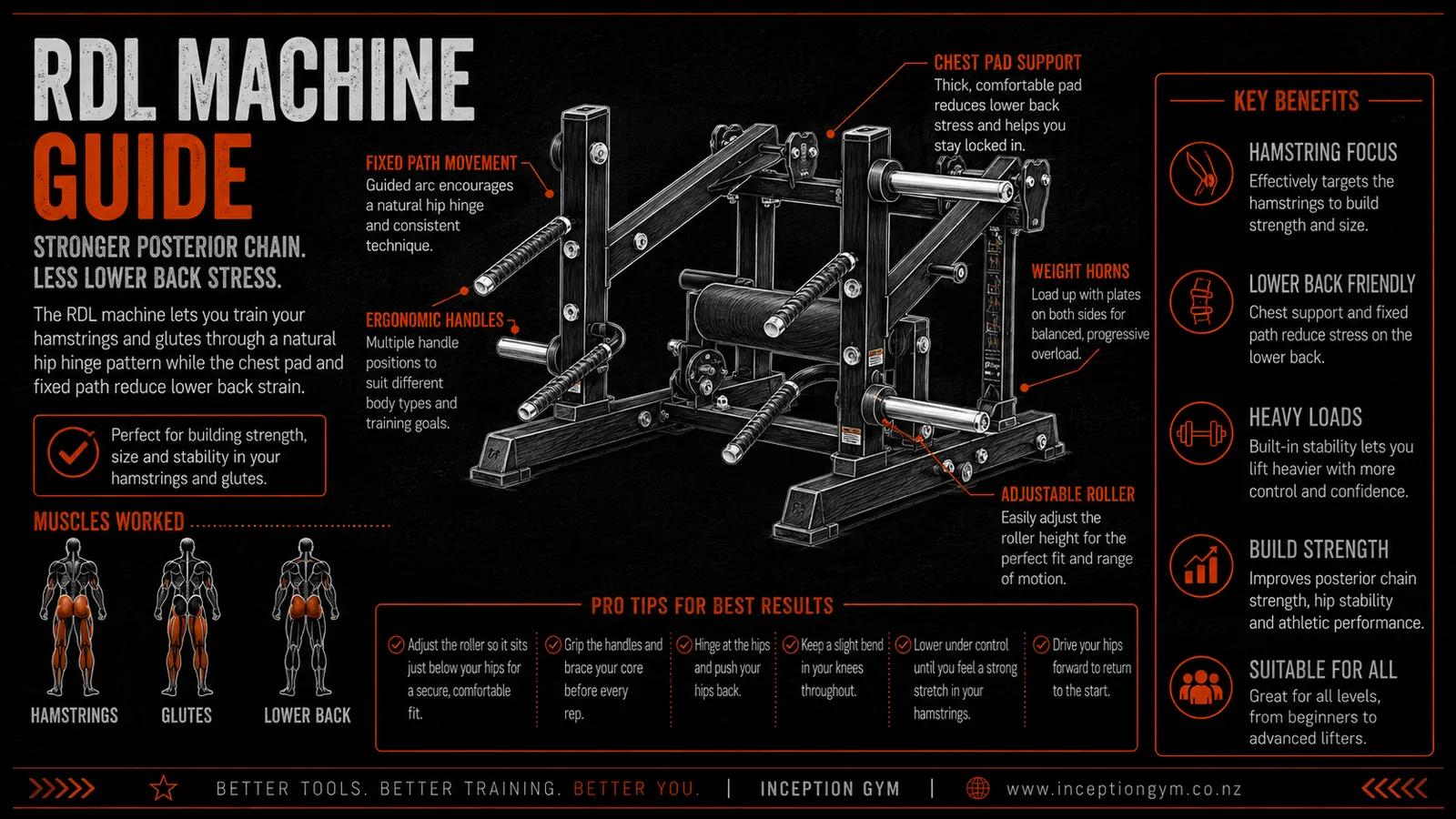
The RDL machine trains your hamstrings, glutes and lower back through a full hip hinge, and it removes the grip, balance and bar-path problems that stop most people from loading a Romanian deadlift properly. It lets you get real posterior chain work from your first session, and it lets experienced lifters push the hamstrings hard without their grip failing first.
I am Dr Matt Walley, co-founder of Inception Gym Christchurch. The RDL machine is one of the pieces I get asked about most on our floor, usually by someone who has been told to "do RDLs" and has never felt them in the right place. This is how I coach it.
Key takeaways
- The RDL is a hip hinge: hips travel back, spine stays neutral, hamstrings stretch under load.
- The machine fixes the loading path, so you can train the hamstrings hard without grip or balance limiting you.
- Loading the hamstrings in their lengthened position is one of the strongest growth stimuli you can give them.
- Programme it twice a week, track your loads, and add the smallest increment when you own the top of your rep range.
- It pairs best with a leg curl, so you train both hamstring functions in one session.
What does the RDL machine train?
The RDL machine trains a hip hinge. The hip flexes while the spine holds neutral, which creates a long, loaded stretch through the back of the legs. Unlike a conventional deadlift that starts from the floor and rests between reps, the RDL keeps continuous tension on the posterior chain for the whole set. Your range is set by hamstring flexibility, not by the floor.
The muscles doing the work
Hamstrings (biceps femoris, semimembranosus, semitendinosus): the primary movers. They lengthen under load as the hips hinge and shorten as you stand back up. The thing I want people to understand is that the RDL loads the hamstrings at their most stretched point, right at the bottom. Loading a muscle in that lengthened position is one of the strongest growth signals we know of, which is why I rate the RDL as one of the best hamstring builders in the building.
Gluteus maximus: the glutes assist hip extension the whole way and are most active as you drive through to standing. The RDL is not primarily a glute exercise, but the stimulus is real.
Erector spinae: your lower back extensors work isometrically to hold neutral spine under load. That builds spinal stability and back endurance without the compressive cost of loaded spinal flexion.
Adductors: the inner thighs contribute to hip extension too, especially deep in the hinge when the hips are most flexed.
Why I push hamstring work so hard
Hamstrings are among the most commonly injured muscles in sport, and most of those strains happen when the hamstring is lengthening under load at speed. That is the exact demand the RDL rehearses, only in a controlled, progressive, loadable way.
Nobody walks into my gym asking to train their hamstrings. They ask for a stronger squat, a faster sprint, or a back that stops nagging them, and the honest answer to all three is the hip hinge they have been avoiding.
Build strength through that lengthened range and you improve two things at once: the tissue's capacity to handle eccentric load, and the coordination that protects it. For the rugby, football and netball players who train with us in Christchurch, that is genuine injury prevention that shows up on the field. For everyone else, a strong posterior chain is what keeps your lower back happy and keeps you moving well as you age.
Barbell RDL vs the RDL machine
Both build the posterior chain. The differences are practical, and I use both with our members depending on where they are.
The barbell Romanian deadlift
The classic. A loaded barbell held against the thighs, hips hinging back as the bar tracks down the front of the legs and stays close to the body throughout.
The barbell version asks for grip strength, thoracic awareness and comfort under free weight, and that takes time. When the bar drifts away, the upper back rounds, or the pelvis loses neutral, you lose both the stimulus and the safety of the lift. For most novice and intermediate lifters, building a solid barbell RDL is a few months of deliberate practice. And at heavy loads, the grip gives out before the hamstrings do. Straps fix that, but they add kit and setup.
The RDL machine
A dedicated RDL machine guides the loading path with a fixed lever, which strips out the balance, grip and bar-path variables. You get to spend your attention on one thing: hinging and feeling the hamstrings.
Here is the practical reason I like having it on the floor. A newer member can load the posterior chain properly from their very first session instead of spending three months earning the right to. An experienced lifter can hammer the hamstrings late in a leg session without their grip being the thing that stops the set. Same movement pattern, two very different problems solved.
It also opens up single-leg work, and single-leg RDL machine reps are one of the best tools I have for evening out a hamstring that is stronger on one side than the other. Those asymmetries are common, and they show up in injury patterns, so I look for them. You can see the full posterior chain line-up on our equipment page.
How do you do an RDL on the machine correctly?
The hip hinge is a foundation pattern. Own it on the machine and it carries over to barbell RDLs, good mornings, kettlebell swings, anything that loads hip flexion.
Setting up
Set yourself to the machine's design with the resistance arm or pad sitting across the hips in standing. Feet about hip-width, a soft bend in the knees, not a locked-out straight leg. Start with hips stacked under your shoulders and a neutral lumbar curve. Take a breath, brace the core gently, build a little intra-abdominal pressure.
The descent
Start the movement by pushing your hips backwards, not by bending the knees forward and not by rounding your spine. I tell people to imagine shutting a car door with their backside. The hips travel rearward, the chest lowers, the torso tips toward horizontal.
Spine stays neutral the whole time. The most common fault I correct is the lower back rounding at the bottom, which dumps the load off the hamstrings and onto the spine. If you cannot reach parallel without rounding, work a shorter range until your flexibility catches up. The descent should feel like a stretch building steadily through the hamstrings. If you feel nothing there, the hinge is wrong, usually the hips are not travelling back far enough or the knees are bending too much.
The ascent
Drive through the heels and squeeze the glutes to extend the hips back to standing. Hips and chest rise together. Do not shoot the hips up first and drag the torso behind them, that just overloads the lower back. At the top, finish with a firm glute squeeze to complete hip extension.
Range of motion
Take the working range to the point where the hamstrings are fully stretched, or to the machine's limit, while keeping a neutral spine. For most people that lands somewhere between 45 and 90 degrees of torso lean, depending on flexibility. Do not force it. Range comes with consistent training, not with grinding a rep you cannot control.
How should you programme the RDL machine?
Frequency and volume
The posterior chain handles moderate frequency well. Two sessions a week of direct posterior chain work is a solid baseline for most intermediates. The RDL machine slots in as a primary movement early in a leg session, or as accessory work after your heavier compounds.
- As a primary exercise: 4 sets of 8 to 10 reps with a 3-second eccentric. Chase the stretch at the bottom and full hip extension at the top.
- As accessory work: 3 sets of 12 to 15 reps at a moderate load, focused on feeling the hamstrings do the job.
What to pair it with
- Leg curl (lying or seated): the leg curl trains the hamstrings through knee flexion, the RDL through hip extension. Train both in the same session and you develop the whole muscle. More on this in the leg extension and hamstring curl guide.
- Hip thrust machine: as I cover in the hip thrust guide, thrusts load the glutes harder in the shortened position, which complements the RDL's strength in the lengthened one.
- Good mornings or back extensions: same hinge pattern, same erector demand, useful as variations or progressions.
Progressive overload
Write down your RDL loads and reps. When you can hit the top of your rep range across every set with full range and a controlled eccentric, add the smallest increment the machine allows. On a lot of machines that is 2.5 to 5kg per side. Those small, honest jumps compound into serious posterior chain strength across a few months. If you want the full framework, read the progressive overload guide.
If you are unsure how to fit posterior chain work into your week, come in and use a free 24-hour trial. Find me or one of the team on the floor and we will walk you through your first RDL session properly.
Recovery and nutrition
Heavy RDL work with an eccentric emphasis produces real muscle damage and soreness in the days after a hard session. That is normal. Recovery nutrition is not optional if you want the hamstrings to grow back stronger.
Protein drives the muscle protein synthesis that rebuilds the tissue, and your total calories have to support the repair. In my experience the single most common reason a member trains hard and sees nothing is that the eating is not matching the effort. I would rather fix that than sell you a harder programme.
We are part of Inception Group, so the nutrition side is under the same roof. Every member gets complimentary body composition scans, which give you real lean-mass numbers over time instead of guessing from the mirror. On supplementation, creatine monohydrate has the strongest evidence base of anything for strength and power across hip hinge movements, and the interest in it from women and members over 50 has climbed for good reason: the ageing and cognitive research is genuinely encouraging. Inception Labs Creatine at our on-site Supplement Solutions store is Creapure-sourced at a clinical dose, at member pricing.
The bottom line
The RDL, machine or barbell, belongs in any lower body programme. The hamstrings are too important for performance and for staying injury-free to be left to squats and leg curls alone. A loaded hip hinge, done consistently with progressive overload, is one of the highest-return things you can put in your training week.
The RDL machine at Inception Gym makes that movement loadable and accessible from day one, whatever your barbell experience. If you want to feel the difference a proper hip hinge makes, claim your free trial, or book your free body scan and we will track the results together. I am usually on the floor. Come and find me.