Lifestyle · Motivation
Setting Gym Goals That Actually Stick: A New Year Guide
Most new year gym goals fail by February. I'm Dr Matt Walley, and here's how I coach members to set fitness goals that stick, starting with a free body scan at Inception Gym Christchurch.
By Dr Matt Walley · 19 February 2025
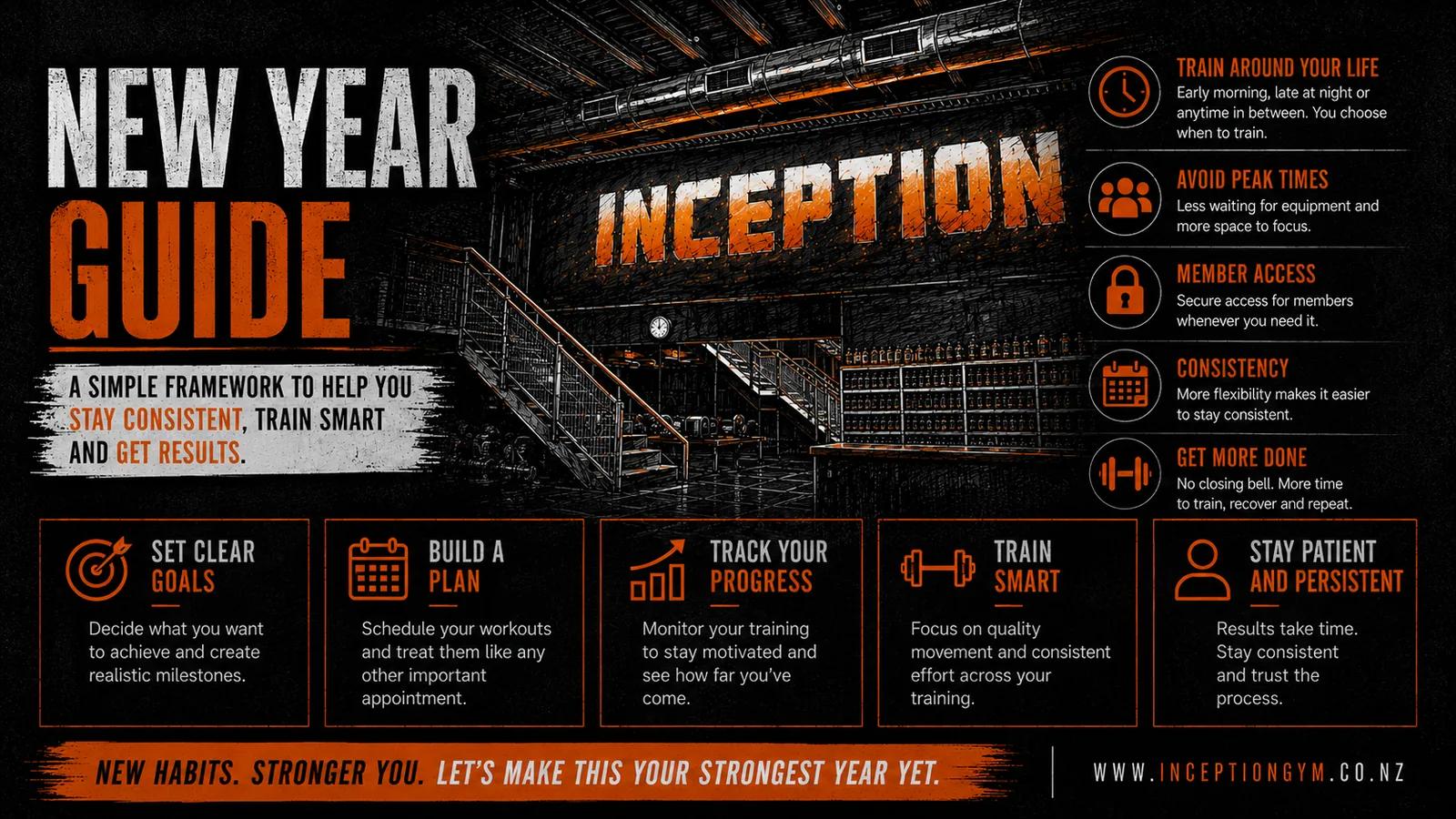
New year gym goals stick when you set them across three layers, outcome, performance and process, and anchor them to a measured baseline. The people who quit in February did not lack willpower; they lacked specific targets and a way to see early progress before the novelty wore off.
I'm Dr Matt Walley. My wife Elise and I founded Inception Gym Christchurch in 2022, and I'm on our 800 sqm floor most days watching who sticks and who fades. This is what I've learned about goal setting that actually holds through the year.
Key takeaways
- Vague goals like "get fit" give you nothing to aim at; specific, layered goals do.
- Set a real baseline with a body composition scan before you commit to any target.
- Split goals into outcome (the year), performance (the quarter) and process (the day).
- Body composition changes take three to six months, not three to six weeks.
- Protein is the highest-leverage nutrition change for most people: 1.6 to 2.0 g/kg per day.
Why do most new year gym goals fail?
Most new year gym goals fail because they are too vague to guide daily behaviour and have no baseline to measure against. Every January, sign-ups spike across Christchurch. Every February, attendance drops back to baseline. Plenty of commercial chains build that pattern into their pricing, selling memberships to people they expect to stop showing up within six weeks.
I refuse to run a gym that way, and I'll be blunt about why: it's a goal-setting problem, not a motivation problem. Here's where it goes wrong.
The goals are too vague
"Get fit." "Lose weight." "Get in shape." Those are wishes, not goals. They give you nothing to aim at and no way to know whether you're making progress. Without feedback, effort feels like it might be pointless, and eventually you stop.
The timeline is unrealistic
Most people walk in expecting visible change within a month. When the body hasn't transformed by mid-February, they decide it isn't working. Meaningful body composition change takes three to six months of consistent effort. Expecting a month to deliver a quarter's worth of results is a setup for disappointment.
There is no baseline
You cannot measure progress without knowing your starting point. If you don't know your muscle mass, body fat percentage or strength levels on the first of January, you have no reference. Even genuine progress can feel invisible.
The approach changes too often
Conflicting advice online, a new programme every fortnight, a new diet every month. Bodies adapt to sustained, progressive stimulus, not constant novelty. Inconsistency prevents the adaptation you're actually training for.
A better framework: outcome, performance and process goals
Effective goal setting runs across three levels at once. This is the structure I walk new members through on their first scan.
Outcome goals: the long-term destination
The headline goals: losing 10kg of fat, adding 5kg of muscle, reaching a certain body fat percentage. Outcome goals are motivating but poorly suited to daily guidance, because they're far away and slow to move. Set one or two for the year. Be specific, and write them down with a target date.
Performance goals: the measurable milestones
Performance goals are intermediate targets that tell you you're on track. Increasing your squat by 20kg over six months. Adding ten minutes to your rowing capacity. Hitting a weekly protein target consistently. Set three to five for the quarter and review them monthly. If you want a structured way to load your lifts over that window, our progressive overload guide lays it out.
Process goals: the daily behaviours
Process goals are commitments to specific actions, independent of the outcome. Training four days a week. Hitting your protein target six days out of seven. Being in bed by 10:30pm on work nights. They're entirely within your control and give you immediate feedback.
Process goals are the engine of consistency: when motivation drops, and it will, they give you something concrete to do regardless of how you feel.
Use a body scan to set a real baseline
The most useful thing you can do in January is establish an objective baseline before you commit to any goal. Without data, you're guessing at your starting point, and I've watched too many people demotivate themselves guessing.
Every Inception member gets free body composition scans. These measure not just your weight but your muscle mass, body fat mass, fat percentage, visceral fat and body water. That's detailed enough to separate fat loss from muscle loss, which a bathroom scale can never do.
When you know your baseline:
- You can set specific, numerical targets grounded in reality rather than wishful thinking.
- You can track progress with precision and know whether your approach is working.
- You can catch problems early. If a scan six weeks in shows you're losing muscle alongside fat, you can adjust protein and training stimulus before the pattern entrenches.
- You have objective evidence of progress even when the mirror feels ambiguous.
Here's a first-hand pattern I see every year: the members who scan at the start, then again at six weeks, three months and six months, are the ones still training in winter. The scan isn't a gimmick to me; it's the feedback loop that turns goal setting from guesswork into a process. If you want to understand what the numbers mean, our body composition scans guide breaks it down, and it's a far better signal than a single BMI figure ever was.
SMART goals applied to the gym
Specific: "Lose weight" becomes "reduce body fat from 28% to 22% by October." "Get stronger" becomes "increase my bench press from 60kg to 80kg by July."
Measurable: body scan data for body composition goals, training logs for strength, gym performance for cardiovascular work. If you can't measure it, you can't track it.
Achievable: work backwards from realistic rates. Natural fat loss tops out around 0.5 to 1% of body weight per week. Natural muscle gain runs roughly 0.5 to 1kg per month for men and about half that for women. Set goals inside those ranges.
Relevant: your goals should connect to something that genuinely matters to you. Aesthetic goals are legitimate. Health goals are legitimate. Goals set because you think you should want them rarely survive a hard week.
Time-bound: put a date on every goal. A goal without a deadline is an intention. Quarterly check-ins work; annual reviews are too infrequent to course-correct.
The first eight weeks
The first two months decide whether a routine becomes a habit or a memory. Here's how I'd structure them.
Weeks one and two: learn the environment
Don't try to maximise training in the first fortnight. Learn the floor, work out your routes between machines, and master the form on your key lifts. We run 92-plus machines across the floor, 43 of them plate-loaded, and two squat racks, so there's a lot to get familiar with before you start chasing numbers. A proper warm-up routine matters more in these early weeks than any heavy set. Rushing into maximum effort before you know what you're doing buys you injury and bad technique that take months to unwind.
Weeks three to six: establish the habit
By week three, the aim is for training to feel automatic:
- Train at the same time on the same days every week. Consistent timing is what makes a habit stick. Our 24/7 access exists precisely so your session slot never has to move.
- Keep sessions to a manageable length. 45 to 60 minutes is sustainable; the 90-minute sessions people attempt in week one usually collapse to nothing by week six.
- Log every session. Write down what you did, the weight, and how it felt. The record is both motivating and essential for progressive overload.
Weeks seven and eight: review and adjust
At the six-week mark, compare where you are against your baseline scan and book a follow-up. Review your performance goals. If something isn't working, adjust now, not after another three months.
What about nutrition?
Training without addressing nutrition is filling a bucket with a hole in it. For most people the highest-leverage change is simply eating more protein, and eating it from food first before reaching for a shaker.
The evidence-backed range for active people working on body composition is 1.6 to 2.0 grams of protein per kilogram of bodyweight per day. At 80kg that's 128 to 160 grams, well above what most people eat without intention. I'd tell any new member to fix that before worrying about anything more exotic. If you're on a GLP-1 medication and training to hold onto muscle, protein and resistance work matter even more; our guide on GLP-1 medication and strength training in Christchurch covers that in detail.
A plan built around your own body scan data, goals and training volume makes a real difference to the speed and quality of results. That's the entire reason we put PhD-led nutrition, a supplement store and free scans under one roof rather than sending members somewhere else for each.
The easiest way to start
If you're not yet a member, the free trial is built for exactly this. Full access to the facility plus a complimentary body scan, no financial commitment. That's enough to make an informed decision and enough baseline data to start setting goals properly, whether or not you join.
Is January actually a good time to start?
Yes, January is a genuinely good time to start, despite the clichés about new year gym rushes. The psychological weight of a new year creates real motivation, and motivation is worth using even when it isn't sufficient on its own.
The trick is to channel it into building systems rather than heroics. Systems, habits and processes survive the inevitable drop in motivation. Maximum effort without systems does not. Start January by establishing your baseline with a body scan. Set specific, layered goals across outcome, performance and process. Commit to a sustainable session frequency. Log everything. Review at six weeks. Adjust.
It's a more boring plan than "new year, new me." It's also the plan that still has you training in April.
Come and set your baseline with us. Book your free body composition scan or take the free trial, and start the year with data instead of guesswork. If you'd rather compare the numbers first, view our membership options.
---
Inception Gym is located at Tower Junction, 65 Blenheim Road, Addington, Christchurch. Every member gets regular free body composition scans throughout their membership. We're rated 5.0 across 1,090+ Google reviews.