Training · Recovery
Gym warm-up routine: how I prep members for better lifts at Inception
The gym warm-up routine I coach on our floor: five to eight minutes of cardio, dynamic activation matched to your session, and progressive warm-up sets. Fewer injuries, better output.
By Dr Matt Walley · 17 April 2025
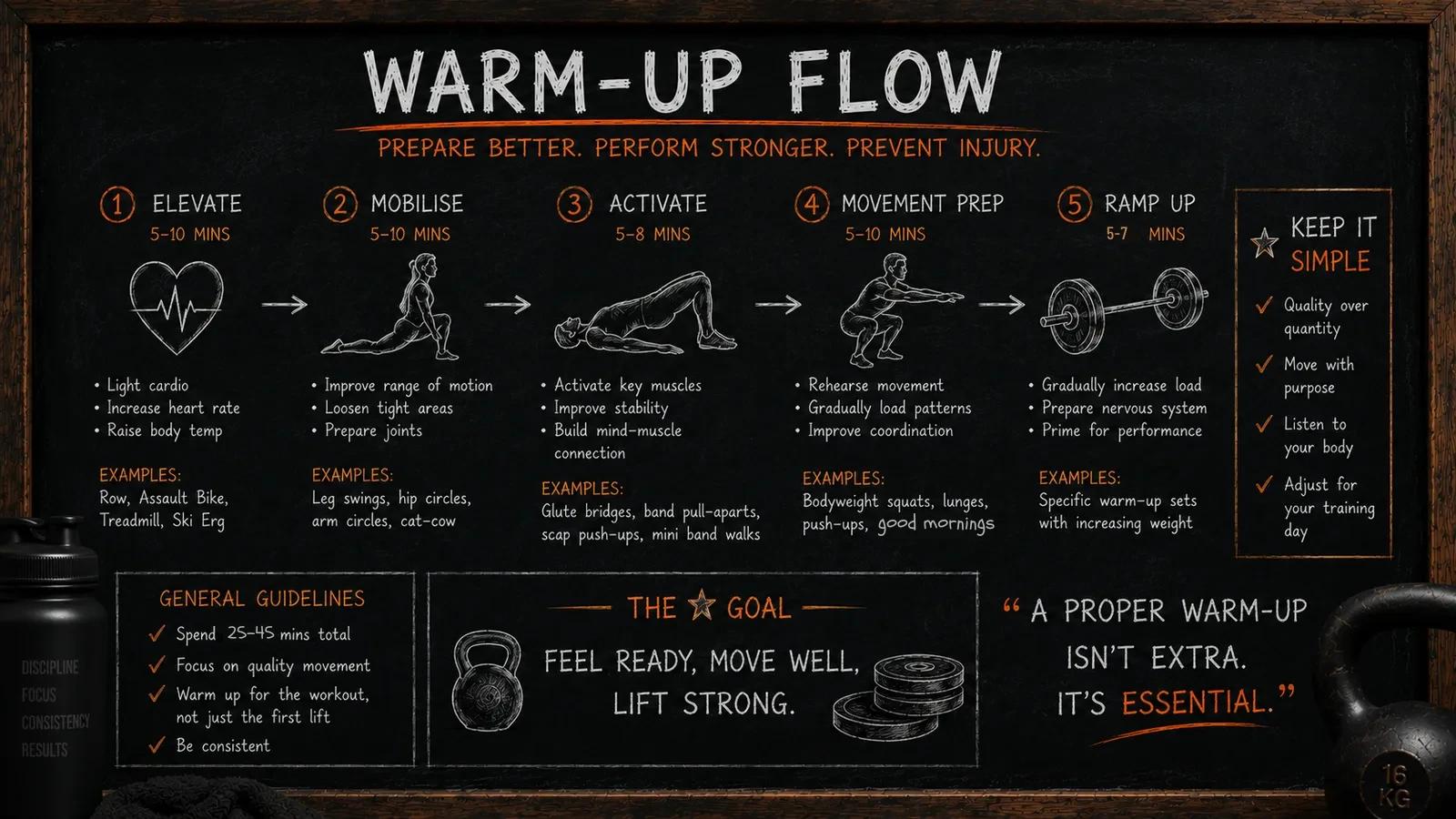
A good gym warm-up routine has three parts: five to eight minutes of easy cardio to raise body temperature, dynamic mobility and activation drills matched to the session you are about to train, and progressive warm-up sets on your first compound lift. Ten to twenty minutes total, and it is the highest-return ten minutes in your session.
I am Dr Matt Walley, and my wife Elise and I have owned and operated Inception Gym in Addington since 2022. I am on our floor most days, and the single most common mistake I watch people make is skipping the warm-up, or doing a token version: a couple of arm circles, thirty seconds on the bike, straight into working sets. Over time that costs you performance, or an injury, or both.
Key takeaways
- A warm-up is not killing time before the real work; it is an investment in the quality of every rep that session.
- Two phases: a general warm-up to raise temperature, then a dynamic warm-up matched to what you are training.
- Static stretching before lifting reduces force output. Save it for after.
- Warm-up sets on heavy compounds are non-negotiable, not optional.
- Ten to twenty minutes for most sessions, longer for heavy squats, deadlifts, and overhead work.
The best warm-up is not the most complex one. It is the one you actually do, every session, without negotiating with yourself about it.
Why a gym warm-up routine matters
The term is literal. Raising your core temperature and the temperature of the working muscles has direct performance benefits. Warmer tissue is more pliable, contracts more forcefully, and recovers faster between efforts than cold tissue. That is not a wellness slogan, it is mechanics.
Beyond temperature, a thorough warm-up:
- Increases synovial fluid in the joints, reducing friction under load
- Elevates heart rate gradually, priming the cardiovascular system
- Activates the specific motor patterns you are about to perform
- Shifts your focus from your day to the training in front of you
- Surfaces any tightness or restriction before it becomes an injury under a loaded bar
Here is my first-hand take after years of watching this play out on our floor: the people who never seem to get hurt are almost never the strongest or the youngest. They are the ones who treat the first fifteen minutes as part of the workout rather than an obstacle to it. Consistency in the warm-up is one of the clearest predictors I have of who is still training pain-free three years later.
The two phases of an effective warm-up
A well-structured warm-up has two phases: the general warm-up and the specific warm-up. Most people do neither properly, and understanding both changes how you start every session.
Phase one: the general warm-up
This raises your overall body temperature and heart rate. Five to eight minutes, comfortably aerobic, not exhausting. You want to arrive at your first exercise with a light sweat and an elevated heart rate, not fatigued.
Options on our floor, and where I point people:
- Ski erg. My default recommendation because it involves the whole body. A moderate five-minute effort raises heart rate, engages the posterior chain, and works the shoulders and arms through a loaded range. Keep it conversational.
- Stationary bike. For lower-body-dominant days, the bike warms the hips, knees, and ankles without loading the spine before you are ready.
- Treadmill incline walk. Five minutes at a moderate incline recruits the glutes and hamstrings more than flat walking. Simple and effective before any lower body session.
- Light skipping. Three to five minutes raises temperature quickly, challenges coordination, and warms the calves and ankles, areas people neglect.
The goal here is not intensity. If you are breathless, you have gone too hard. You have not started your session yet. Our full cardio equipment range gives you a few options, so pick the one that matches the day.
Phase two: the dynamic warm-up
This is where most gym-goers fall short. The dynamic warm-up replaces static stretching, which the research now shows is counterproductive before resistance training, with active movement that prepares the specific muscles and joints for the work ahead.
Dynamic drills move your joints through their full range under control, activate the muscles you are about to load, and prime the nervous system for the patterns you will use. The key word is dynamic: you are moving, not holding.
Dynamic warm-up exercises by session type
For a lower body session (squat, deadlift, leg press)
- Leg swings, front to back. One hand on a wall, swing one leg forward and back in a controlled arc, gradually increasing range. Ten to twelve per leg. Opens the hip flexors and wakes the glutes.
- Lateral leg swings. Same position, swing side to side across the body. Ten per leg. Prepares the hip for multi-directional stability under load.
- Hip circles. Hands on hips, rotate the pelvis in large circles both directions. Eight each way.
- Paused bodyweight squats. Ten to fifteen reps, pausing two seconds at the bottom. Chest up, knees tracking over toes. Mobility and activation in one.
- Glute bridge. On your back, feet flat, drive the hips up, hold two seconds, lower with control. Twelve to fifteen reps. Many people squat and deadlift without their glutes firing properly, which dumps load onto the lower back. This fixes that.
- World's greatest stretch. Step into a long lunge, same-side hand to the floor inside your front foot, open the chest and rotate your arm to the ceiling. Four per side. It opens the hip flexors, thoracic spine, and shoulders at once.
For an upper body session (bench, row, overhead press)
- Arm circles. Start small, build the range. Ten forward, ten back, then switch.
- Band pull-aparts. Light band or a chest-height cable, arms extended, pull to a T. Fifteen to twenty reps. Activates the rear delts and rotator cuff before pressing.
- Shoulder dislocations. Wide grip on a band or dowel, arc it overhead and behind without bending the elbows. Widen the grip if you cannot clear the range pain-free. Ten controlled reps.
- Cat-cow for the thoracic spine. On all fours, drive the movement into the mid-back rather than the lower back. Thoracic mobility is critical for overhead pressing and rowing. Eight to ten slow reps.
- Face pulls, light cable. Rope at face height, pull toward your face, separating the hands and rotating the elbows up. Fifteen reps light. Rear delts, rotator cuff, mid-traps.
- Scapular push-ups. In a push-up position, arms straight, let the chest drop between the shoulder blades, then push the floor away. Wakes the serratus anterior, a neglected stabiliser.
For a pull session (deadlift, rows, lat pulldown)
The world's greatest stretch and cat-cow both belong here too. In addition:
- Bodyweight hip hinge. Feet hip-width, push the hips back toward an imaginary wall, slight knee bend, neutral back. Feel the hamstrings load. Ten slow reps. It grooves the deadlift pattern without load.
- Dead bug. On your back, arms to the ceiling, knees at ninety degrees. Lower opposite arm and leg while pressing the lower back to the floor. Activates the deep core that protects the spine under heavy pulling.
The specific warm-up: working up to your working weight
Once the general and dynamic work is done, do not jump to your first working set. Do warm-up sets. A simple protocol for compound lifts:
- One set at 50% of your working weight for ten reps
- One set at 70% for five reps
- One set at 85 to 90% for two to three reps
- First working set
The specific warm-up grooves the exact pattern you are about to load, exposes technique issues at sub-maximal intensity before they cost you under maximum load, and prepares the tendons and connective tissue for peak force.
My strongest opinion on this: never skip warm-up sets on heavy compounds. Skipping them is not saving time, it is cancelling your insurance policy right before you need it. I have never once seen someone regret an extra warm-up set. I have seen plenty regret the one they skipped.
How long should a gym warm-up take?
A realistic total, both phases plus specific warm-up sets, is ten to twenty minutes depending on the session.
Heavier and more complex work (deadlifts, heavy squats, overhead pressing) warrants longer. Light accessory or machine-only sessions need less. One thing our 24/7 access changes is the psychology of this: when you are not squeezing your whole workout into a packed 6pm hour, you stop treating the warm-up as the thing to cut. That alone has quietly saved a lot of our members' backs and shoulders.
Nutrition and your warm-up
A warm-up is a physical protocol, but pre-workout fuel shapes how well your body responds to it. Arrive depleted, no food for hours and under-hydrated, and even a thorough warm-up underperforms because the body has nothing to work with.
If you want to sort your pre-session fuel, our on-site Supplement Solutions store stocks a full performance range, including the Inception Labs Valor pre-workout with 350mg of caffeine and Alpha GPC for focus. For the fundamentals, our gym nutrition basics guide is a solid starting point.
Common warm-up mistakes I see every week
- Static stretching before lifting. Holding a thirty-second hamstring stretch before deadlifts temporarily lowers force output. Save static work for after the session.
- Skipping the general warm-up. Going straight to activation drills on cold tissue defeats the purpose. Raise temperature first.
- Warming up the wrong body part. Squatting but only warming your shoulders makes no sense. Match the warm-up to the session.
- Turning the warm-up into a conditioning session. Moderate intensity only. If you arrive panting, you went too hard or you arrived too late.
- No warm-up sets on heavy lifts. The dynamic warm-up prepares you to train. Warm-up sets prepare you for your heaviest sets. Both are needed.
Making it a habit
The best warm-up is the one you actually do. If a full protocol feels overwhelming when you are starting out, begin with the minimum: five minutes of general cardio and three or four targeted dynamic drills matched to your session. As the habit forms, add complexity. The protocols above are a starting point, not a ceiling. Pairing this with injury prevention and recovery habits is how you build a body that keeps training.
For how the first few weeks tend to go, see what to expect on your first day at Inception Gym.
Come see the floor
Your session does not start when you load the bar. It starts when you walk through the door, and I would rather show you than tell you. Contract memberships include a free initial PT consultation where we build the warm-up into your programme properly. Start with a free trial, or book a free body composition scan to see exactly where you are starting from. We are rated 5.0 across 1,090+ Google reviews, and I would like the chance to earn yours.