Lifestyle · Professionals
The working professional's guide to fitting training into a busy schedule
How busy professionals in Christchurch fit gym training into a busy schedule. 24/7 access, 45-minute sessions, and a gym rated 5.0 across 1,090+ Google reviews.
By Dr Matt Walley · 5 August 2024
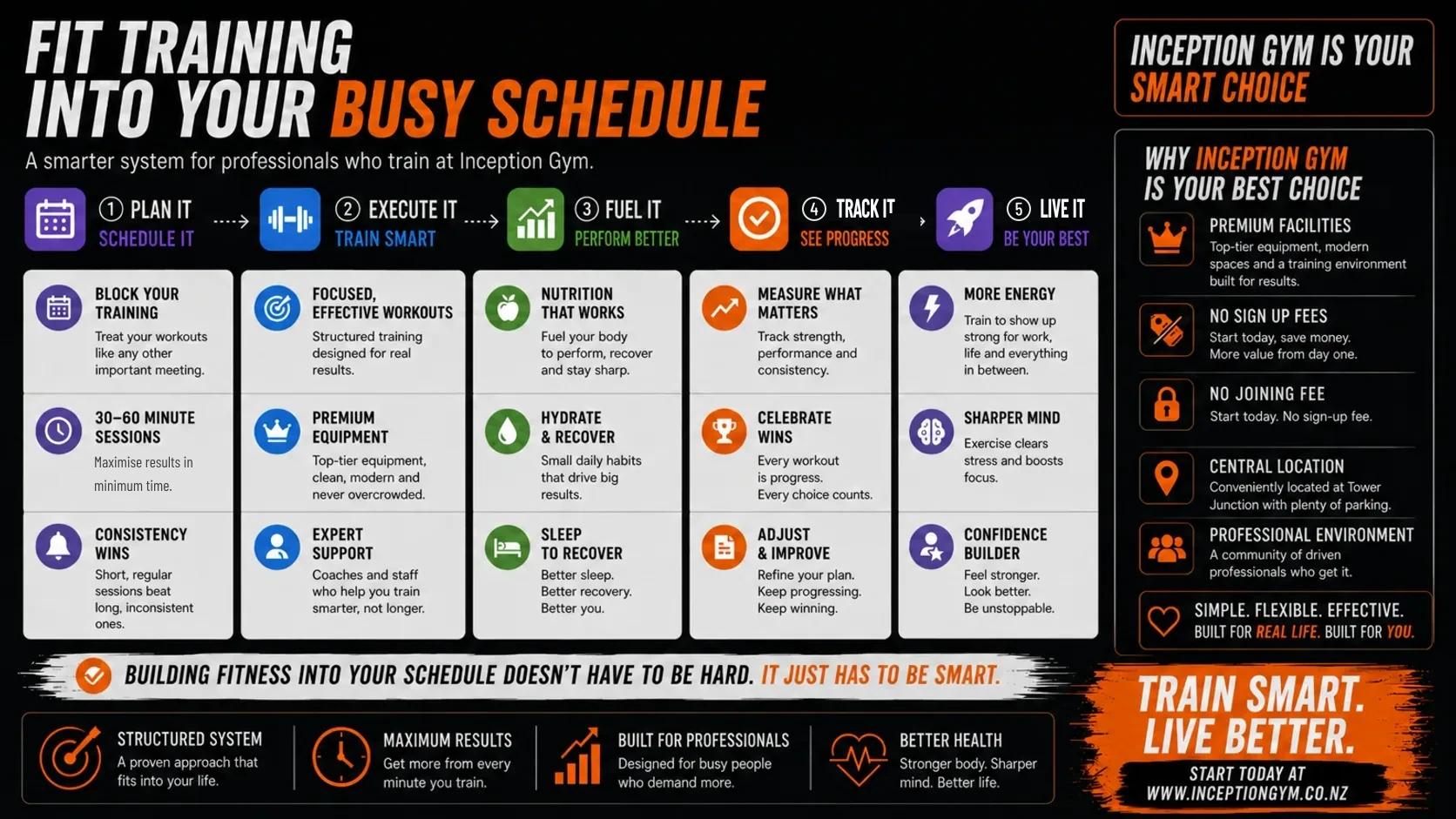
Fitting training into a busy schedule is not a time problem, it is a friction problem. Pick one reliable window (early morning, lunchtime, or late evening), run a structured 45-minute session three times a week, and train at a gym that removes barriers instead of adding them.
I am Dr Matt Walley, and my wife Elise and I founded Inception Gym in 2022. I am on the floor most weeks, and the single thing every consistent member has in common is not spare time. It is a system.
Key takeaways
- You have the same 168 hours as everyone else; consistent trainers just remove friction.
- Three windows work for professionals: early morning, lunchtime, late evening.
- A structured 45-minute session, three times a week, is enough for real progress.
- 24/7 access and a short drive matter more than motivation.
- Prepare the night before and decide once, so you stop deciding daily.
You don't have a time problem
Every working professional has the same 168 hours per week. The ones who train consistently do not have more time than the ones who don't. They have made training non-negotiable, and they have stripped out the small frictions that make it easy to skip.
If you are a busy professional in Christchurch who wants to train but feels there are not enough hours in the day, this guide is for me to answer honestly. The answer is never "find more time." It is "remove barriers and train smarter." In practice that means picking one of three reliable windows, running a structured 45-minute session three times a week, and choosing a gym that removes friction rather than adding it.
After four years watching who sticks and who fades, I can tell you the winners are never the most motivated. They are the ones who removed the most excuses before Monday morning arrived.
What are the three windows that actually work?
Most professionals who train consistently use one of three time windows. Each suits a different work rhythm, family setup, and temperament.
Early morning (5:00am to 7:00am)
Training before work is the most reliable window for one reason: nothing competes with it. No meeting gets booked at 5:30am. No client call interrupts you. Nobody needs anything from you yet.
This window only works with genuine 24/7 access. Not "we open at 5:30am" but "walk in at 4:45am if that is what your day demands." At Inception Gym, 24/7 access is standard on every membership, with secure app-based entry and surveillance active around the clock.
Early mornings are also the quietest hours on our floor. No queue for a rack, no navigating around anyone. Just you, our 92 pieces of equipment, and 800 sqm of purpose-built space. I have walked in myself at 5am and had the whole floor to think on.
Practical tips for early morning training.
- Pack your gym bag the night before and leave it by the door.
- Set a consistent wake time seven days a week to regulate your sleep cycle.
- Eat a small meal or shake within 30 minutes of waking if training fasted does not suit you.
- Keep your first two weeks simple: just show up. Build the habit before you optimise the workout.
Lunchtime (11:30am to 1:30pm)
Lunchtime training keeps growing among Christchurch professionals, and I understand why. It breaks the day, lifts afternoon focus, and turns a slot most people lose to their phones into real training.
The deciding factor is proximity. If your gym is 20 minutes away, you have already burned 40 minutes on driving. We sit at Tower Junction, 65 Blenheim Road, Addington, with direct access off Blenheim Road and 3,000+ free car parks. No circling for a space, no parking fee eating your break. Drive in, train, drive out. I watch members do exactly this every weekday.
During working hours our floor is quieter than the evening peak, so your session is efficient rather than padded with waiting. For more on why Christchurch professionals are choosing midday training, we have covered it in depth.
Practical tips for lunchtime training.
- Block a 90-minute lunch: 30 minutes each way, 30 to 45 minutes training.
- Keep a gym bag in your car permanently.
- Have a post-workout meal prepped and ready at your desk.
- Focus on compound movements to get the most from limited minutes.
Evening (7:00pm to 9:00pm)
If early mornings and lunchtimes do not fit, late evening is your option. After dinner, after the kids are down, after the day is handled. Training at 8pm only works when your gym does not close at 9pm.
Late evenings tend to be quieter than the 5pm to 7pm rush. With 24/7 access there is no closing time to race. Start at 8:30pm and train as long as you need without watching the clock.
Practical tips for evening training.
- Allow two to three hours between your last meal and training if stomach comfort matters to you.
- Keep intensity moderate if you train close to bedtime, as very hard sessions can disrupt sleep for some people.
- Use this window for focused, deliberate training rather than a rushed one.
How long should a busy professional train?
You do not need two hours to get results. Well-structured sessions of 45 to 60 minutes are enough for meaningful strength and body composition progress. The lever is efficiency, not duration.
A 45-minute full body template
A realistic structure for a time-pressed professional:
Warm-up (5 minutes). Light rowing or cross-trainer to raise your heart rate and prepare your joints. Our warm-up guide has a fuller version if you want it.
Compound movements (25 minutes). Four exercises, three sets each, 60 to 90 seconds rest between sets.
- Leg press or squat variation
- Chest press or bench press
- Lat pulldown or seated row
- Shoulder press
Accessory work (10 minutes). Two or three exercises for areas you want to develop.
Cool-down (5 minutes). Light stretching or mobility work.
Run this three days a week and you cover every major muscle group. No wasted time, no filler.
Why equipment quality saves you time
In a gym with thin equipment, you lose time waiting. During peak hours at a busy chain, queuing for a rack or a bench can add 15 to 20 minutes to a session you did not have to spare in the first place. This is the failure mode I built Inception to remove.
Our equipment range runs to 72 machine variants across 92 pieces, with two squat racks and dumbbells up to 70kg. Multiple options for every movement pattern mean there is almost always an alternative when something is in use, and off-peak it is a non-issue. Pin-loaded machines let you change weight in seconds and move quickly between exercises, which is exactly what a 45-minute session needs.
How do you make training non-negotiable?
The members who train for years treat their sessions like meetings that cannot be cancelled. Here is how.
Schedule it like work
Put training in your calendar as a blocked appointment, not a soft reminder. If someone tries to book over it, the answer is "I am not available then." You would not cancel a client meeting for convenience; hold your training to the same standard.
Remove decision points
Decide when and where you train once, then stop deciding. "I train at Inception on Monday, Wednesday and Friday at 6am" costs zero daily willpower. "I will figure out when to go" demands a decision every day, and every decision is a chance to pick the easy option.
Prepare in advance
Lay out your clothes the night before. Pack the bag. Have the post-workout meal ready. Every bit of friction you remove makes showing up easier; every bit you leave in makes skipping easier.
Accept imperfect sessions
Some days you get 30 minutes. Train for 30. Some days you are tired. Train anyway, lighter if needed. A mediocre session beats a skipped one every time. Consistency with imperfect effort always beats perfection with poor attendance. That is the single belief I would tattoo on every new member if they let me.
The compound effect of consistency
Training three times a week for 48 weeks a year is 144 sessions. Over five years that is 720 sessions. The effect of that on your health, energy, body composition and mental clarity is not small.
Our longest-standing members did not get there on bursts of motivation. They got there by showing up three or four times a week, year after year, in a facility that makes showing up easy. That reliability is also why we hold a 5.0 rating across 1,090+ Google reviews: people stay because the system works, not because we hyped them into it.
Nutrition for busy professionals
Training is half the equation. What you eat decides whether the work in the gym turns into results. For time-poor people, meal prep and a simple food-first approach make the difference: aim to build most meals around 1.6 to 2.0 grams of protein per kilogram of bodyweight across the day, then let supplements fill the gaps rather than carry the load.
Inception Nutrition runs PhD-led coaching built for demanding schedules. A structured plan removes the daily guesswork about what to eat and when, which matters most when your calendar leaves no room to improvise. Our free body composition scans then show you whether it is working, in real numbers rather than a bathroom-scale guess.
For supplements, the on-site Supplement Solutions store means you can grab protein, creatine or pre-workout before or after a session, and the Inception Labs range is clinically dosed for training. If you want the honest version of what earns a place in your bag, read supplements that actually work before you spend a cent.
Your schedule isn't the barrier
The barrier is not time. It is friction. A gym that is hard to reach, closes before you can train, queues for equipment, or does not fit your life all create friction. Remove it and training slots into almost any schedule.
We have taken out as much friction as I could find: 24/7 access, 3,000+ free car parks at Tower Junction, 92 pieces of equipment so you rarely wait, and a floor full of people who value their time as much as you value yours. If you are on Fitness Passport, note we charge no tag fees and no sign-up fees, which is still unique in the Christchurch network.
Book a free 24-hour trial and see for yourself how training fits into your week. Prefer to compare first? Explore membership options: from $18.90 per week on a 24-month plan, or $33.90 per week open-term with 28 days' notice if you would rather stay flexible. No joining fee on any plan.
Your schedule is busy, and that is not going to change. But 45 minutes, three times a week, is 2% of your time. The return on that 2% will change the other 98%. Come and prove it to yourself.