Training · Recovery
Training Around Injuries: How to Keep Progressing When Something Hurts
How I coach members to train around injuries at Inception Gym Christchurch: machine alternatives, modification principles, and when to modify versus rest. 5.0 across 1,090+ Google reviews.
By Dr Matt Walley · 17 October 2024
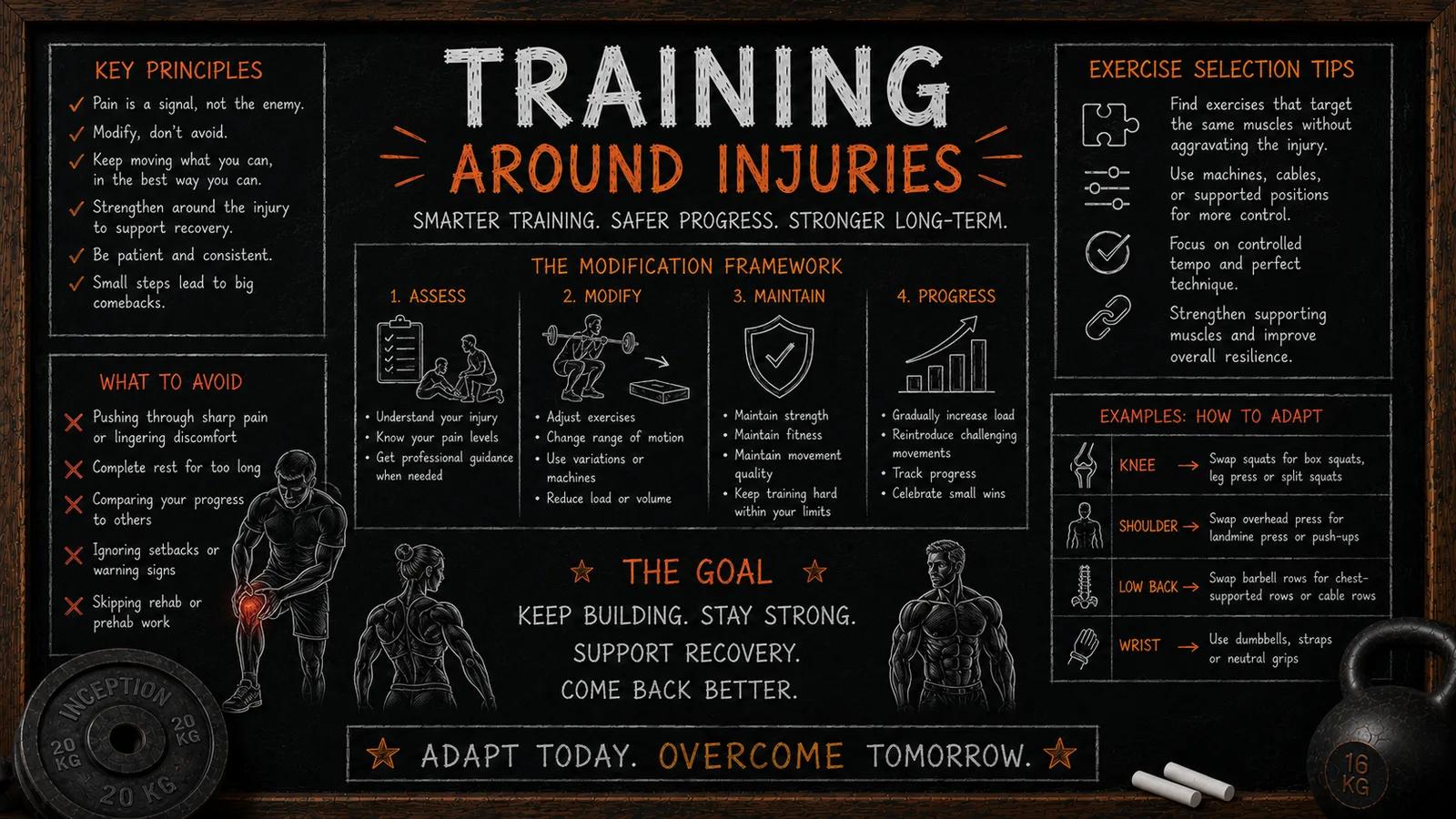
Training around injuries almost always beats stopping entirely. If you can find a movement pattern that loads the target muscle without provoking pain, you modify and keep going. Rest is for the injured area, not for the whole body.
I am Matt Walley, and I have run the floor at Inception Gym Christchurch since Elise and I opened it in 2022. In that time I have watched hundreds of members hit a sore shoulder or a cranky knee and assume the session, or the month, is written off. It rarely needs to be. Training around injuries is a skill, and it is one of the things a deep machine floor is genuinely good for.
Key takeaways
- Most training discomfort sits between normal effort and something needing a doctor. That middle ground is where you modify, not stop.
- Muscles do not care whether tension comes from a barbell, a machine, or a cable. Swap the loading position, keep the stimulus.
- Our 43 plate-loaded machines exist partly so you always have a pain-free way to train a muscle group.
- Rest the injured area, keep training everything else. Blanket rest costs you fitness you did not need to lose.
- A period of injury is a chance to fix the weakness that caused it, not just wait it out.
Discomfort or injury: how do I tell the difference?
Before you decide how to train around an injury, you have to name what you are feeling. On our floor I split it into five buckets.
Muscle soreness (DOMS). The ache that shows up 24 to 48 hours after an unfamiliar or hard session. It is adaptation, not damage. Light to moderate training of a sore muscle actually speeds recovery. Train it.
Training sensation during effort. The burn as a muscle approaches fatigue, the breathlessness of hard conditioning. That is the point. Not a concern.
Sharp, acute pain. Sudden, localised, tied to a specific movement or load. That is the signal to stop the movement immediately and assess. It does not mean the session is over. It means that exercise stops now.
Joint pain. Pain inside a joint rather than the muscle around it deserves respect. Some of it is position-dependent and clears with a movement tweak. Joint pain that persists regardless of position, swells, or comes with instability needs a medical assessment.
Nerve pain. Tingling, numbness, or pain radiating down a limb is nerve-related and needs proper assessment. Training through nerve symptoms can worsen the underlying problem.
Modify, do not stop. In four years on this floor I have almost never met an injury that shut down the whole body. It shuts down a movement. Find another way to load the muscle and you keep your fitness while the tissue heals.
Common training injuries and how I work around them
Shoulder impingement
Impingement, where the rotator cuff tendons get compressed as the arm elevates, is the shoulder complaint I see most. It bites during pressing, especially overhead, and during pulling that takes the arm above the shoulder.
What aggravates it: standard barbell overhead press, upright rows, lateral raises taken behind the body, any press that compresses the shoulder in internal rotation.
How I train around it:
- Replace the overhead press with a landmine press. The angled bar path is far kinder to the joint.
- Press with a neutral grip (palms facing) using our multi-grip bar or the Kadillac.
- For chest, dumbbell presses on a neutral to slightly angled grip are much friendlier than a straight barbell.
- Keep rowing and lat pulldowns, but skip wide-grip pull-ups that force extreme external rotation at the bottom.
- Add face pulls, external rotations, and band work to fix the cuff weakness that usually sits underneath impingement.
The principle: hold your pressing and pulling volume through positions that do not provoke the pinch, and address the strength deficit underneath.
Lower back pain
Lower back pain is everywhere among people who deadlift and squat heavy. The mechanism varies, so the response varies too.
What aggravates it: heavy conventional deadlifts, back squats fought with anterior pelvic tilt, good mornings, anything that piles compression on the lumbar spine at end range.
How I train around it:
- Swap conventional deadlifts for trap bar pulls or our plate-loaded deadlift machine. Both shorten the lumbar moment arm.
- Move from back squat to the leg press, hack squat, or belt squat. You keep the leg stimulus and take the load off the spine.
- Keep the upper body going. Supported pressing, seated pulling, and arm work are usually untouched by a sore back.
- Lighter Romanian deadlifts often survive when floor pulling does not.
- Prioritise core stability: dead bugs, bird dogs, and pallof presses build the bracing that protects the spine.
Substitute the loading position, do not abandon the pattern. Leg day continues through a sensitive back when you change how the weight sits on you.
Knee pain
Training knee pain usually involves the kneecap tracking, the patellar or quad tendon, or plain overuse. The response depends on whether it is load-dependent, position-dependent, or both.
What aggravates it: heavy barbell squats with poor tracking, the leg extension if the patellar tendon is angry, running and jumping if it is patellofemoral.
How I train around it:
- Cut range on squats. Box squats stopping above the painful range let you keep loading with less knee stress.
- Shift to hip-dominant work: Romanian deadlifts, hip thrusts, glute bridges, cable pull-throughs.
- The leg press is often tolerable when the barbell squat is not. Foot placement gives you room to find a pain-free line.
- The leg extension cuts both ways. If the patellar tendon is the issue, leave it. If quad weakness is feeding patellofemoral pain, a limited-range extension can help.
- Watch for swelling. If the knee puffs up during or after a session, drop load and range immediately.
Elbow and wrist issues
Tennis elbow, golfer's elbow, and wrist impingement turn up in people running high pressing and pulling volume.
How I train around them:
- Flip the grip. Supinated pulling (underhand rows, reverse curls) is often better for lateral elbow pain; pronated for medial.
- Use straps so grip stops limiting your pulling when the elbow is the bottleneck.
- Press with a neutral wrist using the multi-grip bar or Kadillac to cut wrist strain versus fixed pronation.
- Temporarily trim direct arm volume while keeping the compounds that do not hurt.
- Elbow sleeves for warmth and support through the session.
Why does equipment depth matter for training around injuries?
Here is the honest reason I obsess over the machine floor. When one loading pattern is off the table, you need another route to the same muscle, and you need it right there, not on a waiting list.
We built 800 sqm around 92 machines across 72 variants, 43 of them plate-loaded. That is not a spec sheet flex. It is redundancy. Muscles adapt to tension over a range of motion. They do not care if that tension comes from a barbell, a plate-loaded arm, a cable, or a dumbbell. So when a specific free-weight movement is out, a machine that hits the same group keeps the stimulus and strips out the mechanical demand that was hurting you.
Some practical swaps I reach for on our floor:
- Barbell back squat becomes the hack squat, leg press, or a Smith machine squat.
- Conventional deadlift becomes the plate-loaded deadlift machine or a trap bar pull.
- Barbell bench becomes the chest press machine or a Smith machine bench.
- Overhead press becomes the machine shoulder press or a cable overhead press.
- Barbell row becomes a chest-supported machine row or a cable row.
- Pull-up becomes the lat pulldown, where you dial the load to exactly what the shoulder tolerates.
If you want to see the range, the full equipment inventory lists every category, and it is worth walking before you assume an injury has closed a door. If you would rather just try it, claim a free trial and I will happily point you at the right substitutions in person.
When should I modify, and when should I rest?
I run every case through the same four questions.
- Can you find a movement that loads the target muscle without pain? Yes, modify and continue. No, rest that area.
- Is the pain worsening despite modification? If tweaks are not calming it down, the area needs rest and assessment.
- Is there swelling, real instability, or neurological symptoms? Those are medical signals. Pause that area pending a proper diagnosis.
- Is this a fresh acute injury or a familiar chronic niggle? A new acute injury earns more caution than an old friend you know how to manage.
The value of asking someone on the floor
One of the genuinely useful things about training at an owner-operated gym is that expertise is standing right there. We have been owner-operated since 2022, and during staffed hours you can talk through an injury, a movement, or a modification without booking anything.
Staffed hours are Monday to Thursday 9am to 7pm and Friday and Saturday 10am to 2pm, unstaffed Sundays and public holidays, and the door itself is open 24 hours, 7 days. "My shoulder is complaining on presses, what now" is a question you can get answered on the spot, not in a week.
Recovery also moves faster when the nutrition supports tissue repair. That is where the wider Inception Group helps: our free body composition scans let members track lean mass through a modified block instead of guessing, and recovery-focused nutrition coaching sits under the same roof. Protein intake matters most of all here, and I dig into targets in our protein guide. If you want to fold recovery into the bigger picture, rest days and recovery is the companion read to this one.
Use the injury, do not just wait it out
The point of training around an injury is not to keep your session count ticking while something heals. It is to spend that window fixing the weakness that caused the injury in the first place.
Most training injuries have a cause you can name: a muscular imbalance, a mobility limit, a technique error, a load-management mistake. A modified block that addresses those can leave you stronger on the other side than you were going in.
Use shoulder impingement to build the cuff strength you were missing. Use lower back pain to finally train the core stability your programme skipped. Use knee pain as the nudge to sort out hip and ankle mobility. Managed well, an injury is not a setback. It is the correction that redirects your training somewhere more sustainable.
If something is hurting and you are not sure how to keep training around it, come in and see me. Claim a free trial, book a free body composition scan, or compare membership options and start training around the problem instead of stopping for it. Inception Gym holds a 5.0 rating across 1,090+ Google reviews, and a lot of those members trained straight through something sore because we gave them a way to.