Equipment · Legs
Calf Training: How to Build Bigger, Stronger Calves
How I coach calf training at Inception Gym Christchurch: the gastrocnemius and soleus, full range of motion, rep ranges, and the calf raise machines on our floor.
By Dr Matt Walley · 12 July 2026
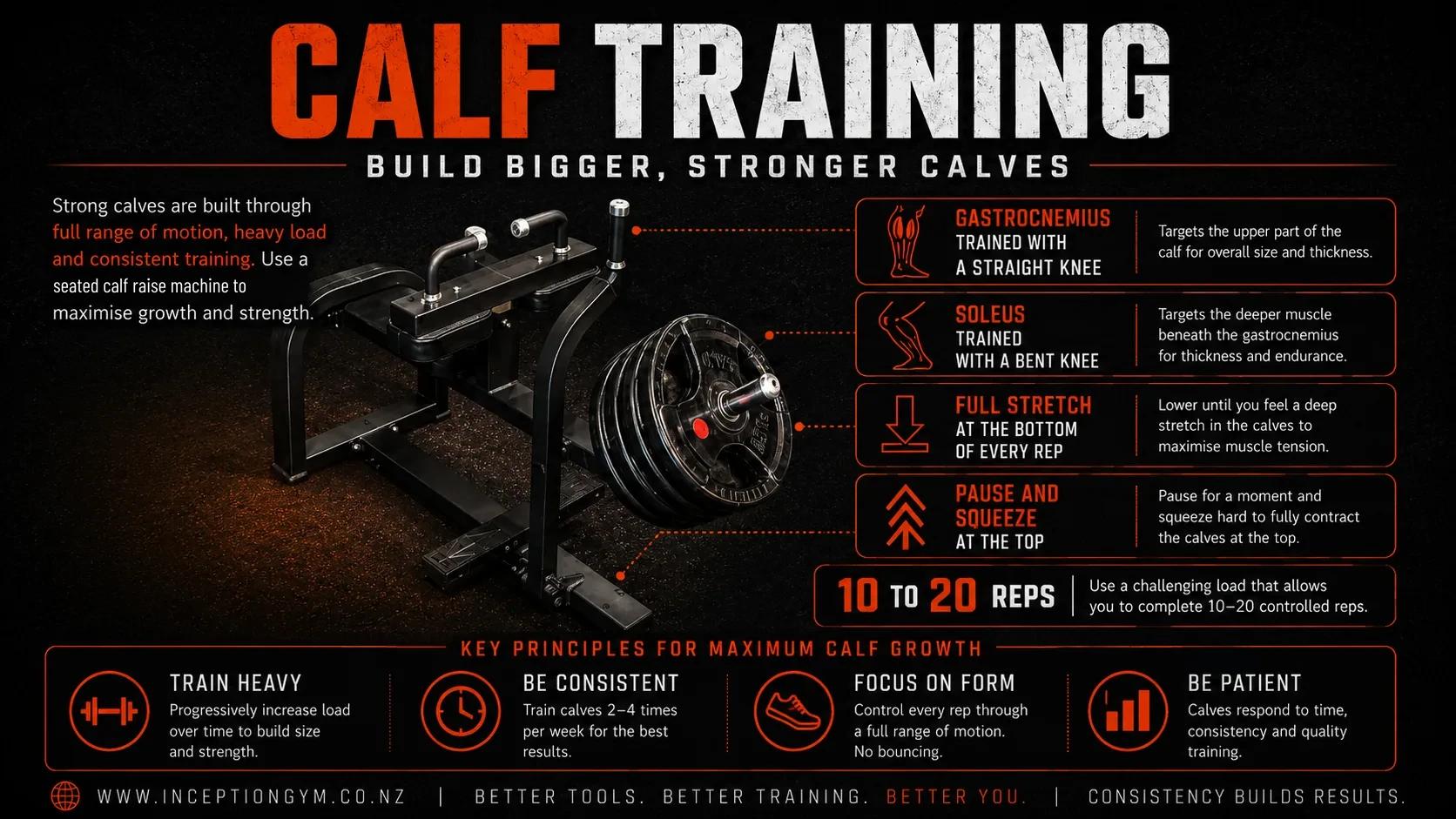
If your calves refuse to grow, it is almost never genetics alone. Calf training works when you fix three things: hit both calf muscles by training with a straight knee and a bent knee, pause in a deep stretch instead of bouncing, and progress the load week to week instead of treating calves as an afterthought.
I am Matt, and I co-founded Inception Gym in 2022. I coach this on our floor at Tower Junction most weeks, so this is not textbook theory. It is what I have watched actually turn stubborn calves around.
Key takeaways
- The calf is two muscles: the gastrocnemius (trained knee-straight) and the soleus (trained knee-bent). Train both.
- The stretch is the stimulus. Pause one to two seconds at the bottom and stop bouncing off the Achilles.
- Calves want higher reps, 10 to 20 for most sets, with some heavier straight-knee work retained.
- They grow slowly. Give logged, progressive work about six months before you judge it.
Why won't my calves grow?
For most people the honest answer is that calves are undertrained, not cursed. They are already conditioned by every step you take, and they get hit with three lazy half-rep sets once a week. That combination guarantees nothing happens.
This guide covers the anatomy that dictates exercise selection, why calves have a reputation for being stubborn, the technique details that matter more here than almost anywhere else, and how I have members load calf raises on the equipment we actually own.
Two muscles, two knee positions
The calf is not one muscle. It is two muscles with different jobs, and the position of your knee decides which one you are actually training.
The gastrocnemius
The gastrocnemius is the visible, diamond-shaped muscle at the top of the calf. It crosses two joints: it plantarflexes the ankle (points the toes) and it also crosses the knee, assisting knee flexion. That two-joint arrangement matters. When the knee is bent, the gastrocnemius is shortened at the knee end and loses much of its ability to produce force at the ankle. When the knee is straight, it is at full working length and takes the majority of the load.
Straight-knee movements train the gastrocnemius: standing calf raises, calf raises on a leg press, single-leg calf raises off a step.
The soleus
The soleus sits underneath the gastrocnemius, broader and flatter, running from below the knee to the Achilles tendon. It crosses only the ankle, so knee position does not shorten it. When the knee is bent and the gastrocnemius is compromised, the soleus does the work.
Bent-knee movements train the soleus: the seated calf raise is the classic example, with the knees fixed at roughly 90 degrees under a padded lever.
The practical rule is simple. Straight knee for the gastrocnemius, bent knee for the soleus. I insist on both, because a well-developed soleus pushes the gastrocnemius outward and adds width to the whole lower leg, not just the upper portion. The single most common mistake I correct on our floor is a lifter who only ever does one knee position and wonders why half the muscle never changes.
Why calves are stubborn
Two well-established factors explain why calves lag for most lifters.
They are already highly trained. Every step you take loads the calves. Walking, stairs, standing, carrying shopping across the 3,000-plus car parks at Tower Junction: the calf muscles handle thousands of low-intensity contractions every day. A muscle conditioned by that much daily volume does not respond to three lazy sets of half reps once a week. It needs a stimulus meaningfully harder than daily life already provides, which means real load, real range and real proximity to failure.
The soleus is dominated by slow-twitch fibres. The soleus is one of the most slow-twitch muscles in the body, built for endurance and postural work rather than explosive force. Slow-twitch fibres are fatigue-resistant, which means they tolerate high volumes and generally need more reps and more time under tension before they receive a growth signal. The gastrocnemius carries a more mixed fibre profile and responds to heavier work as well. This is why calf programming leans on higher rep ranges than most muscle groups while still keeping some heavy sets in the plan.
Neither factor makes growth impossible. They just raise the price of entry. Calves grow for people who train them deliberately and progressively, the same progressive overload logic that drives every other muscle, applied with a bit more patience.
Technique: the stretch is the stimulus
Calf raises are the exercise most commonly ruined by ego and momentum. The pattern is familiar on any gym floor: heavy load, tiny bounces off the toes, the Achilles tendon acting as a spring while the muscle barely lengthens.
The Achilles is the strongest tendon in the body and stores elastic energy extremely well. Bounce at the bottom of a calf raise and the tendon returns much of the force for free, which is excellent for sprinting and useless for hypertrophy. The muscle has to do the work for the muscle to grow.
If I could enforce one rule on the calf machines, it would be a full two-second pause at the bottom. It humbles the weight, it kills the bounce, and it is the difference between calves that grow and calves that just get sore.
The fix is a strict protocol:
Full stretch at the bottom. Lower until your heels are well below the level of your toes and you feel a deep stretch through the calf. Training a muscle at long lengths, under load, is one of the most reliable hypertrophy signals in exercise science, and the deep stretched position is exactly the range that bounced reps skip.
Pause in the stretch. Hold the bottom for one to two seconds. The pause dissipates the elastic energy stored in the Achilles, so the concentric that follows is produced by muscle, not tendon recoil. This one change makes the same weight dramatically harder and dramatically more productive.
Full contraction at the top. Drive all the way up onto the balls of the feet and squeeze briefly at the top. No half-height reps.
Control the lowering. Two to three seconds down, back into the full stretch. The eccentric is where much of the growth stimulus lives.
Expect to use far less weight than a bounced rep allows. That is the point. Ten strict, paused, full-range reps beat thirty bounces every time. When a member drops their calf weight by a third after I show them the pause, and then tells me their calves are finally sore in the right place, that is the whole lesson in one session.
Rep ranges and programming
Given the fibre profile and daily conditioning, calves respond best to a blend that favours higher reps with some heavier work retained.
The base: 10 to 20 reps. Most calf volume should sit here, taken close to failure with the strict technique above. The soleus in particular thrives on higher reps and longer time under tension, so seated calf raises can run to the top of this range or slightly beyond.
Some heavier work: 6 to 10 reps. The gastrocnemius handles and benefits from heavier loading. One or two heavier straight-knee sets per week keep the strength stimulus in the programme and give you a clear number to progress.
A practical weekly structure:
- Session 1: standing or leg-press calf raises, 4 sets of 8 to 12, heavy, paused at the bottom
- Session 2: seated calf raises, 3 to 4 sets of 15 to 20, moderate load, slow eccentrics
- Optional finisher: single-leg calf raises off a step, bodyweight or light dumbbell, 2 sets near failure
Two to three sessions per week is realistic because calf work generates little systemic fatigue; it can sit at the end of leg day or be attached to upper body sessions without compromising anything. Progress the same way you would any lift: add a rep, then add load, and log it. Calves punish vague effort and reward boring consistency.
The calf setup at Inception Gym
Calf training rewards machines, because machines let you load heavy while keeping balance out of the equation, so every gram of effort goes into the muscle. Plate-loaded machines suit calves particularly well: small plate increments make the slow progression calves demand easy to track.
On our floor the dedicated option is the plate-loaded calf raise machine, which loads plantarflexion directly with a stable platform and a deep stretch position at the bottom.
Beyond the dedicated machine, our leg press machines double as calf stations. Set the sled or carriage at a comfortable knee angle short of lockout, place the balls of your feet on the lower edge of the platform, and perform calf raises against the sled: the angled, seated and vertical leg press machines all load the movement heavy and stable, with the same full-stretch, paused technique. Between the dedicated machine and the presses, you have straight-knee gastrocnemius work covered several ways, part of the 92-plus machines and 43 plate-loaded pieces across our 800 sqm floor. You can view the full equipment inventory to see the rest, or come try it on a free trial and I will show you the pause in person.
The honest timeline
Calves grow slower than quads or glutes for most people. The members I have watched genuinely turn theirs around tell the same story: they stopped treating calves as a throwaway finisher, trained them two to three times a week with strict full-range reps, and gave it six months of logged progression before judging the result. Not one of them found a shortcut. They just stopped skipping the boring version.
That is the deal. Two muscles, two knee positions, a deep pause in the stretch, 10 to 20 reps for most of the volume with some heavier sets, and patience. There is no secret exercise. There is only doing the unglamorous version properly, for longer than feels fair.
Related guides: leg extensions and hamstring curls, hack squat vs leg press.
If you want to train calves the way this guide describes, come and do it here. The plate-loaded calf raise machine and every leg press sit on our floor at Tower Junction, Addington, open 24 hours a day, part of a gym rated 5.0 across 1,090+ Google reviews. Start with a free trial and I will show you a paused rep the first time you are in. If you want to track whether the work is actually adding lower-leg mass, our members get free body composition scans to prove it either way.
---
The plate-loaded calf raise machine and the leg press machines are part of the 92-plus pieces of equipment on the floor at Inception Gym, Tower Junction, Addington. [View all equipment](/facilities/equipment) or [start with a free trial](/memberships/free-trial) and train calves properly this week.