Lifestyle · Culture
Gym etiquette: the unwritten rules every member should know
The gym etiquette rules that actually matter, written by Inception Gym's owner. Re-racking, hygiene, sharing equipment, and the culture behind our 5.0 across 1,090+ Google reviews.
By Dr Matt Walley · 20 May 2025
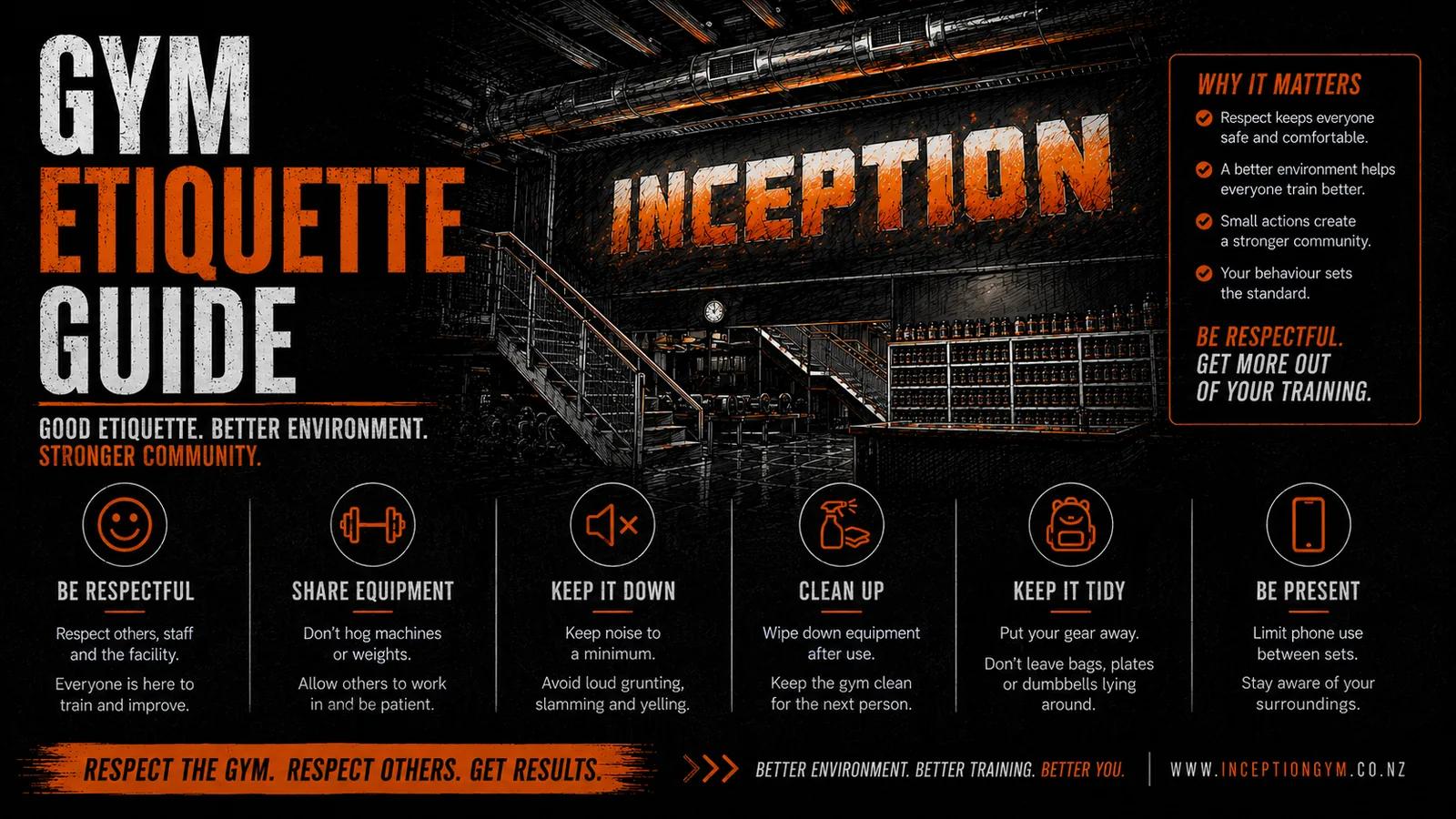
Good gym etiquette comes down to one rule: leave the space, and the people in it, better than you found them. Re-rack your weights, wipe your sweat, share equipment when asked, and give people room to concentrate. Everything else is detail.
I am Dr Matt Walley, and my wife Elise and I built Inception Gym in Addington in 2022. I am on our floor most days, so I can tell you exactly what good gym etiquette looks like in practice, and why it is the quiet engine behind the culture our members mention again and again.
Key takeaways
- Re-racking is the single most important habit, and the one most often skipped.
- Wiping equipment is a genuine hygiene issue, not just a courtesy.
- Sharing works: "do you mind if I work in" is a normal, welcome question here.
- Give lifters silence and space during a heavy set. It is a safety issue.
- Culture is built one member at a time, which is why we protect it.
Why does gym etiquette matter?
A gym is a shared space, and gym etiquette is simply how you behave when your actions land on other people. Unlike training in your garage, everything you do here touches someone else's session. The person who leaves plates on the bar inconveniences the next lifter. The person who sits on a machine scrolling their phone builds an artificial queue behind them.
Good etiquette is not about following arbitrary rules for their own sake. It is mutual respect: acknowledging that everyone on the floor has the same right to a quality session as you do.
If you were strong enough to lift it off the rack, you are strong enough to put it back. That single sentence covers about half of gym etiquette on its own.
When everyone observes the basics, our 800 sqm floor runs smoothly and stays calm even at peak. When it breaks down, it only takes a handful of inconsiderate people to sour the room for everyone.
The core rules
Re-rack your weights
This is the most important rule in any gym, and the one I see broken most. When you have finished with dumbbells, plates, or any loaded equipment, return it to where it lives.
That means:
- Dumbbells back on the rack in ascending order. We run dumbbells up to 70kg, and a rack out of sequence slows down everyone hunting for a pair.
- Plates stripped off the barbell and returned to the tree.
- Machine weight stacks reset to a sensible default.
- Kettlebells, bands, and any portable kit back in its storage spot.
Here is something I have learned from running the floor: a tidy gym stays tidy, and a messy one snowballs fast. The moment one bar sits loaded and abandoned, the next person feels licence to do the same. Re-racking is not just courtesy, it is what keeps our 43 plate-loaded machines and full equipment floor usable at 6pm on a Tuesday.
Wipe down equipment after use
Sweat is unavoidable. Leaving it on the pad is not. After any bench, machine, or mat, wipe it down with the spray and cloths we keep stationed around the floor. This is non-negotiable.
The spots people miss most:
- The neck and head support on benches
- The seat and back pad on cable machines
- Cardio handles and screens
- The mat area where you were lying
This is hygiene, not fussiness. Skin infections can move across shared surfaces, and a ten-second wipe protects you as much as the next person.
Give people space when they are lifting
When someone is mid-set, do not cross their line of sight, reach past them, or start a chat. The set lasts under a minute. Wait.
This matters most under heavy load. A near-maximal squat or deadlift needs total concentration, and breaking someone's focus in that moment is genuinely dangerous. We run two squat racks, so at busy times people do end up training close together. If you need a dumbbell sitting near someone actively lifting, wait for the set to finish and catch their eye before you step in.
Ask before working in
If someone is on the piece of kit you want, you have two polite moves: wait, or ask to work in. Working in means sharing during their rest periods. "Do you mind if I work in" is a completely normal question, and on our floor it is almost always met with a yes.
What is not acceptable: taking equipment without asking, changing someone's settings without permission, or hovering in a way that pressures them to cut their rest short.
Phone courtesy
Using your phone for music, tracking, or checking your programme is normal. Beyond that:
- Do not sit on a machine scrolling while people wait.
- Keep calls short and quiet.
- Do not film other people without their knowledge or consent.
- Keep video calls off the floor entirely.
The principle is simple: your phone should never extend into someone else's space or hold up their session.
Respect the mirror
Our mirrors are form tools, not selfie backdrops during a busy block when others need them for technique feedback. Do not plant yourself between someone and the mirror while they are actively using it to check their lift.
Cardio time limits
At peak, most gyms post time limits on cardio. Honour them. If someone is waiting for a bike and there is a posted limit, stick to it. If the floor is quiet, use your judgement.
Barbell and rack etiquette
When you are in a rack others might want:
- Use the lightest suitable bar. Do not tie up a specialty bar when a standard one does the job.
- Strip all your plates when you are done, no matter how briefly you were there.
- Do not occupy a squat rack for work that does not need it. Barbell curls in the squat rack is the classic offence: move to a free bar or dumbbells.
With only two squat racks, this one genuinely matters to how our floor flows. Guarding a rack for curls while a queue forms behind you is the fastest way to frustrate the room.
Hygiene beyond wiping
Come to the gym clean. It sounds obvious, and for almost everyone it is. Be mindful of strong cologne or perfume too: in an enclosed room full of people breathing hard, heavy fragrance genuinely bothers members with asthma or sensitivities.
If you have an open wound, cover it. If you are visibly unwell, stay home. We are open 24 hours, every day of the year, so the gym will be here when you have recovered.
How do you handle someone with bad etiquette?
This is the awkward part, and the right approach depends on the situation.
Minor issues, like not re-racking. Mention it, lightly. Most people simply did not think, or are brand new. "Hey, would you mind putting those back when you're done" in a friendly tone is completely reasonable.
Safety issues near you. If someone's technique directly puts you at risk, a quiet word is fair. If it is only their own safety and they are not in your space, it is generally not your place to correct another adult unsolicited.
Persistent or serious issues. Tell our staff. That is what we are here for. Because Elise and I own and operate this place, that feedback reaches people who can actually act on it, whether you raise it during staffed hours, Monday to Thursday 9am to 7pm and Friday and Saturday 10am to 2pm (unstaffed Sundays and public holidays), or send it through directly.
What our culture is really made of
Our 5.0 rating across 1,090+ Google reviews is not only about the machines. It reflects the people who train here.
Here is my honest read after four years on this floor. A lot of our members are working professionals who train during weekday business hours: people who take their health seriously, value their time, and behave like adults in a shared room. The culture is professional and welcoming without ever being cliquey or intimidating. I did not manufacture that. The membership built it, one considerate session at a time, and my job is mostly to protect it.
That is also why etiquette is not a small thing to me. Every new member who joins and observes it adds to that culture. Every person who ignores it chips away at something that took years to establish and would take a fraction of that to lose.
If you are new here and unsure about any of this, do not be anxious. Asking "is this the right way" or "do you mind if I use this" is always the correct instinct, and our staff are on hand during staffed hours to answer anything without a shred of judgment. If walking in feels daunting, book a free trial and come see how calm the floor actually is before you commit to anything.
For a fuller picture of your first visit, read the first day at Inception Gym guide. For more on the culture itself, see building community, not just a gym.
A word on unsolicited advice
One last point, aimed mostly at experienced lifters: unsolicited training advice is rarely welcome.
Unless someone is doing something genuinely dangerous, or has actually asked, keep your technical opinions to yourself. Everyone is at a different stage, and what reads as "wrong" to your eye may be intentional, may suit their goals or a physical limitation, or may simply be a different valid approach.
I say this as the person who owns the place: the gym floor is not the venue for coaching strangers. If you genuinely want to help a newer member, offer to share equipment or point them toward our staff or the PT team. That is far more useful than a form correction nobody requested. If you want structured guidance yourself, our personal training team is the right resource, and contract members get a free initial PT consultation with their membership.
The simple summary
Good gym etiquette reduces to one idea: be considerate of the people you share the room with. Put things back. Keep the kit clean. Give people space. Ask before taking. Say something briefly rather than quietly resent it.
Do those, and you will be the kind of member every gym needs more of, and you will train in exactly the sort of environment those standards create.
Come see it for yourself. Start your free trial and train on a floor where these standards actually hold. If you want to understand the room before you walk in, that is the best way to do it.