Guides
Your Whoop Says Recover. Should You? How to Use HRV and Readiness Scores for Training
How to use HRV for training, in plain English. I run a 92-machine floor at Inception Gym Christchurch, 5.0 across 1,090+ Google reviews, and here is how I turn a Whoop or Oura readiness score into a real training decision.
By Dr Matt Walley · 12 July 2026
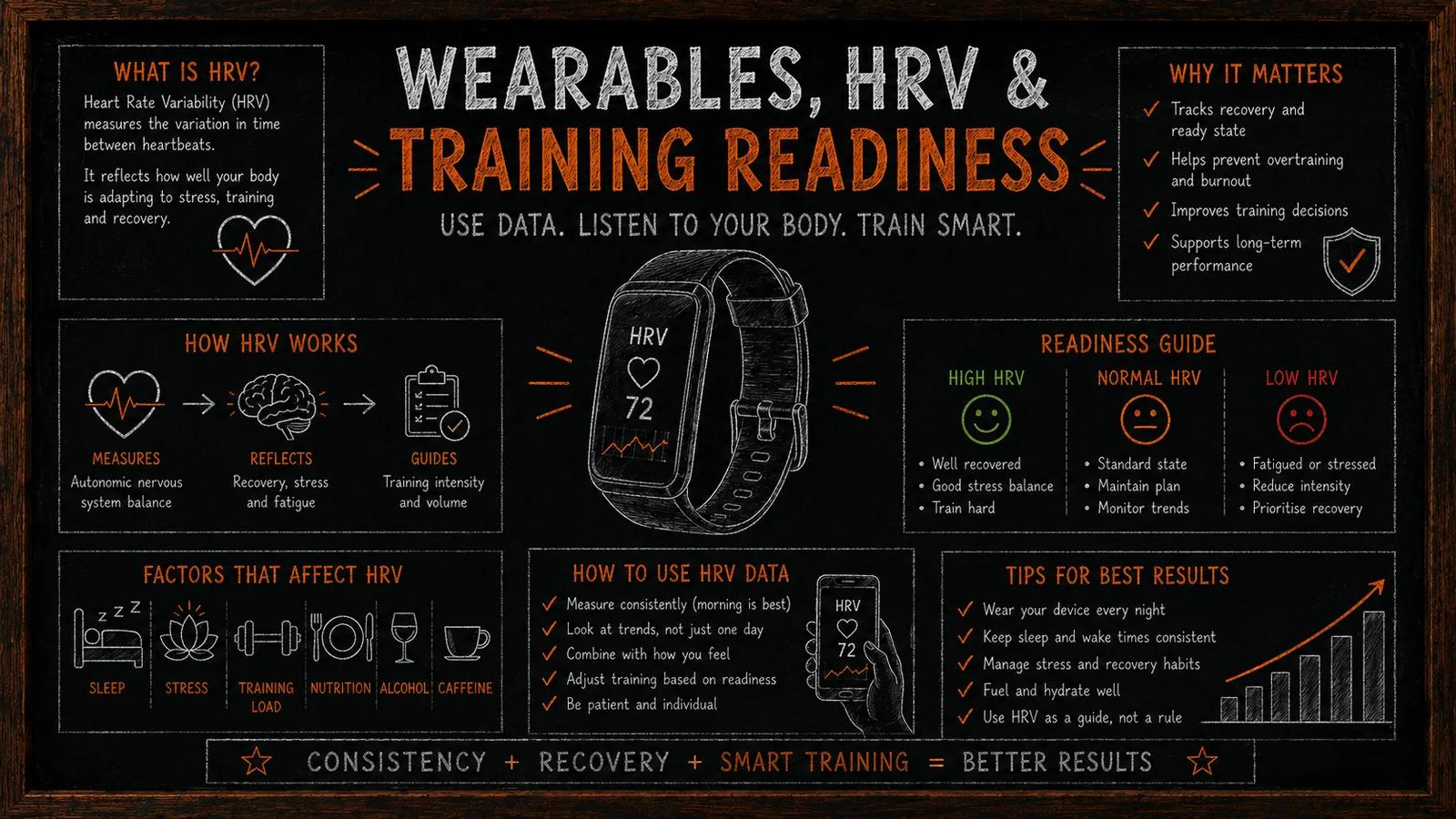
How to use HRV for training: treat your readiness score as one input, not an order. A green score is permission to push, a red score is a prompt to investigate why, and the actual decision belongs to you and a coach who can see what the ring cannot.
I am Dr Matt Walley, CEO and co-founder of Inception Gym Christchurch. Wearables have held the number-one spot in the ACSM fitness trends survey for a third straight year, and the story in 2026 is depth: heart rate variability, sleep staging, and daily readiness scores all promising to tell you when to train hard. More of my members walk in wearing a Whoop, an Oura ring, or a Garmin than ever before. The data is genuinely useful. What almost nobody teaches you is how to turn a number into a decision on the gym floor.
Key takeaways
- HRV is the beat-to-beat variation in your heartbeat, and higher usually signals a recovered, adaptable nervous system.
- A readiness score blends HRV, resting heart rate, and sleep into one number, but it does not know your training history or your life.
- Use the score to auto-regulate load, not to cancel sessions on reflex.
- A single low score is often noise. A three or four day downward trend is a signal.
- The ring measures. It cannot coach. That interpretation layer is where results are actually made.
What is HRV, in plain English?
HRV stands for heart rate variability. It is not your heart rate. It is the tiny variation in time between one heartbeat and the next.
Here is the counterintuitive part most people get backwards: you want that variation to be higher, not steadier. A heart that ticks like a metronome is usually a stressed heart. A heart with healthy variation is one where your parasympathetic nervous system, the recover-and-repair side, is doing its job.
- Higher HRV generally means your nervous system is balanced and ready to absorb hard work.
- Lower HRV generally means your body is under load, whether from training, poor sleep, illness, alcohol, or plain life stress.
Whoop, Oura, and Garmin all measure this overnight, then feed it into a readiness or recovery score. That is where the confusion starts, because the score hides the raw data behind a colour.
What does an Oura readiness score or Whoop recovery actually mean?
A readiness score is a blend. It takes your overnight HRV, your resting heart rate, your sleep duration and quality, and sometimes your recent training strain, then compresses all of it into a single percentage or a red, amber, green colour.
That compression is convenient and slightly dishonest. Two people can both score 55 percent for completely different reasons: one drank two glasses of wine, the other is three weeks into a hard training block and genuinely fatigued. Same number, opposite meaning.
A readiness score is a smoke alarm, not a diagnosis. It tells you something might be worth checking. It does not tell you the house is on fire, and it certainly does not tell you what to do next.
So the score is a starting point for a question, not the answer. The real skill is reading what sits underneath it.
How to use HRV for training without becoming a slave to the number
This is the practical core. When you open the app in the morning, run it through three filters before you touch your programme.
- Is this a single reading or a trend? One low morning after a bad night's sleep is noise. Ignore it. A steady three to four day decline in HRV is your body telling you something real.
- Do you know why it moved? If you had a late night, a few drinks, or a stressful week at work, the low score is explained. You do not need to panic-deload because you stayed up watching the cricket.
- What does the session ask of you today? A red score before a heavy squat day matters more than a red score before an easy accessory and cardio day.
Only after those three questions do you adjust. And the adjustment is almost never binary.
Auto-regulation: the adjustment most people miss
The mistake I see constantly is treating readiness as a light switch: green means train, red means skip. That is the least useful way to use the data. Auto-regulation is a dimmer, not a switch.
If your score is amber and you cannot explain it, you do not cancel the session. You dial it back:
- Keep the same exercises, but drop the top set intensity by 5 to 10 percent.
- Cut one or two working sets from the highest-fatigue lifts.
- Trade a heavy triple for a technique-focused set of six at a lighter load.
- Keep the movement, lose the ego. You still bank the practice and the habit.
You showed up, you moved, you trained the pattern, and you did not dig a recovery hole. That is a far better outcome than a skipped session followed by guilt.
When is a low readiness score just noise?
Most of the time, honestly. In my experience running a 92-machine floor, the members who improve fastest are not the ones with the most obedient devices. They are the ones who learned when to override the ring.
A low score is usually noise when:
- You slept badly for one obvious, temporary reason.
- You travelled, drank, or ate late the night before.
- You are a woman and your cycle phase is affecting overnight numbers, which is normal and predictable, not a red flag.
- Your subjective sense is fine. You feel good, you are eager to train, and only the app disagrees.
A low score deserves respect when it is backed by real symptoms: heavy legs on the warm-up, no drive, elevated resting heart rate for several days, a scratchy throat, or a genuine sense of being run down. When the data and your body agree, listen.
What a low score should actually trigger
When the trend is real and your body confirms it, you have earned a proper adjustment. This is where a deload or a lighter block belongs.
- One-off real fatigue: swap the heavy session for mobility, an easy walk, or light full-body work.
- A three to four day HRV decline with symptoms: pull back volume across the week, not just one session.
- Two weeks of suppressed readiness in a hard block: that is a deload week asking to happen. Cut volume by roughly 40 to 50 percent for a week and let your numbers recover.
At Inception we have free body composition scans for members, and I often pair the conversation about readiness data with what the scan shows over months. A wearable tells you about today. A scan trend tells you whether your programming is actually working. Put together, they beat either one alone. You can book a free body scan whenever you want to ground the numbers in something physical.
Why the ring cannot coach you
Here is my strongest opinion, and it is the reason I am not worried about wearables replacing what we do.
A ring can tell you that your HRV dropped 18 percent. It cannot tell you that you deadlifted a personal best on Tuesday and that the drop is exactly what should happen after a hard pull. It cannot see that your form broke down on the last set, or that you have been unconsciously shortening your range on the leg press for a fortnight. It cannot look at you across the floor and notice that your left shoulder is riding up on every press.
The device is a sensor. It has no context, no memory of your training block, and no eyes. Context is the entire job of coaching.
I have watched members spiral because a device told them they were unrecovered on a day they felt fantastic, so they skipped, lost momentum, and broke a streak that took months to build. I have watched others ignore three weeks of clearly falling numbers because they felt fine, right up until a minor injury they trained straight through. Neither group was failed by the hardware. They were failed by having no human layer to interpret it. That layer is why our personal training in Christchurch exists, and it is the part a subscription cannot ship.
A simple weekly routine for using your wearable
You do not need a spreadsheet. You need a habit.
- Each morning: glance at the trend line, not just today's colour. Ask the three filter questions.
- Before a hard session: if the score is low and unexplained, decide your dial-back before you start, not mid-set when your ego is involved.
- Once a week: look at the seven day pattern. That is where deload decisions live.
- Every visit: trust your warm-up. How the first working sets feel will tell you more than any overnight metric.
The wearable is the map. Your body and, ideally, a coach are the terrain. When they disagree, the terrain wins.
The honest limits of the technology
I want to be straight about this, because gym marketing rarely is. Consumer HRV readings vary by device, by strap position, by how you slept, and by measurement window. The absolute number matters far less than your own trend against your own baseline. Do not compare your HRV to your training partner's. It is close to meaningless across two different people.
And no readiness score has ever added a plate to the bar for anyone. The data is a decision aid. Progress still comes from showing up, training with intent, eating and sleeping like you mean it, and being consistent for longer than feels interesting. The wearable can nudge those decisions. It cannot make them.
Train where the data meets a human
If you are already collecting HRV, sleep, and readiness data and you are not sure what to do with it, that is exactly the gap we fill. Come and train on a floor where someone can actually help you turn a morning score into a decision.
The lowest-friction way to start is a free trial at Inception Gym: no fee, just a proper session on our floor so you can feel the difference between a number and a plan. Bring your ring, bring your questions, and I or one of our coaches will help you read it properly. If you would rather see the equipment first, the full 92-machine inventory is here, and you are always welcome to get in touch before you come in.
Your device is doing its job. Let us do ours.