Training
Can you build muscle and run at the same time? The hybrid training truth
A PhD owner-operator settles the concurrent training debate: how to run a hybrid training program that builds muscle and cardio in the same week without one killing the other.
By Dr Matt Walley · 12 July 2026
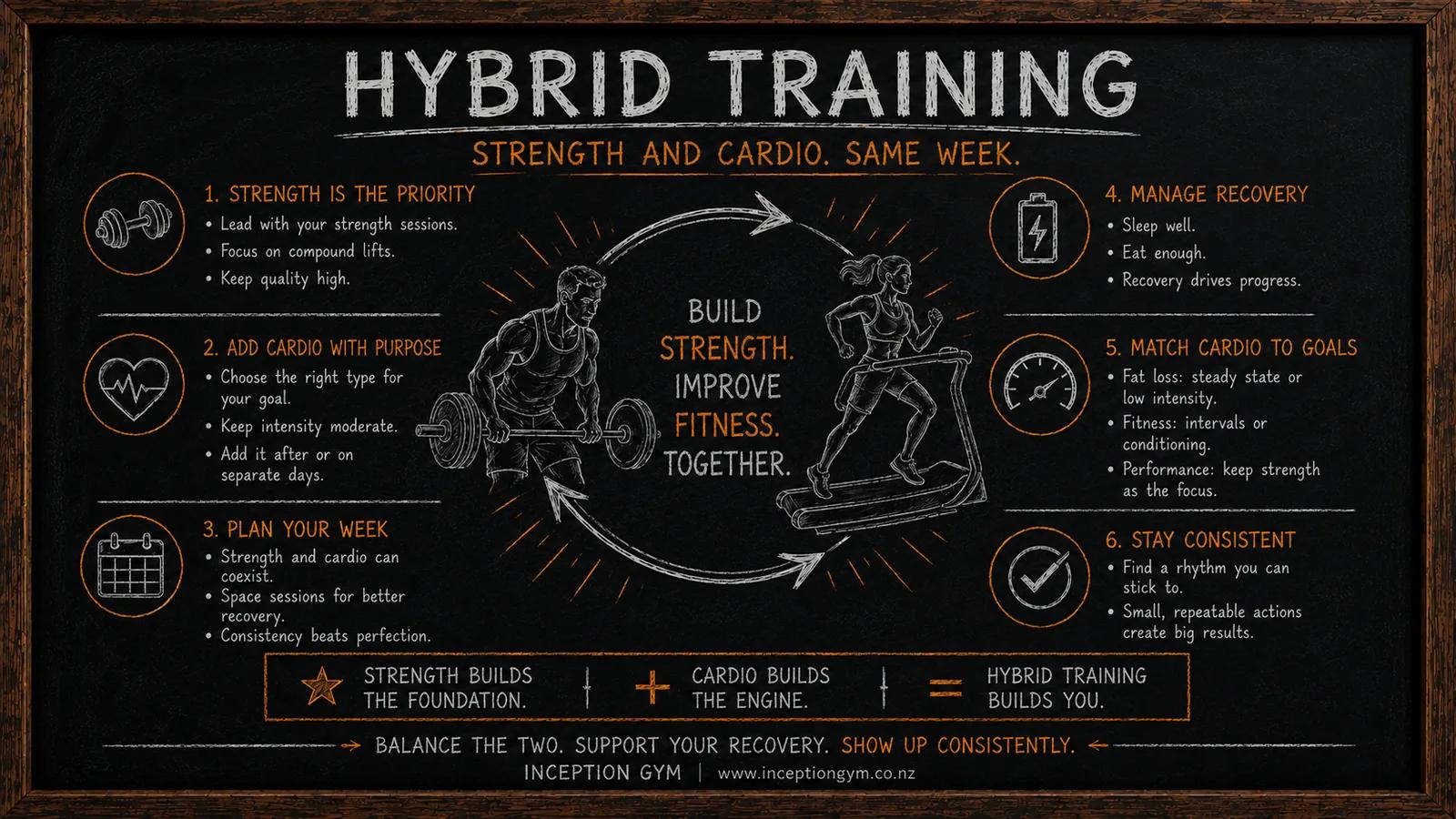
Yes, you can build muscle and run in the same week. A well-built hybrid training program pairs 3 to 4 focused strength days with 150 to 200 minutes of easy Zone 2 cardio, and the cardio complements the lifting rather than stealing from it. The old fear that cardio kills gains comes from people doing both hard, on the same muscles, back to back. Space it and sequence it properly and the two support each other.
Key takeaways
- A hybrid training program that works: 3 to 4 strength sessions plus 150 to 200 minutes of low-intensity cardio per week.
- Cardio only blunts muscle growth when it is high-intensity, high-volume, and stacked right before or after your hardest lifting.
- Lift first, or separate lifting and cardio by several hours, and keep most of your cardio in Zone 2.
- You do not need two gyms. One 800 sqm room with real strength depth and real cardio kit removes the gym-hopping problem entirely.
- Eat enough. Most people who "lose gains" to cardio simply stopped eating for the extra work.
I have run the floor at Inception since 2022, and the concurrent training question comes up almost every week. Someone wants to hold their squat and press numbers but also run a half marathon, or they want to lean out without watching their hard-won muscle disappear. The good news is that the science and my own eyes on the floor agree: a hybrid training program is not a compromise, it is a plan.
Does cardio kill gains, honestly?
This is the fear at the centre of the whole debate, so let me answer it plainly. Cardio does not kill gains in any way that matters for the average member. What kills gains is a specific, avoidable pattern.
The interference effect is real but narrow. It shows up most when:
- The cardio is high-intensity and high-volume, not easy aerobic work.
- The cardio hits the same muscles you are trying to grow, so running hard on already-trashed legs.
- The hard cardio sits immediately before or after your heaviest lifting, when recovery is thinnest.
- Total fatigue outruns recovery week after week, which is really an overtraining problem wearing a cardio costume.
Take those four away and the interference shrinks to almost nothing. Easy Zone 2 cardio, the kind where you can still hold a conversation, barely touches your strength adaptations. In many people it improves recovery between sets and between sessions because a stronger aerobic base clears fatigue faster.
The people who "lose their gains to cardio" almost never lost them to cardio. They lost them to eating like someone who is not training twice as much.
The 2026 hybrid training program template
Here is the structure I point members toward when they want both. It is deliberately simple because simple is what people actually follow.
The weekly shape
- Strength: 3 to 4 sessions. This is your priority if muscle is the goal. Upper, lower, and either a third full-body day or a fourth to split push and pull.
- Zone 2 cardio: 150 to 200 minutes total. Break it into 3 or 4 easy sessions of 40 to 50 minutes. Incline treadmill walking, spin bike, ski erg, all fine.
- Optional hard cardio: one short session. If you want a fitness ceiling, add a single 15 to 20 minute interval session, placed on a day away from your heavy lower body work.
That is the whole engine. Notice that most of the cardio is easy. The mistake I see most is people making every cardio session a lung-burner, then wondering why their legs feel dead under the bar.
Where the sessions sit
The sequencing matters more than the total volume for most people. My rules:
- Lift first when you must combine them. Do your strength work fresh, then cardio after, never the reverse for a muscle-focused block.
- Separate by hours where you can. Lift in the morning, walk or ride in the evening. The gap lets each system recover on its own clock.
- Keep hard cardio away from heavy legs. Do not run intervals the day before or after your squat session if legs are a priority.
- Guard one full rest day. Hybrid work adds up. A true off day protects both adaptations.
Why one room matters more than people think
Here is a piece of first-hand experience you will not get from a generic training blog. The single biggest reason people fail at hybrid training in Christchurch is logistics, not physiology.
They join a cheap cardio-heavy chain, discover the strength kit is thin, then buy a second membership somewhere with racks. Now they are driving between two gyms, and the friction quietly kills the plan inside a month. I have watched it happen to new members who arrived at Inception already burnt out on the two-gym shuffle.
We built one 800 sqm room to remove exactly that friction. On the same floor you get 92 machines across 72 variants, 43 of them plate-loaded, 2 squat racks, dumbbells up to 70kg, and a full bank of cardio equipment. You can finish your last set of Romanian deadlifts and walk twenty steps to start your Zone 2 ride. No car, no second membership, no excuse to skip the second half of the session.
In my experience running this floor, removing that one logistical hurdle does more for adherence than any clever programming tweak. You can browse the full equipment inventory if you want to see the strength and cardio depth before you visit.
What I see hybrid members get wrong
A few patterns show up again and again on the floor, and they are all fixable.
They train easy cardio too hard. Zone 2 should feel almost boringly comfortable. If you are gasping, you are in the wrong zone and you are borrowing recovery from your lifting.
They do not eat for the extra work. This is the real gains-killer. Add three or four cardio sessions and you have added meaningful energy expenditure. If bodyweight is dropping and you wanted to hold muscle, eat more. Our members get free body composition scans so they can actually see whether they are losing fat or losing muscle, instead of guessing. That distinction changes the whole plan.
They chase two peaks at once. You cannot set a squat PR and a 10km PR in the same fortnight. Pick a lead goal for each block, let the other hold steady, then swap the emphasis. Hybrid is a see-saw, not a tightrope.
They skip the rest day because they feel fine. Fatigue in hybrid training is cumulative and sneaky. The week you feel invincible is usually the week before you feel flat. Protect the off day.
A contrarian take on "hybrid athlete" splits
The internet has turned "hybrid athlete" into a badge, and I think the marketing has overcomplicated a simple idea. You do not need a twelve-variable spreadsheet, a heart rate strap for every session, and a periodised block plan borrowed from an elite triathlete.
For the vast majority of people, hybrid training is just this: lift hard three or four times, walk or ride easy most other days, keep one hard cardio session if you enjoy it, and eat enough to fund all of it. The people who overthink the split usually undertrain the basics. Consistency across twelve weeks beats the perfect programme you abandon in ten days.
If you want that plan tailored to your body and your goals, that is exactly what owner-operated coaching is for. Because Elise and I run the place ourselves, our personal training is set up to dial in the strength-to-cardio balance for you rather than hand you a template and hope.
How to start this week
If you are sitting on the fence about whether you can do both, stop theorising and test it on your own body. Come train on our floor, do your lifting, then do twenty easy minutes of cardio in the same room, and feel how little it costs you when it is done right.
The simplest first step is a free trial: use the strength kit and the cardio kit in one visit and see the one-room advantage for yourself. If you want to know exactly where your muscle and fat sit before you start a hybrid block, book a free body composition scan so you are measuring, not guessing. We are open 24 hours, 7 days, 365 days a year, so the plan fits your schedule, not the other way around.
Build the muscle. Run the distance. You can do both in the same week, in the same room, and I will show you how on the floor.