Guides
Sauna, ice baths and contrast therapy: what actually helps you recover
An owner-operator's evidence-based verdict on gym recovery methods: sauna, cold plunge, contrast therapy, red-light, compression and percussion, and how to build a stack that works. From Inception Gym, rated 5.0 across 1,090+ Google reviews.
By Dr Matt Walley · 12 July 2026
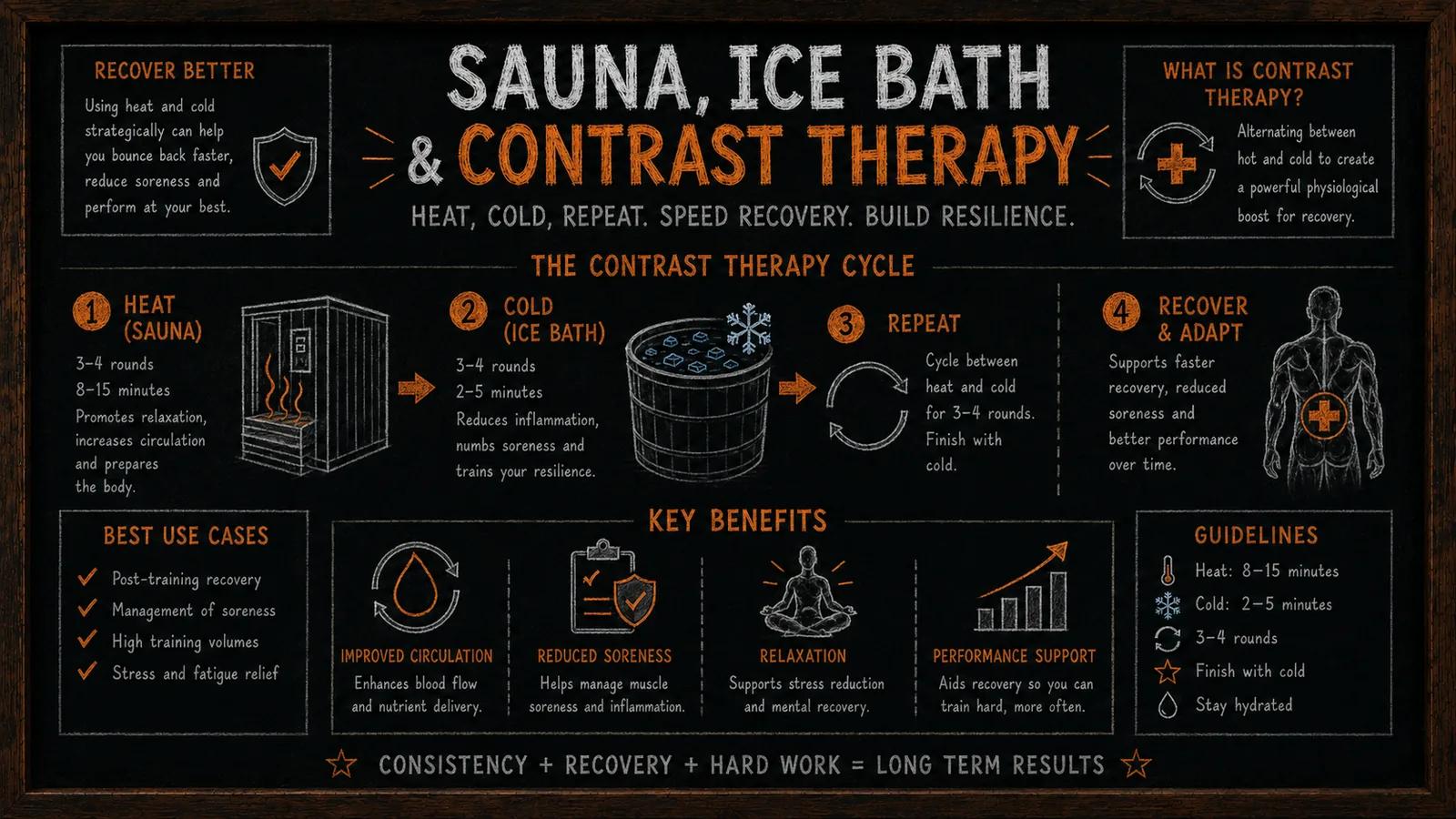
The gym recovery methods that move the needle most are sleep, protein and sensible training load. Sauna, cold plunge and contrast therapy are real finishers that help you feel better and train more consistently, but they sit on top of the fundamentals, not in place of them.
I am Dr Matt Walley. My wife Elise and I founded Inception Gym Christchurch in 2022, and I am on our floor most days watching how people actually train and recover. Recovery has shifted from an afterthought to an expectation, and contrast therapy is one of the biggest fitness stories in New Zealand right now. So here is my honest, no-hype read on what earns its place and what is mostly theatre.
One thing up front, because I would rather be straight with you: we do not have a sauna, an ice bath, or a contrast setup on the floor at Inception. This is my independent take on the research and on what I actually see work, not a pitch for our own hardware. What we invest in for recovery is the part that moves the needle most: intelligent programming, free body composition scans, on-site PhD-led nutrition, and an 800 sqm floor with the space to train hard and deload properly.
Key takeaways
- Sleep and protein do more for recovery than any piece of hardware. Fix those first.
- Sauna and heat exposure genuinely help you feel loose and recover between hard sessions.
- Cold plunges work for how you feel and for managing soreness, with one important caveat around muscle growth.
- Contrast therapy stacks heat and cold, and the ritual value is a real part of why it works.
- Red-light, compression boots and percussion guns are finishers, not foundations.
What actually drives recovery?
Before any gadget, recovery comes down to a short, boring list. I say boring because it is not new, and it does not photograph well, but it is what separates people who progress from people who stall.
- Sleep. Seven to nine hours, consistent timing. This is where your body does the repair work.
- Protein and total energy. Enough protein spread across the day, and enough food overall to support the training you are asking your body to do.
- Training load that makes sense. Progressive, not punishing. The best recovery tool is often a slightly easier week.
- Movement and blood flow. Walking, easy cardio, mobility. It sounds too simple to matter, and it matters.
If you are chasing an ice bath but sleeping six hours and under-eating protein, you have bought a nice hat for a house with no roof. Get the fundamentals right and everything else compounds.
This is the single most common thing I see people get wrong. They will spend on the shiny recovery add-on and skip the free, unglamorous inputs that actually determine whether they turn up and train hard the next day. One of the quiet reasons we run free body composition scans for members is so people can see, objectively, whether their recovery and nutrition are supporting muscle rather than working against it.
Does sauna after a workout help?
Yes, and it is one of my favourites for how it makes people train over a week rather than a single session. Heat exposure increases blood flow, helps you feel loose, and for a lot of members it is the moment the shoulders finally drop after a hard day.
The honest framing: sauna after a workout is excellent for perceived recovery, relaxation and consistency. If feeling better makes you show up three days in a row instead of two, that is a real training effect, even if the mechanism is partly about how you feel.
A few practical notes I give people on the floor:
- Hydrate properly around sauna use. You will sweat more than you think.
- If your goal today was maximum strength or hypertrophy, do the lifting first and sauna after.
- Keep sessions sensible in length. This is recovery, not an endurance event.
Do cold plunges work?
Mostly yes, with one caveat that almost nobody tells you.
Cold plunges and ice baths are genuinely good for two things: managing that heavy, aching soreness after a brutal session, and the sharp mental reset a lot of people love. If you finish a plunge feeling clear-headed and less beaten up, that is not in your imagination.
The caveat, and this is where I will be a bit contrarian: if your primary goal is building muscle, do not slam an ice bath immediately after every hard resistance session. Cold exposure right after lifting can blunt some of the adaptation signal your body is trying to act on. That inflammatory response you are trying to freeze away is part of how the muscle gets the message to grow.
So here is my rule of thumb, from watching how our members actually train:
- Chasing muscle and strength: keep cold away from the hour or two right after lifting. Use it on rest days or well separated from the session.
- In-season, managing fatigue, or just love how it feels: plunge whenever it helps you function and recover.
If you are looking for a cold plunge in Christchurch, my advice is the same as for any recovery tool: judge it by whether it helps you train more consistently, not by whether it trends.
What is contrast therapy, and is it worth it?
Contrast therapy alternates heat and cold, typically a few minutes hot in a sauna then a short sharp cold plunge, repeated a couple of times. It is the headline recovery trend across New Zealand in 2026, and I understand why.
Part of the appeal is physiological: the alternating vessel dilation and constriction, the flush of blood flow, the invigorating finish. Part of it, and I will say this plainly, is ritual. There is a discipline and a shared experience to a proper contrast round that makes people take recovery seriously in a way a foam roller in the corner never did.
I do not think the ritual part is a weakness. In my experience running Inception, the recovery methods people actually stick with are the ones that feel like something, not the ones buried in a spreadsheet. Contrast therapy is worth it if you enjoy it and it gets you recovering deliberately. It is not a magic accelerant that lets you ignore the fundamentals above.
What about red-light, compression boots and percussion guns?
These are the finishers of the finisher pile. Useful, pleasant, worth a place if you enjoy them, but keep the expectations calibrated.
- Red-light therapy: promising and comfortable. Treat it as a small bonus, not a load-bearing pillar of your programme.
- Compression boots: great for the feeling of fresh legs, popular with people on their feet all day. The main benefit is comfort and gentle blood flow.
- Percussion guns: genuinely handy for loosening a tight spot and for warm-ups. I use one. Just do not expect it to undo a training block that is simply too heavy.
Here is a specific coaching observation I keep coming back to: the members who own the most recovery gadgets are not always the best-recovered. The best-recovered are usually the ones with the most boring sleep and nutrition habits, who then use the hardware as a genuine finisher. The gear is the cherry, not the cake.
How should I structure a recovery stack?
Think of it in layers, from the load-bearing to the nice-to-have. Build from the bottom up and never skip a lower layer to add a higher one.
- Foundation, every day: sleep, protein, sensible load, daily movement.
- Weekly rhythm: a deliberately easier week when you need it, and a genuine rest day or two.
- Feel-good recovery, most days: sauna, easy walks, mobility, a bit of sun.
- Targeted tools, as it suits you: cold plunge (mind the muscle-growth timing), contrast rounds, compression, percussion, red-light.
A sensible weekly pattern for most of our members looks like: lift hard, eat and sleep well, use a sauna when you have access to one, keep any cold plunge separated from your heaviest lifting days if muscle is the goal, and enjoy a contrast round when you want a proper reset. That is it. It is not complicated, and it should not be expensive to run.
If you want a second set of eyes on your programming and recovery load, our team is on the floor daily, and you can read more about how we coach here.
The one-line verdict
Recovery hardware is a finisher, not a substitute. Sauna, cold and contrast are all real and all worth using, but they earn their value only once your sleep, protein and training load are handled. Get the free stuff right first, then let the plunge and the sauna do what they are genuinely good at.
Come and feel the difference
The best way to judge any of this is to train somewhere that takes it seriously. We built Inception as an 800 sqm purpose-built floor with the equipment depth to train hard and the space to recover properly, and it is why members have rated us 5.0 across 1,090+ Google reviews. If you want to test-drive how a consistent training and recovery rhythm feels, book a free trial, and if you are a member already, claim your free body scan so we can make sure your recovery is actually building the results you are after. When you are ready to join, our membership options are here.